


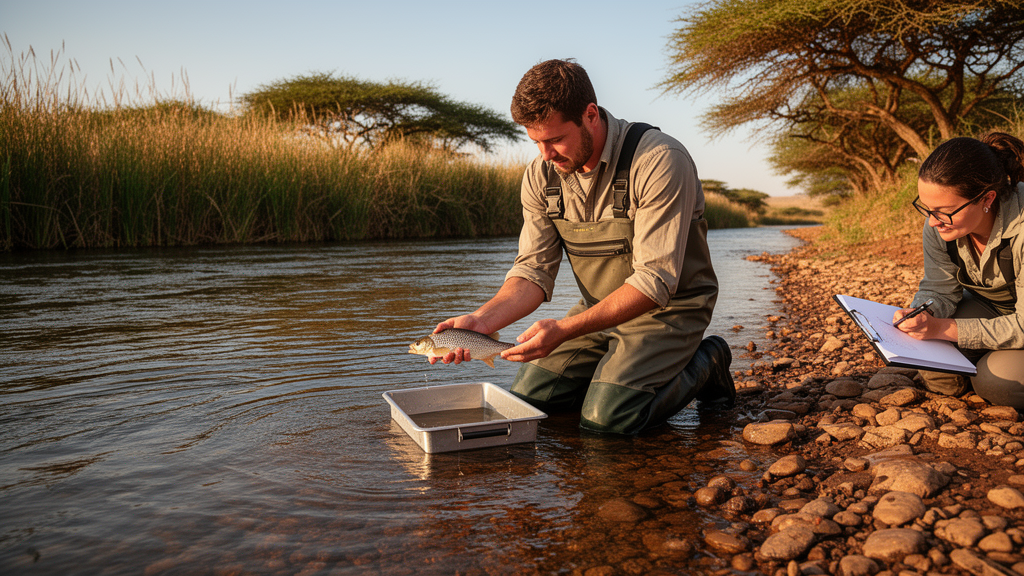
Wild freshwater fish in two of southern Africa’s most intensively farmed river basins carry measurable traces of both banned legacy insecticides and modern neonicotinoids, according to a new open-access study published in Archives of Environmental Contamination and Toxicology. The research, led by Marelize Marsay together with colleagues in South Africa and Japan, is the first report of neonicotinoid residues in wild freshwater fish anywhere in southern Africa. It examined muscle tissue from 82 fish belonging to nine species collected from the Inkomati and Letaba catchments, two systems that drain some of the region’s most productive irrigated farmland and, in the case of the Letaba, flow directly through the Kruger National Park.
The team screened the fish for 19 organochlorine pesticides (OCPs) and 13 neonicotinoids. The organochlorine results were strikingly narrow: only two compounds, p,p’-DDE and p,p’-DDD, both breakdown products of the infamous insecticide DDT, were detected above the analytical limits. p,p’-DDE was found in 21 of the 82 fish sampled across the Crocodile, Inkomati and Letaba rivers and Tzaneen Dam, while p,p’-DDD appeared in just seven fish from the Inkomati and Crocodile rivers and the dam. No parent DDT was detected at all, and there were no statistically significant differences between sites or species, although concentrations overall were higher in fish from the Letaba catchment than in those from the Inkomati.
The pattern of metabolites tells a story about the age of the contamination. DDT breaks down in the environment into the more stable compounds DDE and DDD, and these metabolites persist far longer in living tissue than the parent compound. Reported half-lives in fish are roughly eight months for p,p’-DDT but approximately seven years for p,p’-DDD and p,p’-DDE. The predominance of the two metabolites, in the complete absence of detectable parent DDT, therefore suggests that the residues in these fish largely represent aged, degraded DDT that has lingered in sediments and food webs for decades, rather than substantial recent inputs of fresh insecticide. The authors note that trace amounts of DDT below the detection limit cannot be entirely excluded, but such low levels point to no substantial or recent input of the parent compound.
Why is DDT still relevant at all? Southern African countries continue to use it for indoor residual spraying against the mosquitoes that transmit malaria, because no effective alternative exists in areas where the insects have developed resistance to other agents. In South Africa, spraying continues in Limpopo, Mpumalanga and KwaZulu-Natal. The Letaba catchment lies in a region with a long history of such use, and earlier work there found fish carrying concentrations of DDE and DDD three orders of magnitude higher than those in the Crocodile and Sabie rivers. The new measurements, while generally low, confirm that this historic use remains chemically evident in the catchment’s fish, echoing sediment studies showing that DDT concentrations there have declined since 1998 but have not vanished.
Feeding ecology appears to shape who accumulates what. The highest p,p’-DDE concentration was measured in an African sharptooth catfish (Clarias gariepinus) from Tzaneen Dam, and the highest p,p’-DDD in a Limpopo bulldog (Marcusenius krameri) from the Letaba River. Elevated levels clustered in benthic and omnivorous species, including sharptooth catfish, largescale yellowfish (Labeobarbus marequensis), the bulldog and the Eastern butter catfish (Schilbe depressirostris), which feed on sediment-dwelling organisms. Because sediments act as long-term sinks for persistent pesticides, fish closely associated with the streambed face exposure long after spraying has stopped, and species-specific traits such as habitat use, diet and skin characteristics may further influence uptake.
The neonicotinoid side of the study breaks new ground for the region. Of the 12 neonicotinoids analysed, five were detected: acetamiprid, clothianidin, dinotefuran, imidacloprid and thiamethoxam. Acetamiprid, one of the most widely used neonicotinoids worldwide and heavily applied to citrus and cotton in both catchments, was the only compound found at every sampling site and in nearly every fish species. Imidacloprid followed, but only in fish from the Inkomati catchment, consistent with pesticide-use maps showing extensive application around the Sabie and Crocodile rivers. Clothianidin turned up in just five of the 82 fish, dinotefuran in three and thiamethoxam in two, all from the Inkomati River in Mozambique.
That Mozambican hotspot is more than a curiosity. The Crocodile River crosses the border and joins the Komati to form the Inkomati, and Mozambique’s malaria-control programme shifted from DDT to pyrethroids and organophosphates and eventually to neonicotinoids, specifically clothianidin, until 2021, while dinotefuran has also been reported for vector control there. The detection of clothianidin, dinotefuran and thiamethoxam exclusively in fish from the Mozambican stretch of the river is therefore consistent with a mix of agricultural runoff and vector-control practices in the downstream portion of this transboundary basin. In contrast, imidacloprid use in the Letaba catchment occurs upstream of the sampling sites, and the compound dissipates rapidly from water through photolysis and hydrolysis, with half-lives of only a few days, which may explain its absence in that system.
Species differences emerged here too. The only statistically significant contrast in the entire dataset was higher imidacloprid in giant mottled eels (Anguilla marmorata) than in tigerfish (Hydrocynus vittatus) at the Inkomati River. Notably, only the eels and the sharptooth catfish, both scaleless, bottom-associated omnivores, carried detectable levels of all five neonicotinoids at that site. The authors suggest that close contact with contaminated sediment, potential dermal uptake through scaleless skin and relatively high lipid content may increase exposure in these species, though differences in diet, body composition and detoxification capacity could also contribute.
How do these numbers compare internationally? The neonicotinoid concentrations were very low, measured in picograms per gram of dry tissue, with acetamiprid ranging from below detection to 38 pg/g. In a Chinese study, zebrafish continuously exposed for 22 weeks to the lowest test concentration of acetamiprid, 0.15 micrograms per litre, accumulated 140 to 400 pg/g, suggesting either lower environmental exposure or limited muscle accumulation in the South African fish. Nigerian work on the Owena River reported acetamiprid and thiamethoxam at 10,000 to 160,000 pg/g, orders of magnitude higher, while a Ghanaian survey of two agricultural reservoirs found no neonicotinoids at all. The DDE and DDD levels in the present study were generally similar to or lower than those reported for other southern African systems and comparable to values from Uganda and Ethiopia, though the authors caution that comparisons are complicated by differences between dry-weight, wet-weight and lipid-weight reporting.
Several important caveats frame the findings. Muscle tissue, the matrix analysed here, reflects long-term exposure but has relatively low lipid content, so it may underestimate total body burdens of lipophilic contaminants; liver and other high-lipid tissues can hold far more, with one Chinese study finding neonicotinoid concentrations ten times higher in liver than in muscle. The analytical method also showed low recovery rates for three neonicotinoid compounds, meaning their non-detection cannot be taken as definitive evidence of absence. Low replication for some species-site combinations limited statistical power. Despite these constraints, the study delivers a clear message: concentrations of both legacy and current-use pesticides in these wild fish were below levels of concern for vertebrates, yet the detection of DDT metabolites decades after heavy use confirms extraordinary environmental persistence, and the first regional evidence of neonicotinoids in wild fish fills a critical data gap. The authors call for expanded monitoring across multiple tissues, water and sediment to properly characterise exposure and support environmental management decisions across African freshwater ecosystems.
Subject of Research: Pesticide residues in wild freshwater fish from two subtropical South African river basins
Article Title: Legacy (Organochlorine) and Current Use (Neonicotinoid) Pesticides in Fish from Two Subtropical River Basins
Article References: Marsay, M., Ohoro, C. R., Nimako, C., Yohannes, Y. B., Ikenaka, Y., Smit, N. J., Ishizuka, M., & Wepener, V. (2026). Legacy (Organochlorine) and Current Use (Neonicotinoid) Pesticides in Fish from Two Subtropical River Basins. Archives of Environmental Contamination and Toxicology, 91(3), Article 27. https://doi.org/10.1007/s00244-026-01219-z
Image Credits: AI Generated
DOI: 10.1007/s00244-026-01219-z
Keywords: organochlorine pesticides, neonicotinoids, DDT, bioaccumulation, freshwater fish, South Africa, Inkomati catchment, Letaba catchment, malaria vector control, Kruger National Park, environmental monitoring, pesticide residues
Cite Scienmag News
Sloane Callahan. (October 26, 2026). Legacy DDT Residues and First Neonicotinoid Traces Found in Wild Fish from Two South African River Basins. Scienmag. https://scienmag.com/legacy-ddt-residues-and-first-neonicotinoid-traces-found-in-wild-fish-from-two-south-african-river-basins/
Sloane Callahan. "Legacy DDT Residues and First Neonicotinoid Traces Found in Wild Fish from Two South African River Basins." Scienmag, 26 October 2026, https://scienmag.com/legacy-ddt-residues-and-first-neonicotinoid-traces-found-in-wild-fish-from-two-south-african-river-basins/. Accessed 26 October 2026.
Sloane Callahan. "Legacy DDT Residues and First Neonicotinoid Traces Found in Wild Fish from Two South African River Basins." Scienmag. October 26, 2026. https://scienmag.com/legacy-ddt-residues-and-first-neonicotinoid-traces-found-in-wild-fish-from-two-south-african-river-basins/


