


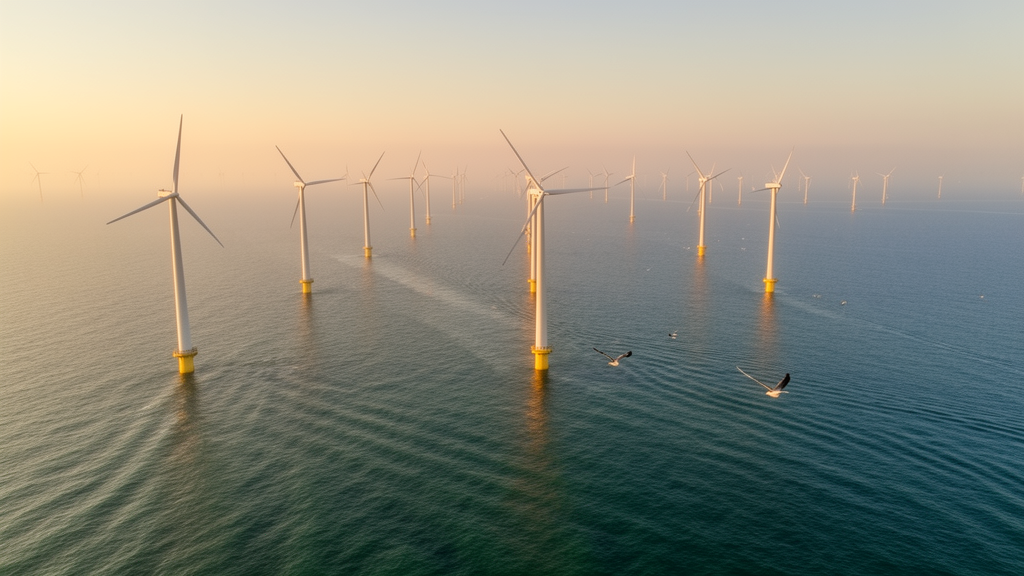
Machine-learning surrogates are becoming the workhorses of wind-farm design, promising to replace hours of expensive aeroelastic simulation with near-instant predictions of electrical power and structural fatigue. But a new study of the Lillgrund offshore wind farm reveals a subtlety that could reshape how these digital stand-ins are built: the way the incoming wind field is represented to the model matters enormously, and the best representation depends entirely on what you are trying to predict. For electrical power, two simple numbers describing the average wind over the rotor were almost enough. For fatigue loads, the full spatial texture of the wind across the rotor plane was often decisive.
The research, published in Wind Energy Science, draws on the publicly available HAWC2Farm Lillgrund dataset, a collection of 1000 independent one-hour aeroelastic simulations of the 48-turbine Danish offshore wind farm, of which 800 publicly released simulations were used. Each turbine has a rated power of 2.3 megawatts, and the simulations spanned randomly generated atmospheric conditions: wind speeds from 4 to 20 metres per second, power-law shear exponents from 0.1 to 0.3, and turbulence intensities from 2.5 to 10 percent. Every second, the wind field immediately upstream of each rotor was recorded on a uniform 30-by-30 grid covering 1.1 rotor diameters, with each rotor diameter measuring 92.6 metres.
Each hour-long simulation was divided into six non-overlapping 10-minute intervals, and for every turbine and interval the rotor-plane wind field was aggregated into two 30-by-30 maps: one showing the mean wind speed and one showing the standard deviation, a measure of temporal variability. This produced 288 observations per simulation and 230,400 observations in total. Each observation consisted of a flattened 1800-dimensional input vector, formed by concatenating the 900 grid values of the mean field with the 900 values of the standard-deviation field, paired with the electrical power and 12 fatigue-relevant damage-equivalent load targets covering components at the blade root, tower base, tower top, and main bearing.
From this common data, the study constructed four input configurations. A minimal baseline retained only the spatial averages of the mean wind-speed and temporal-variance fields, deliberately discarding all distributed information. The flattened representation kept all 1800 grid values but destroyed their two-dimensional arrangement. A principal component analysis (PCA) representation compressed the full input into a compact set of orthogonal components. Finally, a spatial representation restored the original 30-by-30 topology as a two-channel tensor. The baseline, flattened, and PCA configurations were all evaluated with the same SimpleMLP architecture under 5-fold GroupKFold cross-validation, ensuring that any performance differences could be attributed to the input representation rather than the model class. The spatial configuration was assessed separately with a convolutional neural network (CNN), since its results reflect the combined effect of topology-preserving input and a convolutional architecture.
The cross-validation design deserves attention for its rigour. Groups corresponded to complete simulation realisations, so all 288 turbine-interval observations from a given simulation were assigned exclusively to training or validation sets, preventing information leakage from correlated samples. Normalisation statistics and the PCA basis were fitted only on training data within each fold. All models were trained in PyTorch with the AdamW optimiser, mini-batches of 256 samples, cosine-annealed learning rates, and early stopping with a patience of 20 epochs, with performance reported as the mean and standard deviation across the five validation folds.
For electrical power prediction, the headline result was striking. Reducing the rotor-plane inflow to just two numbers increased the SimpleMLP’s root-mean-squared error (RMSE) from 6.756 kilowatts with the full grid to 51.184 kilowatts with the baseline. Yet even that baseline error amounts to only about 2.225 percent of the turbine’s 2.3-megawatt rated power, with a coefficient of determination of 0.9966. In other words, the rotor-averaged wind speed and variance already capture most of the information needed to predict power, and the distributed representations mainly serve to shave down the remaining error. Within the fixed-architecture comparison, PCA delivered the best performance: compressing 1800 variables to 128 principal components lowered the RMSE to 5.534 kilowatts, an improvement of roughly 18.1 percent over the full flattened input, with the mean absolute error falling from 4.176 to 2.791 kilowatts, or about 0.121 percent of rated power.
A sensitivity analysis of the PCA dimensionality added an instructive twist. Although just two principal components captured more than 95 percent of the variance in the inflow data, the prediction error at that compression remained comparatively high. Error dropped rapidly between 4 and 32 components and plateaued near 128, where the lowest RMSE was achieved; expanding to 256 components brought no further gain. The lesson is that explained input variance is not the same thing as predictive information, a distinction that matters for anyone compressing wind-field data for machine-learning pipelines. Notably, a deeper residual network (ResMLP) with twelve residual blocks actually performed worse than the shallow SimpleMLP on the same flattened input, achieving an RMSE of 19.146 kilowatts for power, showing that extra model capacity alone does not guarantee better predictions.
Fatigue-load prediction told a very different story, and one that varied sharply between load channels. Collapsing the inflow to the two-variable baseline multiplied the SimpleMLP’s RMSE by roughly 4.6 for blade-root edgewise bending, which rose from 42.67 to 196.61 kilonewton-metres, and by factors of about 6.4 and 6.5 for the main-bearing bending components, which climbed from around 31 to nearly 200 kilonewton-metres. Yet tower-base fore-aft bending, a quantity dominated by rotor-integrated thrust, barely benefited from distributed information, with RMSE improving only from 117.07 to 110.58 kilonewton-metres. This pattern is physically coherent: thrust-dominated loads are largely captured by rotor-averaged quantities, whereas loads sensitive to asymmetric rotor loading depend on the spatial structure of the wind across the disc. Under the fixed SimpleMLP architecture, the PCA and full-grid representations performed broadly similarly on fatigue, with neither showing a consistent advantage across all 12 channels, in contrast to PCA’s clear win for power.
The topology-aware CNN emerged as the fatigue champion, achieving the lowest RMSE for all 12 load components. Because it differs from the fully connected models in both input structure and architectural inductive bias, the authors caution that this cannot be read as the isolated effect of preserving spatial topology; it demonstrates that the evaluated combination of spatial input and convolutional architecture is particularly effective for fatigue prediction. The deeper ResMLP again underperformed the SimpleMLP on all 12 fatigue channels with the same flattened input. Taken together, the results show that no single representation or model class is universally optimal: the PCA-SimpleMLP configuration was the most accurate for electrical power, while the spatial CNN was best for fatigue loads, and the value of distributed rotor-plane information differs both between tasks and between individual load channels.
The study’s authors are careful to frame the limitations. The conclusions apply specifically to temporally aggregated inflow information, represented by 10-minute mean and standard-deviation fields, and may not extend to time-resolved flow fields or richer statistics. The architectures tested are not exhaustive, and transformer-based or graph-based alternatives could shift the rankings. The dataset represents a single wind-farm configuration under simulated conditions, without the measurement noise, missing data, and unmodelled atmospheric variability of field deployments, and operational use would require estimating rotor-scale inflow from sparse sources such as nacelle-mounted lidar, whose line-of-sight limitations and wake contamination would need to be addressed. The intended role of the surrogate framework is not to eliminate the high-fidelity simulations needed to build its training database but to provide computationally inexpensive predictions once that database exists, targeting applications such as wind-farm layout optimisation, flow-control studies, fatigue-aware optimisation, and large-scale parametric investigations. Within those bounds, the message is clear and practical: choose the inflow representation and surrogate architecture jointly, according to the prediction objective, rather than assuming one configuration will serve power and structural-load modelling equally well.
Subject of Research: Influence of rotor-plane inflow representation on machine-learning surrogate prediction of electrical power and fatigue loads in offshore wind farms
Article Title: The influence of flow-field representation on electrical power and fatigue-load surrogate modelling in offshore wind farms
Article References: Ganapathi Subramanian, P. (2026). The influence of flow-field representation on electrical power and fatigue-load surrogate modelling in offshore wind farms. Wind Energy Science, 11(10), 4041-4057. https://doi.org/10.5194/wes-11-4041-2026
Image Credits: AI Generated
Keywords: offshore wind farms, surrogate modelling, machine learning, fatigue loads, electrical power prediction, rotor-plane inflow, principal component analysis, convolutional neural network, aeroelastic simulation, HAWC2Farm, Lillgrund, wind energy
Cite Scienmag News
Blake Davidson. (October 26, 2026). How You Picture the Wind Changes What AI Predicts in Offshore Wind Farms. Scienmag. https://scienmag.com/how-you-picture-the-wind-changes-what-ai-predicts-in-offshore-wind-farms/
Blake Davidson. "How You Picture the Wind Changes What AI Predicts in Offshore Wind Farms." Scienmag, 26 October 2026, https://scienmag.com/how-you-picture-the-wind-changes-what-ai-predicts-in-offshore-wind-farms/. Accessed 26 October 2026.
Blake Davidson. "How You Picture the Wind Changes What AI Predicts in Offshore Wind Farms." Scienmag. October 26, 2026. https://scienmag.com/how-you-picture-the-wind-changes-what-ai-predicts-in-offshore-wind-farms/


