


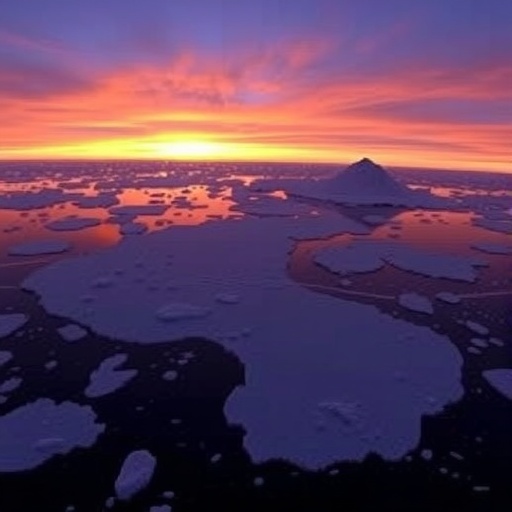
The Last Interglacial period, scientifically known as Marine Isotope Stage 5e (MIS 5e), which spanned approximately from 129,000 to 116,000 years ago, represents one of the Earth’s recent warm climate intervals that have intrigued climate scientists and geologists alike. This epoch is especially significant because global mean sea levels were estimated to be 5 to 10 meters higher than today, a fact that challenges existing knowledge about ice sheet stability and contributions to past sea level rise. Although the West Antarctic Ice Sheet (WAIS) has been hypothesized as a potential major contributor to this heightened sea level, definitive insights into its role during MIS 5e have remained elusive. However, a groundbreaking study led by Carter et al. has unveiled new geological and model-based evidence from Antarctic ice cores, providing a much clearer understanding of the interaction between ice sheet dynamics and atmospheric conditions during this pivotal warm period.
In this novel study, scientists have analyzed high-resolution dust composition records extracted from an ice core obtained at the Allan Hills Blue Ice Area (BIA) in Antarctica. This record spans a vast climatic range, covering the Penultimate Glacial Maximum (MIS 6) through to the Last Interglacial (MIS 5e). The significance of dust trapped in Antarctic ice cores lies in its geochemical signature, which serves as a reliable indicator of dust provenance—revealing the source regions of atmospheric dust during different climate states. Remarkably, the dust from MIS 6, a generally colder and glacial period, showed predominant contributions from South American sources. This implies the transport of long-range dust from continental sources, consistent with colder glacial atmospheric circulation patterns.
By contrast, the dust signature during MIS 5e was strikingly different. The analysis revealed a distinct presence of young volcanic material that originated from the McMurdo Sound sector of the West Antarctic Rift System and from nearby ice-free outcrops in the Transantarctic Mountains. These were not only proximate to the sampling site but also indicated a dramatic shift in regional wind patterns and surface exposure of Antarctic landscapes. This shift in dust composition suggests that during MIS 5e, large portions of the Ross Ice Shelf and the WAIS were diminished or even absent, exposing new land and volcanic sources that contributed to the dust burden found in the ice cores.
Building on these observations, the research team employed sophisticated Earth system model simulations to investigate the dynamical implications of this ice loss. Models demonstrated that the retreat or loss of the Ross Ice Shelf combined with the reduction of the WAIS significantly altered local atmospheric circulation. The exposure of the Ross Sea coastline intensified near-surface winds and increased precipitation rates in the area, in turn enhancing the transport of dust from these newly exposed Antarctic sources. The model outputs strikingly matched the empirical dust provenance records, reinforcing the idea that MIS 5e was marked by substantially altered Antarctic ice dynamics and atmospheric conditions.
This convergence of empirical data and computational modeling represents a major advance in paleoclimate reconstruction. It supports the long-suspected hypothesis that the WAIS contributed to elevated sea levels during the Last Interglacial by retreating or collapsing and that the Ross Ice Shelf was largely diminished during this time. The proxy signals of volcanic dust derived from the West Antarctic Rift and Transantarctic Mountains effectively serve as geological fingerprints of past ice shelf loss and increased surface exposure, which were hitherto difficult to detect with such precision.
The implications of this research extend beyond solely understanding past climate conditions; they provide important analogues for future climate change scenarios. Contemporary climate models often struggle to predict the behavior of polar ice sheets in warming climates. This study’s findings imply that ice shelves and ice sheets are highly sensitive to relatively moderate warming, with regional circulations responding rapidly to changes in ice extent. Enhanced coastal winds and consequent increases in precipitation could either accelerate ice mass loss or influence ice sheet stability in complex feedback loops, highlighting the urgent need to refine current predictive models based on such high-resolution proxy reconstructions.
Furthermore, the revelation that the WAIS and Ross Ice Shelf were substantially diminished during MIS 5e challenges previous assumptions that Antarctic ice sheets were mostly stable during past warm intervals. It elevates the importance of West Antarctica as a dynamic contributor to global sea level variability during interglacial periods, necessitating renewed focus on this region’s inherent vulnerabilities in modern climate change studies. Understanding the mechanisms by which dust transport pathways changed due to wind speed alterations and ice shelf exposure also sheds light on atmospheric circulation changes connected with polar climate feedbacks.
The study’s methodology was particularly notable: by combining geochemical fingerprinting of dust particles with ice core chronologies and earth system models, the researchers achieved an unprecedented window into the coupling between atmosphere-cryosphere processes and ice sheet dynamics. The ability to link atmospheric dust composition directly to ice sheet retreat provides a powerful tool for deciphering Earth’s climatic past, illuminating the complex interplay of regional tectonics, volcanic activity, and climate-driven ice fluctuations.
While the ice core from Allan Hills stands as a central archive for this work, the broader data synthesis incorporated marine sediment records, isotopic studies, and advanced climate simulations aligning with paleoenvironmental reconstructions. This multidisciplinary approach reinforces the notion that unraveling past climate puzzles requires integration across multiple scientific domains and spatial scales, offering a template for future investigations into Earth’s climate system resilience and response times.
Ultimately, the robust connection between volcanic dust provenance and the extent of Antarctic ice sheets during MIS 5e strengthens the argument for significant West Antarctic ice loss contributing to sea level rise. This further implies that coastal and atmospheric feedbacks played vital roles in modulating ice sheet dynamics during times of elevated global temperatures—key insights as modern trends hint toward similar patterns in a warming world.
As scientific understanding deepens, the study prompts a reevaluation of ice sheet vulnerability thresholds and encourages the incorporation of dust provenance proxies in ongoing paleoclimate research. By providing direct geochemical evidence of ice shelf retreat, this work bridges gaps between ice core records and climate modeling, ultimately refining predictions of future sea level rise and the response of polar regions to ongoing climate shifts.
In summary, the investigation undertaken by Carter and colleagues offers a transformative perspective on Antarctic ice sheet behavior during the last time Earth experienced warmth comparable to projections for the near future. Their research elucidates how changes in ice extent directly influenced atmospheric conditions, dust transport, and subsequently our planet’s sea level, emphasizing the dynamic nature of the West Antarctic Ice Sheet and implicating its historical sensitivity during past interglacials. These insights carry profound consequences both for paleoclimate understanding and for anticipating ongoing and future impacts of global warming on polar ice and coastal environments worldwide.
Cite Scienmag News
Violet Maxwell. (May 25, 2026). Last Interglacial Warming Shrinks West Antarctic Ice. Scienmag. https://scienmag.com/last-interglacial-warming-shrinks-west-antarctic-ice/
Violet Maxwell. "Last Interglacial Warming Shrinks West Antarctic Ice." Scienmag, 25 May 2026, https://scienmag.com/last-interglacial-warming-shrinks-west-antarctic-ice/. Accessed 5 September 2026.
Violet Maxwell. "Last Interglacial Warming Shrinks West Antarctic Ice." Scienmag. May 25, 2026. https://scienmag.com/last-interglacial-warming-shrinks-west-antarctic-ice/


