


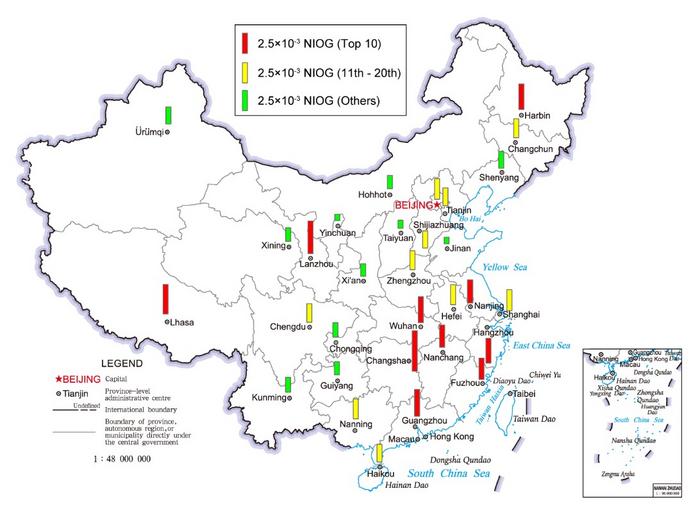
Air pollution is one of the most critical environmental challenges in modern society. The World Health Organization has recently lowered the recommended annual concentration of PM2.5 from 10 μg/m3 to 5 μg/m3. Nevertheless, this does not take into account the variations in ambient particle composition and toxicity among cities.

Credit: LU ZHANG, MAOSHENG YAO
Air pollution is one of the most critical environmental challenges in modern society. The World Health Organization has recently lowered the recommended annual concentration of PM2.5 from 10 μg/m3 to 5 μg/m3. Nevertheless, this does not take into account the variations in ambient particle composition and toxicity among cities.
In a study published in the Fundamental Research, researchers from the State Key Joint Laboratory of Environmental Simulation and Pollution Control at Peking University discovered large variations in the composition and toxicity of particulate matters (PM) at a national scale in the country.
“Optimal air pollution control practice requires a balance between health benefits and economic price. The health effects from PM exposure not only depend on the mass levels, but also on the actual toxicity,” explains the senior author Maosheng Yao. “Without adequate information would make it difficult to assess the effectiveness of the air pollution control practice.”
Current air quality standard depends on sole use of PM mass concentration level, and hence neglecting the differences in their toxicity and health impact per unit of mass. To develop a tailored air pollution control strategy, the authors believe there is a need to develop an inventory of PM toxicity on a global scale.
“Previously, we have studied the PM toxicity for 19 global cities. However, to date, a national scale study in China about PM toxicity is still lacking. This is largely due to the difficulty of carrying out large-scale sampling with traditional sampling methods and PM toxicity differences among cities,” adds the author of the work Lu Zhang
Compared with traditional methods, PM collection using air conditioning (AC) filter membrane is convenient, and low cost, with the main advantage of collecting a large amount of PM samples over a sustained time period. In this aspect, the samples could be more representative for a city in terms of time scale and space.”
Using this method, the researchers collected a total of 465 AC filters from 31 major Chinese cities. Dithiothreitol (DTT) assays of these samples showed that the toxicity difference for the cities was up to 6.5 times.
“Our results further underscored the toxicity differences was partially due to the differences in biological materials such as endotoxin, bacteria and fungi, together with chemical compositions such as metals. Thus, city-specific air pollution control strategy that integrates toxicity factor should be enacted in to maximize health and economic co-benefits,” concludes Dr. Yao.
###
Contact the author: Maosheng Yao, State Key Joint Laboratory of Environmental Simulation and Pollution Control, College of Environmental Sciences and Engineering, Peking University, Beijing China, yao@pku.edu.cn
The publisher KeAi was established by Elsevier and China Science Publishing & Media Ltd to unfold quality research globally. In 2013, our focus shifted to open access publishing. We now proudly publish more than 100 world-class, open access, English language journals, spanning all scientific disciplines. Many of these are titles we publish in partnership with prestigious societies and academic institutions, such as the National Natural Science Foundation of China (NSFC).
Journal
Fundamental Research
Method of Research
Observational study
Subject of Research
People
Article Title
Ambient particle composition and toxicity in 31 major cities in China
COI Statement
The authors declare that they have no known competing financial interests or personal relationships that could have appeared to influence the work reported in this paper.
Cite Scienmag News
Russell Cooper. (June 26, 2024). Large variations in composition and toxicity of ambient particles found in 31 major cities in China. Scienmag. https://scienmag.com/large-variations-in-composition-and-toxicity-of-ambient-particles-found-in-31-major-cities-in-china/
Russell Cooper. "Large variations in composition and toxicity of ambient particles found in 31 major cities in China." Scienmag, 26 June 2024, https://scienmag.com/large-variations-in-composition-and-toxicity-of-ambient-particles-found-in-31-major-cities-in-china/. Accessed 6 September 2026.
Russell Cooper. "Large variations in composition and toxicity of ambient particles found in 31 major cities in China." Scienmag. June 26, 2024. https://scienmag.com/large-variations-in-composition-and-toxicity-of-ambient-particles-found-in-31-major-cities-in-china/

