


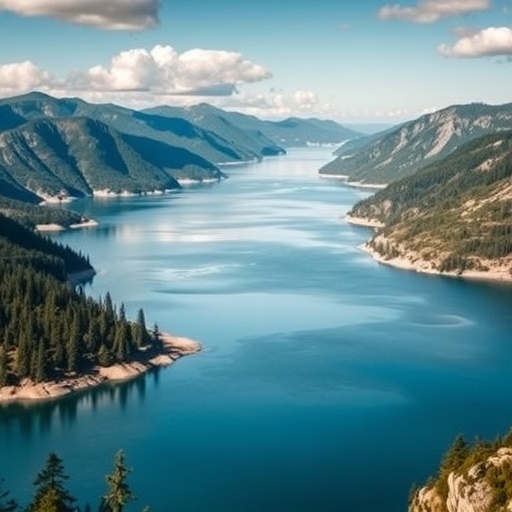
Lakes have traditionally been perceived as net sources of carbon dioxide emissions, contributing to atmospheric greenhouse gases and exacerbating climate change. However, groundbreaking new research from Uppsala University challenges this longstanding assumption by revealing that lakes, particularly their littoral zones—the nearshore areas rich in aquatic vegetation—may actually function as significant carbon sinks. This revelation redefines our understanding of inland water bodies in the global carbon cycle and calls for a major revision of how these ecosystems are accounted for in continental-scale carbon budgets.
The littoral zones of lakes are characterized by dense growths of aquatic plants that typically exhibit rapid biomass accumulation rates. These plants absorb considerable amounts of atmospheric carbon dioxide during photosynthesis, capturing carbon at rates often exceeding that of terrestrial ecosystems. Moreover, a substantial proportion of the carbon from organic matter produced in these zones is transferred to sediment, where it can be sequestered long-term. Despite the vast extent of these vegetated littoral areas—which globally exceed the total length of marine coastlines by a factor of four—their role in carbon sequestration has been widely neglected in prior assessments of lake carbon fluxes.
In an innovative approach, the research team at Uppsala University integrated data on the spatial extent, biomass production, and carbon storage potential of littoral vegetation into a global-scale carbon budget model for lakes. This represents the first comprehensive effort to include the littoral zone’s biotic components in estimations of lake carbon dynamics. By coupling existing datasets with a conceptual framework linking the littoral vegetation to carbon exchange at the lake center and sedimentation processes, the study delivers unprecedented insight into the magnitude of carbon sequestration that these shallows provide.
The results are startling and transformative. The inclusion of littoral vegetation in the global lake carbon accounting framework alters the narrative from lakes being sources of carbon emissions to being net carbon sinks. Specifically, the researchers documented that the carbon sequestered annually in lake sediments, largely fueled by the production of littoral zone plants, surpasses the carbon emitted to the atmosphere. This shift in understanding has far-reaching implications, suggesting a pivotal role for lacustrine ecosystems in mitigating climate change, a function that has been vastly underestimated in climate models.
Charlotte Grasset, the study’s lead author, explains that their initial objective was to compose a conceptual discourse spotlighting the overlooked contribution of aquatic plants in lake carbon cycling. Yet, their preliminary quantitative analyses revealed that littoral zones play a globally significant role in carbon budgets, prompting a paradigm shift from conceptual discussion to empirical quantification. This transition underscores the critical importance of integrating littoral vegetation into carbon cycle research and broad-scale environmental policy considerations.
The methodology employed involves synthesizing data from a multitude of sources, including measurements of aquatic plant productivity, sediment carbon storage rates, and gas flux measurements from multiple lake systems worldwide. The model further accounts for spatial variability by relating littoral zone size to lake area and volume, thereby enabling continental extrapolations. The study also evaluates uncertainties stemming from variability in plant biomass, sedimentation rates, and gas exchange processes to refine estimates and identify knowledge gaps requiring targeted field investigations.
Another profound implication of the study lies in the interdisciplinary benefits of restoring and conserving lake littoral zones. By enhancing aquatic plant growth and sediment carbon storage, these habitats not only sequester carbon but also improve water quality and support biodiversity. The authors highlight restoring lake shores as a promising nature-based climate solution that has been overlooked compared to the well-studied “blue carbon” ecosystems of marine coastal environments, such as mangroves and seagrasses. This research encourages policymakers and conservationists to reevaluate inland aquatic habitats as critical assets in climate mitigation strategies.
Despite the strong findings, the authors emphasize the need for expanded empirical research to further validate and refine their models. Current data on the areal extent and productivity of vegetated littoral zones are sparse, and carbon gas exchange dynamics between plants, sediments, and the atmosphere are complex and not fully understood. Future work should prioritize in situ measurements across diverse lake types and climatic zones to enhance precision and reduce uncertainties in carbon budget assessments.
The global scaling of littoral zone contributions confronts scientists with the challenge of mapping heterogeneous aquatic vegetation patterns using remote sensing technologies and ground-truthing. Advanced techniques such as hyperspectral imaging and lidar offer promising avenues to quantify vegetated littoral extents at high resolution. Integrating these spatial data with ecological and biogeochemical measurements will be crucial to develop more accurate continental and global carbon budgets.
Importantly, this study recalibrates the carbon accounting framework used by global climate models by incorporating freshwater ecosystem dynamics previously omitted or underrepresented. By doing so, it advances our capacity to predict carbon fluxes more accurately and underscores the multifaceted roles lakes play in global biogeochemical cycles, moving beyond simplistic classifications as carbon emitters. This provides new perspectives on the resilience and adaptation potential of freshwater systems under changing environmental conditions.
The paradigm shift from lakes as carbon sources to sinks also has profound consequences for regional greenhouse gas inventories. Freshwater ecosystems have been difficult to quantify in national carbon reporting, partly due to their complex and variable nature. This research offers a methodological blueprint for including littoral zone carbon sinks in official carbon budgets, thereby enhancing the accuracy of emission inventories and informing climate policy.
In conclusion, the recognition of lake littoral zones as potent carbon sinks necessitates an urgent reevaluation of global carbon budgets and calls for intensified research and conservation efforts aimed at protecting these vital ecosystems. This study paves the way for integrating freshwater littoral zones into climate mitigation frameworks, augmenting nature-based solutions for tackling the climate crisis. As the scientific community continues to unravel the complexities of carbon dynamics in aquatic environments, this research stands as a landmark contribution reshaping our understanding of the carbon cycle.
Cite Scienmag News
Violet Maxwell. (August 11, 2025). Lake Coastlines Play a Crucial Role in the Global Carbon Cycle. Scienmag. https://scienmag.com/lake-coastlines-play-a-crucial-role-in-the-global-carbon-cycle/
Violet Maxwell. "Lake Coastlines Play a Crucial Role in the Global Carbon Cycle." Scienmag, 11 August 2025, https://scienmag.com/lake-coastlines-play-a-crucial-role-in-the-global-carbon-cycle/. Accessed 3 September 2026.
Violet Maxwell. "Lake Coastlines Play a Crucial Role in the Global Carbon Cycle." Scienmag. August 11, 2025. https://scienmag.com/lake-coastlines-play-a-crucial-role-in-the-global-carbon-cycle/


