


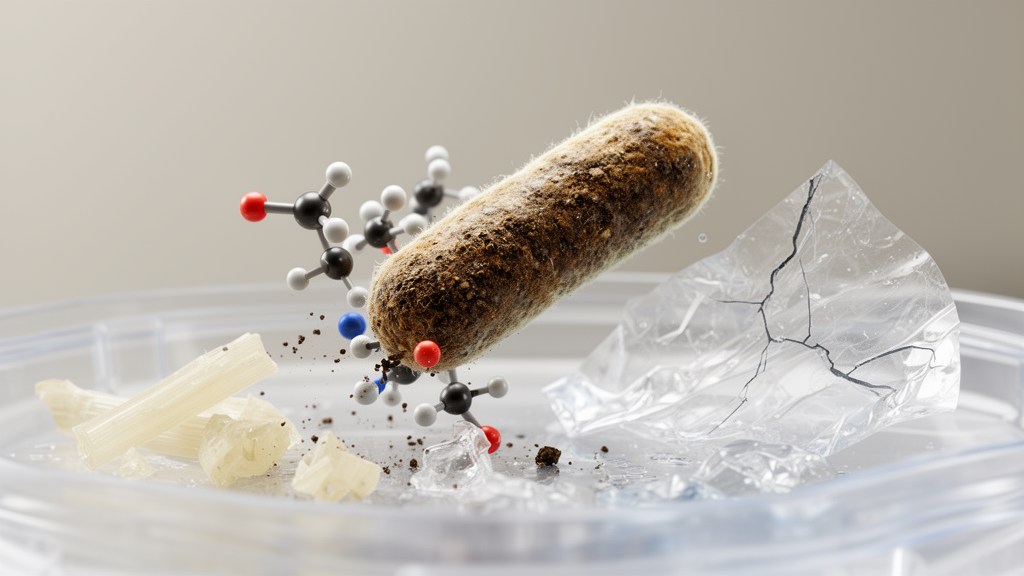
A four-week laboratory study found higher weight loss in PET and polystyrene samples exposed to Pseudomonas fluorescens after ultraviolet pretreatment than in untreated samples. The study used two-dimensional PET sheets and three-dimensional PS blocks maintained in sequential batch cultures at 30 °C, according to the article abstract. By the fourth week, UV-pretreated PET had lost 7.11% of its mass, compared with 5.33% for untreated PET. For PS, the corresponding values were 41.42% and 32.5%.
Researchers monitored degradation using gravimetric analysis, scanning electron microscopy and Fourier-transform infrared spectroscopy. The electron microscopy observations described progressive structural deterioration in both polymers. PET samples developed severe fracturing and flaking, while PS blocks showed large hollow cavities that the authors said contributed to loss of structural integrity. These observations were reported for the laboratory samples and do not establish how the process would perform in other settings.
The abstract also reported changes in the PET infrared spectra during the third and fourth weeks, particularly in the 1000–1700 cm−1 wave-number region. The researchers associated these changes with loss of polymer integrity and fragmentation. For PS, they said early formation of hydroxy and hydroperoxide groups was indicated by broadening of the peak at 3400 cm−1 and linked this pattern to the accelerated onset of biodegradation. The reported measurements therefore point to surface deterioration and changes in the tested polymer samples, but the abstract does not provide enough detail to quantify all analytical differences or determine their statistical uncertainty.
This was a controlled laboratory experiment rather than a field trial, and the available abstract does not report replication, sample size, statistical testing, complete controls, or the extent to which other microorganisms or environmental conditions affected the results. It also does not establish that the observed weight changes represent complete mineralization. The findings are limited to the tested PET sheets, PS blocks, culture conditions, UV pretreatment and four-week observation period; broader effects on plastic-waste management were not evaluated in the reported experiment.
Subject of Research: Laboratory assessment of Pseudomonas fluorescens degradation of UV-pretreated PET and polystyrene
Article Title: Pseudomonas fluorescens mediated plastic degradation and influence of UV pretreatment
Article References: Manoj, N., A., M., S., B., P., D., Martin, A. A., & Ashraf, S. (2026). Pseudomonas fluorescens mediated plastic degradation and influence of UV pretreatment. Discover Sustainability. https://doi.org/10.1007/s43621-026-04894-z
Image Credits: AI Generated
DOI: 10.1007/s43621-026-04894-z
Keywords: Pseudomonas fluorescens, plastic biodegradation, polyethylene terephthalate, polystyrene, UV pretreatment, gravimetric analysis, scanning electron microscopy, Fourier-transform infrared spectroscopy, Pseudomonas, fluorescens, mediated, plastic
Cite Scienmag News
Violet Maxwell. (October 20, 2026). Laboratory study links UV pretreatment to greater weight loss in PET and polystyrene exposed to Pseudomonas fluorescens. Scienmag. https://scienmag.com/laboratory-study-links-uv-pretreatment-to-greater-weight-loss-in-pet-and-polystyrene-exposed-to-pseudomonas-fluorescens/
Violet Maxwell. "Laboratory study links UV pretreatment to greater weight loss in PET and polystyrene exposed to Pseudomonas fluorescens." Scienmag, 20 October 2026, https://scienmag.com/laboratory-study-links-uv-pretreatment-to-greater-weight-loss-in-pet-and-polystyrene-exposed-to-pseudomonas-fluorescens/. Accessed 20 October 2026.
Violet Maxwell. "Laboratory study links UV pretreatment to greater weight loss in PET and polystyrene exposed to Pseudomonas fluorescens." Scienmag. October 20, 2026. https://scienmag.com/laboratory-study-links-uv-pretreatment-to-greater-weight-loss-in-pet-and-polystyrene-exposed-to-pseudomonas-fluorescens/


