


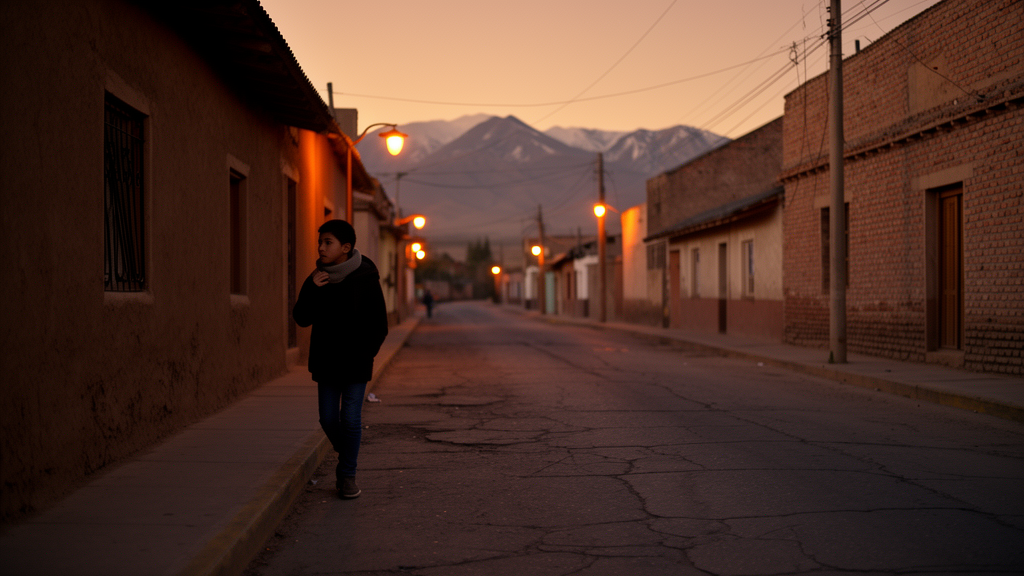
A qualitative study of 19 LGBTIQA+ adults in Chile found that territorial conditions shaped the feasibility of safety, support and survival in and around Talca, a medium-sized city, compared with Santiago. Participants described differences in access to information, recognizable support networks, community spaces, anonymity and mobility. The study supports an analytical—not representative—comparison between the two cities, and its findings are bounded by a sample that was predominantly young, cisgender and university-educated, with no trans women included.
Researchers conducted seven semi-structured interviews and two focus groups as part of a broader project on violence experienced by LGBTIQA+ people in Chile. The Talca sample comprised seven individual interviews and one focus group with seven participants, while the Santiago comparison consisted of one focus group with five participants. All participants were over 18, lived in one of the two cities and reported subjective experiences of violence. Recruitment combined purposive and snowball sampling through LGBTIQA+ organizations and social networks.
The analysis used reflexive thematic analysis following Braun and Clarke, with reporting guided by the Consolidated Criteria for Reporting Qualitative Research. The researchers selected cases from the broader corpus according to predefined criteria: a high density of explicit territorial references and representation of both study sites. Coding was conducted collaboratively through repeated discussion, but the team did not calculate inter-coder agreement, consistent with the reflexive approach. The selection was not intended to represent all LGBTIQA+ residents of Talca or Santiago statistically.
The first theme was described as an “infrastructure of possibility”: access to information, support references, social networks and spaces affected whether LGBTIQA+ life appeared practicable or precarious. Participants associated territorial context with differences in the language available to describe their experiences and with the ability to identify organizations or people to approach for help. Where formal references were absent, participants described turning to friends or forming self-organized support groups. Accounts also showed that access was stratified within metropolitan Santiago, indicating that administrative boundaries did not necessarily correspond to equal availability of information or support.
The second theme concerned surveillance and reputation. Participants linked conditions in Talca and nearby rural environments with being recognized, observed or subjected to rumor, which narrowed the scope for everyday expression and help-seeking. These accounts included pressure to alter gender expression, voice or conduct in family and professional settings. The authors also describe identity-based mistreatment within LGBTIQA+ environments, including the use of deadnaming by peers or relatives. The analysis treats such behavior as an extension of surveillance rather than as an effect external to community life.
The third theme concerned mobility and education as partial openings. Moving for study and traveling through urban circuits exposed participants to people, events and spaces that were less available in their places of residence, expanding possible futures and social networks. The opening was described as incomplete and reversible: capabilities encountered in Santiago did not necessarily become available after returning to Talca. Messaging groups and locally organized gatherings also functioned as alternative infrastructures of connection in the smaller city, complicating any simple depiction of Talca as lacking solidarity.
The comparison does not establish that territorial scale alone causes violence or determines outcomes. Class, educational position, family relationships, professional environments and community connections shaped participants’ possibilities within the same territory. The authors therefore describe the infrastructure of possibility as jointly produced rather than as a pure effect of city size. A participant’s educational trajectory, for example, could provide access to information and new social contexts, while educational and socioeconomic position also stratified recognition within LGBTIQA+ spaces.
Several limitations constrain the findings. The sample was confined to people aged 19 to 35 who had completed or were pursuing university studies, and it included no trans women. Talca contributed seven interviews and one focus group, whereas Santiago contributed only a focus group; because individual interviews and group discussions can elicit different accounts, some apparent differences between sites may reflect data type rather than place. Recruitment through organizations may also have favored participants with stronger community connections. Rurality appeared mainly through participants’ biographies and movements from rural areas, rather than through sustained comparison with people currently residing in rural localities.
No official Chilean statistical source reported violence or discrimination by sexual orientation or gender identity with the regional disaggregation needed for a direct incidence comparison. The study also used only one focus group for Santiago and treated that city as a contrasting horizon through which participants narrated Talca. Within these limits, the qualitative analysis concludes that urban scale, network density, social legibility and information access operate as conditions shaping LGBTIQA+ violence and survival. The authors say the findings point toward responses addressing territorial conditions, including connectivity, information circulation, community spaces, recognizable support routes and confidentiality safeguards adapted to medium-sized cities and rural environments.
Subject of Research: Qualitative study of territorial conditions shaping LGBTIQA+ violence and survival in Talca and Santiago, Chile
Article Title: Talca no es Santiago: Moral geography, rurality, and infrastructure of possibility in LGBTIQA+ violence and survival
Article References: Albornoz Fuentes, W. O., Valenzuela Gajardo, C. D. P., & Cid Ramírez, T. A. (2026). Talca no es Santiago: Moral geography, rurality, and infrastructure of possibility in LGBTIQA+ violence and survival. PLOS One, 21(10), e0360622. https://doi.org/10.1371/journal.pone.0360622
Image Credits: AI Generated
DOI: 10.1371/journal.pone.0360622
Keywords: LGBTIQA+ violence, qualitative research, Talca, Santiago, territorial inequality, social surveillance, support networks, rurality, education and mobility, Moral, geography, infrastructure
Cite Scienmag News
Courtney Benton. (October 20, 2026). Qualitative study of young, university-educated adults links territorial conditions to LGBTIQA+ violence and survival in Chile. Scienmag. https://scienmag.com/qualitative-study-of-young-university-educated-adults-links-territorial-conditions-to-lgbtiqa-violence-and-survival-in-chile/
Courtney Benton. "Qualitative study of young, university-educated adults links territorial conditions to LGBTIQA+ violence and survival in Chile." Scienmag, 20 October 2026, https://scienmag.com/qualitative-study-of-young-university-educated-adults-links-territorial-conditions-to-lgbtiqa-violence-and-survival-in-chile/. Accessed 20 October 2026.
Courtney Benton. "Qualitative study of young, university-educated adults links territorial conditions to LGBTIQA+ violence and survival in Chile." Scienmag. October 20, 2026. https://scienmag.com/qualitative-study-of-young-university-educated-adults-links-territorial-conditions-to-lgbtiqa-violence-and-survival-in-chile/


