


A state-level observational study of 28 Indian states from 2018 to 2024 found that infrastructure development became more evenly distributed over time, while positive spatial clustering persisted across the period. The study, summarized in the available abstract, developed a Holistic Infrastructure Development Index (HIDI) combining four Sustainable Development Goal dimensions: water and sanitation, clean energy, industry and infrastructure, and sustainable cities. It also incorporated state-level per-capita public expenditure as a proxy for fiscal capacity.
The analysis used state-level SDG and fiscal data from the NITI Aayog SDG India Index, producing 112 observations across 28 states. Cross-sectional dispersion in HIDI fell by 12.0%. A convergence regression relating log growth to initial HIDI returned a beta coefficient of −0.681, with a correlation of −0.902 and R² of 0.81 (p < 0.001). These results are consistent with convergence in the study measure, but the observational design does not establish that the convergence was caused by any particular policy or expenditure pattern.
Spatial analysis found positive and statistically significant autocorrelation in every wave. Global Moran’s I values ranged from +0.196 to +0.420, with permutation-based pseudo-p values no greater than 0.048. The abstract reports that stronger performers were concentrated in the western–southern corridor, whereas several northeastern states showed persistent underperformance. Fiscal capacity was not uniformly associated with stronger infrastructure outcomes: dispersion was greatest among states in the highest fiscal-capacity quartile. The authors describe this pattern as the “Infrastructure Fiscal Nexus Paradox” and associate it with governance quality and absorptive capacity rather than presenting expenditure as a sufficient explanation.
The authors organize the observed patterns into four illustrative development archetypes—Fiscal-Augmented Performers, Efficiency-Led Performers, Catch-Up Leaders, and Development Traps. Based on the abstract, they suggest that intergovernmental transfers could be linked to fiscal need as well as demonstrated implementation capacity and infrastructure outcomes. The findings are bounded by the study’s state-level scope, use of public expenditure as a proxy for fiscal capacity, and observational approach. The available abstract does not provide normalization details, equations, or operational definitions for the four archetypes, and the summary alone does not allow assessment of the full study or its sensitivity to alternative model specifications.
Subject of Research: State-level analysis of infrastructure development convergence and spatial patterns across India from 2018 to 2024
Article Title: Spatial dynamics of infrastructure development across Indian states
Article References: Paitonpatrick, S., & Dar, S. N. (2026). Spatial dynamics of infrastructure development across Indian states. Discover Sustainability. https://doi.org/10.1007/s43621-026-04787-1
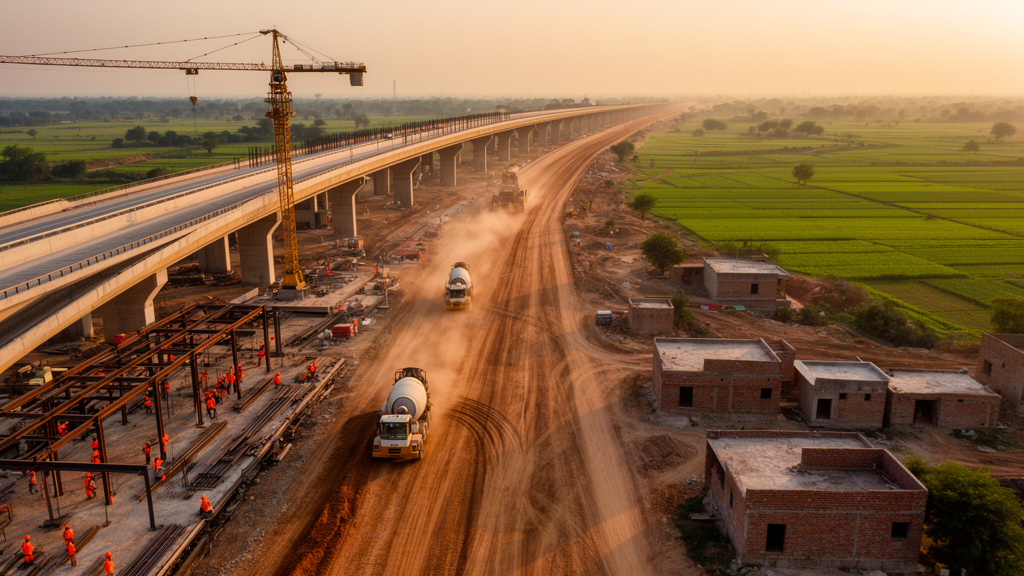
Image Credits: AI Generated
DOI: 10.1007/s43621-026-04787-1
Keywords: India, infrastructure development, state-level study, Sustainable Development Goals, fiscal capacity, spatial autocorrelation, regional disparities, convergence analysis, Spatial, dynamics, infrastructure, development
Cite Scienmag News
Violet Maxwell. (October 20, 2026). Study finds narrowing infrastructure gaps but persistent spatial clustering across 28 Indian states. Scienmag. https://scienmag.com/study-finds-narrowing-infrastructure-gaps-but-persistent-spatial-clustering-across-28-indian-states/
Violet Maxwell. "Study finds narrowing infrastructure gaps but persistent spatial clustering across 28 Indian states." Scienmag, 20 October 2026, https://scienmag.com/study-finds-narrowing-infrastructure-gaps-but-persistent-spatial-clustering-across-28-indian-states/. Accessed 20 October 2026.
Violet Maxwell. "Study finds narrowing infrastructure gaps but persistent spatial clustering across 28 Indian states." Scienmag. October 20, 2026. https://scienmag.com/study-finds-narrowing-infrastructure-gaps-but-persistent-spatial-clustering-across-28-indian-states/


