


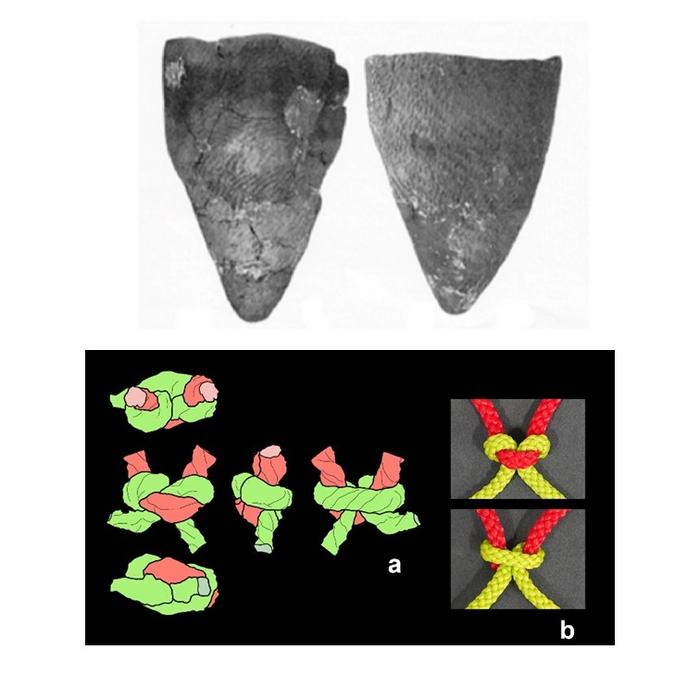
In an extraordinary leap forward for archaeological science, a cutting-edge study led by researchers from Kumamoto University has pioneered the digital resurrection of prehistoric fishing nets dating back over six millennia. Utilizing state-of-the-art X-ray computed tomography (CT) alongside innovative silicone casting techniques, this team has, for the first time globally, intricately reconstructed the complex structures of fishing nets embedded within ancient pottery from Japan’s Jomon period. This breakthrough not only revitalizes long-lost organic artifacts but profoundly deepens our understanding of prehistoric craftsmanship and cultural practices.
The research hinged on the analysis of ceramic fragments unearthed across two geographically distinct Japanese regions: northern Hokkaido and southern Kyushu. These fragments contained subtle impressions left by fishing nets integrated in or adhered to their surfaces, invisible to the naked eye but preservable thanks to the unique properties of Jomon pottery. Employing high-resolution X-ray CT scanning, the investigators non-invasively visualized the three-dimensional architecture of these net remnants without damaging the fragile ceramics, preserving invaluable archaeological context.
In northern Hokkaido, the team uncovered evidence of what is categorized as Shizunai-Nakano style pottery, which incorporates distinct net imprints. These nets were composed of large mesh sizes tied with reef knots — a sophisticated technique that ensured structural integrity for ocean fishing gear. Intriguingly, the nets were reutilized as internal reinforcement within the pottery coils, revealing a nuanced early example of tool recycling. Such dual use indicates a sophisticated understanding of material properties and resource optimization in Neolithic communities.
Conversely, the pottery artifacts analyzed from southern Kyushu, dating to the transitional Final Jomon and early Yayoi periods, exhibited remnants of finely meshed nets. These nets, meticulously constructed with simpler overhand knots or using an intricate “knotted wrapping” technique, likely functioned as molds or form liners during pottery shaping processes. This suggests that nets, beyond their primary fishing purpose, also had vital technological applications in ceramic production, highlighting the multifunctional role of textile tools within prehistoric societies.
The application of CT imaging not only rendered a digital reconstruction of net patterns but revealed critical manufacturing features such as thread twist directionality and knot typology, which are fundamental in determining net function and origin. Such prosaic yet indispensable details deliver unprecedented insights into ancient weaving methodologies and regional variations indicative of cultural exchange and localized adaptations.
One of the more remarkable aspects of the study is its exploration of the labor investment required for net production. By extrapolating knotting speed and thread handling dynamics, the researchers estimated that crafting a single fishing net demanded in excess of 85 hours of painstaking manual labor. This immense temporal investment underscores the nets’ economic and social value, reinforcing their centrality in subsistence activities and their symbolic stature within Jomon communities.
Professor Emeritus Hiroki Obata, the lead archaeologist, emphasized the broader implications of this reuse, positioning these ancient practices as a proto-form of sustainability. “Our findings reveal an early form of environmental and resource consciousness, mirroring concepts promoted in today’s Sustainable Development Goals,” he stated. The repurposing of fishing nets as structural elements in pottery embodies a sophisticated material ecology rarely acknowledged in prehistoric studies.
Critically, this study challenges prior assumptions that all yarn or fiber impressions in pottery unequivocally represent fishing gear. Instead, the digital reconstructions demonstrate that net impressions reflect a broader spectrum of functional adaptations spanning fishing, carrying, and pot-making. Hence, these findings necessitate a reassessment of how archaeologists interpret fiber impressions in ceramic records, fostering more nuanced interpretations of ancient material culture.
Furthermore, the research breaks methodological ground by merging non-destructive imaging with physical replication via silicone casting, allowing for tactile examination of fragile net structures previously inaccessible to scholars. This methodological synergy exemplifies the growing trend of interdisciplinary innovation in archaeology, where physics, materials science, and ethnographic knowledge coalesce to reconstruct forgotten technologies.
The potential impact of these techniques extends beyond Japanese prehistory. By proving the viability of resurrecting organic, textile-based artifacts that seldom survive in conventional excavations, this approach opens new frontiers in identifying and conserving similar vanished materials worldwide. Future applications could revolutionize the archaeological understanding of textile production, trade networks, and craft specialization in ancient societies globally.
Published in the Journal of Archaeological Science, this landmark research stands as a testament to the power of modern imaging technology in unraveling the intricate narratives encased within archaeological artifacts. It bridges the temporal chasm separating contemporary researchers from Neolithic artisans, illuminating the sophistication and adaptability of early human societies through the lens of their everyday tools.
As the scientific community digests these revelations, anticipation grows for further studies employing similar digital reconstruction methodologies. This could herald a new era where the intangible heritage of ancient societies—woven through threads and knots long entombed—can be examined, preserved, and celebrated with unprecedented fidelity and respect.
Cite Scienmag News
Courtney Benton. (September 26, 2025). Kumamoto University Researchers Achieve World-First: Ancient Fishing Nets Reconstructed from Pottery Using X-ray CT. Scienmag. https://scienmag.com/kumamoto-university-researchers-achieve-world-first-ancient-fishing-nets-reconstructed-from-pottery-using-x-ray-ct/
Courtney Benton. "Kumamoto University Researchers Achieve World-First: Ancient Fishing Nets Reconstructed from Pottery Using X-ray CT." Scienmag, 26 September 2025, https://scienmag.com/kumamoto-university-researchers-achieve-world-first-ancient-fishing-nets-reconstructed-from-pottery-using-x-ray-ct/. Accessed 3 September 2026.
Courtney Benton. "Kumamoto University Researchers Achieve World-First: Ancient Fishing Nets Reconstructed from Pottery Using X-ray CT." Scienmag. September 26, 2025. https://scienmag.com/kumamoto-university-researchers-achieve-world-first-ancient-fishing-nets-reconstructed-from-pottery-using-x-ray-ct/


