


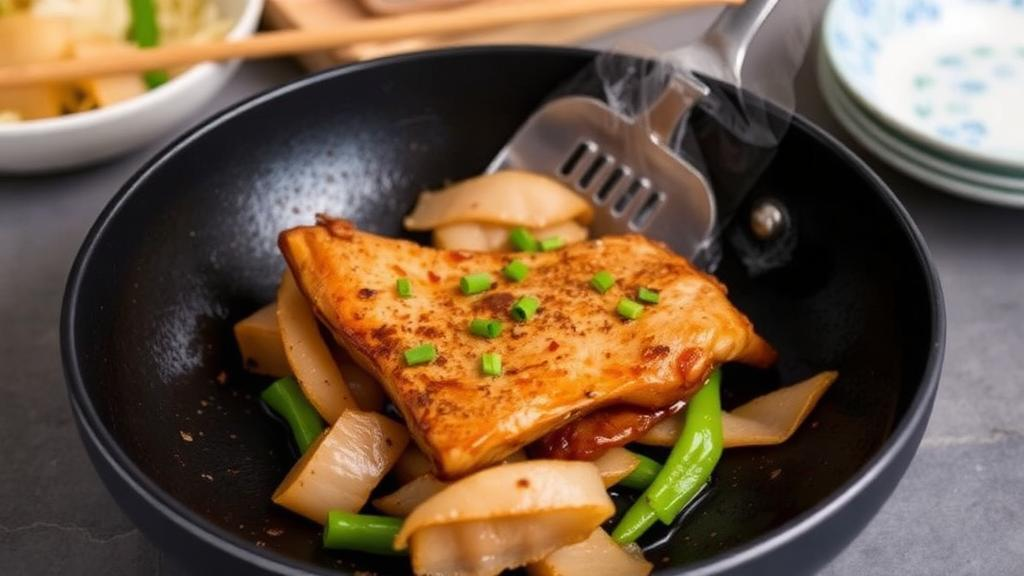
The sizzle of pork belly hitting a hot wok is one of the most recognizable sounds in Chinese cooking, and the aroma it releases is the product of a fierce chemical contest between lipid oxidation and the Maillard reaction. But that same high-heat process also generates cooking oil fumes, a complex aerosol of aldehydes, ketones, alcohols and polycyclic aromatic hydrocarbons that epidemiological studies have linked to respiratory disorders, cardiovascular disease and lung cancer. A new study published in Food Chemistry: X has now mapped, in unusual molecular detail, how the timing of fume extraction during stir-frying reshapes both the flavor of the meat and the burden of potentially harmful carbonyls in the kitchen air. The findings suggest that when a range hood or exhaust system runs may matter as much as whether it runs at all.
Researchers led by Jingnan Lu and Baocai Xu used an intelligent stir-frying machine equipped with an integrated overhead forced-exhaust system to cook standardized strips of pork belly at 200 degrees Celsius. The machine’s fume-control module could be switched on or off independently during two distinct phases: an initial heating phase lasting 190 seconds and a subsequent residual-heat phase lasting another 170 seconds. By toggling the module across these phases, the team created four experimental regimes. In the OO treatment, exhaust ran continuously, simulating conventional practice. In the CC treatment, it stayed off throughout. The CO treatment kept the exhaust closed during heating but open during residual heat, while the OC treatment reversed that sequence. Each batch contained identical amounts of pork, peanut oil, cooking wine, soy sauce and brine, ensuring that ventilation was the only variable.
The analytical arsenal deployed on the resulting meat was formidable. Headspace solid-phase microextraction coupled with gas chromatography-mass spectrometry identified 62 volatile compounds, including 16 aldehydes, 9 alcohols, 8 pyrazines and 6 furans. Gas chromatography-ion mobility spectrometry resolved 70 volatile features and generated fingerprint plots distinguishing the treatments. Electronic nose and electronic tongue instruments provided rapid whole-profile sensory maps, while conventional assays quantified free amino acids, free fatty acids and thiobarbituric acid-reactive substances, a standard marker of secondary lipid oxidation. Principal component analysis and orthogonal partial least-squares discriminant analysis then organized the data, with the statistical models showing excellent fit and predictive power.
The results were striking. Meat cooked with the exhaust fully closed, the CC treatment, contained the richest and most distinctive volatile profile. It held the greatest number of compounds, including six found nowhere else, and the highest concentrations of straight-chain aldehydes such as nonanal, octanal, heptanal and hexanal, which arise from the oxidative cleavage of oleic and linoleic acids. Pyrazines and furans, heterocyclic compounds born of Maillard chemistry and Strecker degradation, also accumulated to significantly higher levels under closed conditions. Odor activity value calculations identified 3-methylbutanal, 2-methylbutanal, hexanal, ethyl acetate, ethyl butyrate and 2,5-dimethylpyrazine as the principal aroma-active compounds, and every one of them reached its highest OAV in the CC group.
The taste chemistry told a parallel story. Total free amino acids in the CC meat reached 760.99 milligrams per 100 grams, 27.3 percent higher than in the continuously ventilated OO group, likely because the hot, humid, fume-laden chamber accelerated thermal degradation of proteins. Glutamic acid, the dominant umami driver, achieved a taste activity value of 10.63 in the CC group, while alanine contributed sweetness. Proline, a known precursor of pyrazines, was 2.13 times more abundant in the CC meat than in the OO control, and methionine dropped by 32.2 percent, consistent with its conversion into sulfur-containing volatiles that the electronic nose detected through its sulfide-sensitive sensors.
Lipid analysis revealed the cost of that aromatic richness. The CC group showed the lowest total free fatty acid content, at 58.63 milligrams per 100 grams compared with 147.72 in the OO group, with saturated, monounsaturated and polyunsaturated fatty acids all depleted. Thiobarbituric acid-reactive substances followed the same gradient, ranking CC highest at 0.992 milligrams of malondialdehyde per kilogram, then CO, OC and finally OO at 0.363. Notably, closure during the active heating phase drove more oxidation than closure during residual heat, indicating that the earliest minutes of stir-frying are chemically decisive. The researchers attribute this to greater oxygen retention and thermal accumulation inside the sealed chamber, which fuels autoxidation of the most vulnerable unsaturated fatty acids.
Meanwhile, the air inside the cooking chamber told the other half of the story. When the exhaust stayed closed throughout, total aldehyde and ketone concentrations reached 4,868.89 micrograms per cubic meter, roughly 6.5 times the 750.75 measured under continuous ventilation. Acetaldehyde dominated every treatment, accounting for 42.66 to 61.18 percent of total carbonyls, with formaldehyde, butanal and hexanal also elevated. These short-chain carbonyls volatilize readily at frying temperatures and originate from fatty acid cleavage as well as from the very oxidation pathways that generate meat aroma. In other words, the compounds that make pork belly delicious and the compounds that make cooking fumes hazardous are close chemical cousins, sharing common thermochemical origins in the sizzling fat.
Correlation network analysis made that kinship explicit. Fume-derived formaldehyde, acetaldehyde, acrolein or acetone, propionaldehyde and butyraldehyde emerged as the most highly connected hub nodes, positively associated with meat volatiles including pentanal, 2-methylpentanal, 2-methylheptanal and several alcohols, but negatively associated with acetone, 2-hexylfuran and tetrahydro-2-methylfuran. The predominance of positive correlations suggests that most flavor compounds are generated synergistically alongside fume carbonyls, while the negative links hint at substrate competition or diversion of reaction pathways. The overlap means that simply trapping more fume does not necessarily strip flavor from the food; instead, ventilation timing shifts the competitive balance between oxidation and Maillard chemistry inside the chamber itself.
The practical takeaway is a compromise. Closing the exhaust during the intense heating phase and opening it during residual heat, the CO regime, preserved comparatively high flavor quality while cutting total aldehyde and ketone emissions by about 13.4 percent relative to full closure. The authors argue that this stage-specific strategy offers the best available balance between sensory quality and emission control, and that it provides a template for adaptive fume-control algorithms in intelligent cooking appliances. For a world increasingly concerned about indoor air quality, the message is unexpectedly nuanced: the fight against cooking fumes is not a war on flavor, but a matter of timing the exhaust so that the chemistry of aroma and the chemistry of pollution can be nudged in different directions.
Subject of Research: The relationship between cooking oil fume ventilation timing and volatile flavor compound retention in stir-fried pork belly
Article Title: Revealing the mechanistic correlation between volatile flavor retention and cooking oil fume reduction in stir-fried pork belly
Article References: Lu, J., Ding, H., Sun, J., Wu, L., Hu, M., Xu, K., Wang, H., Chen, X., Cai, K., & Xu, B. (2026). Revealing the mechanistic correlation between volatile flavor retention and cooking oil fume reduction in stir-fried pork belly. Food Chemistry: X, 39, Article 104547. https://doi.org/10.1016/j.fochx.2026.104547
Image Credits: AI Generated
DOI: 10.1016/j.fochx.2026.104547
Keywords: stir-frying, cooking oil fumes, pork belly, volatile flavor compounds, lipid oxidation, Maillard reaction, aldehydes, pyrazines, free amino acids, ventilation, food chemistry, indoor air quality
Cite Scienmag News
Bethany Barker. (October 3, 2026). Kitchen Chemistry Showdown: How Ventilation Timing Shapes the Flavor of Stir-Fried Pork Belly. Scienmag. https://scienmag.com/kitchen-chemistry-showdown-how-ventilation-timing-shapes-the-flavor-of-stir-fried-pork-belly/
Bethany Barker. "Kitchen Chemistry Showdown: How Ventilation Timing Shapes the Flavor of Stir-Fried Pork Belly." Scienmag, 3 October 2026, https://scienmag.com/kitchen-chemistry-showdown-how-ventilation-timing-shapes-the-flavor-of-stir-fried-pork-belly/. Accessed 5 October 2026.
Bethany Barker. "Kitchen Chemistry Showdown: How Ventilation Timing Shapes the Flavor of Stir-Fried Pork Belly." Scienmag. October 3, 2026. https://scienmag.com/kitchen-chemistry-showdown-how-ventilation-timing-shapes-the-flavor-of-stir-fried-pork-belly/


