


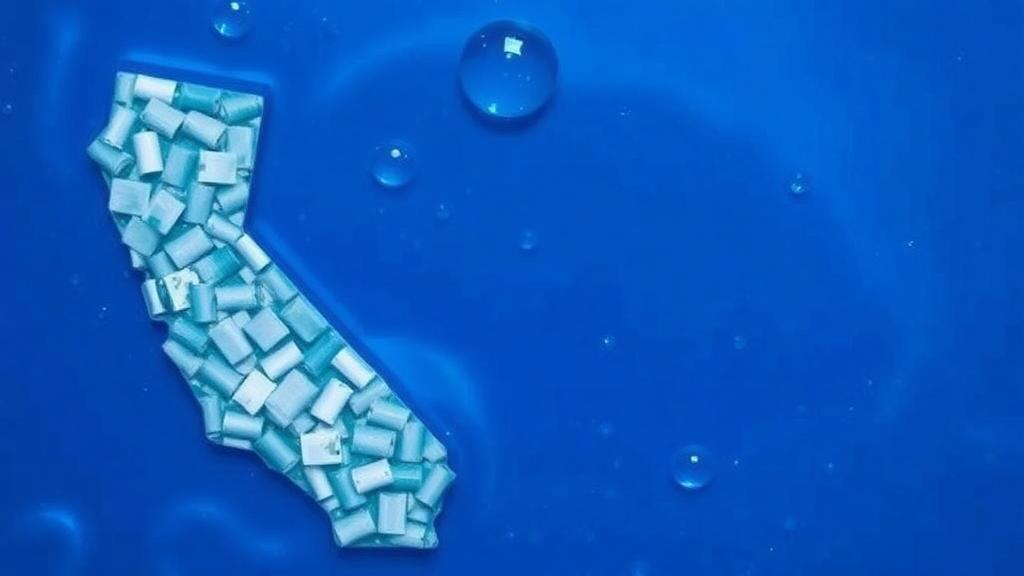
While international negotiators remain deadlocked over a binding global plastics treaty, California is quietly opening a new legal front in the fight against plastic pollution. On October 1, the state will add microplastics to its Candidate Chemicals List, a procedural milestone that marks the first formal step in a process that could eventually lead to regulation of the tiny synthetic particles now found in water, food, and human tissue. The move, though administrative in appearance, carries significant weight: it is the mechanism by which California’s Department of Toxic Substances Control begins assessing substances that evidence suggests may harm people or the environment, and it creates the legal scaffolding upon which future product-specific rules can be built.
The significance of the listing is explained in a recent paper led by Stanford University researchers and published in Frontiers in Environmental Science, which traces a decade of California’s evolving approach to microplastic regulation and draws lessons for other states and countries. The work, supported by the Stanford Center for Human and Planetary Health, was coauthored by environmental scientist Amelia Meyer, pediatric otolaryngologist Kara Meister, and policy specialist Sarina Patel, alongside Desiree LaBeaud of the Stanford School of Medicine and Chloe Smith of the London School of Economics Sustainability Regulation Observatory. Together, the authors argue that California’s incremental, multi-pronged strategy offers a working model at a moment when global governance of plastics has stalled.
According to Patel, a policy program manager at the Stanford Woods Institute for the Environment and a former California Legislature science fellow, the October 1 change matters because it resolves a long-standing legal ambiguity. While microplastics have been measured in the environment for years, there has been no coherent legal framework for treating them as pollution that must be mitigated. Classing microplastics as a chemical of concern, she explains, opens an important legal door. The listing itself does not restrict any product; it is the procedural prerequisite that allows the state to designate specific products for regulation, a process that still requires public comment and formal review before any rule takes effect.
The technical challenge facing regulators today is far greater than the one California confronted in 2015, when it banned microbeads in wash-off cosmetics such as facial scrubs. That law was relatively straightforward to design and enforce, Meyer notes, because microbeads were intentionally manufactured, had a clear point source, shared a common shape and texture, and were largely non-essential. Particles shed from tire wear and synthetic clothing present a fundamentally different regulatory problem. When microplastics are released continuously from millions of cars and washing machines, interventions cannot be confined to the manufacturing stage; they must reach into how products are used, maintained, and disposed of across the entire economy.
The scientific backdrop to these policy choices is sobering but incomplete. Microplastics have been detected in human blood, organs, and other bodily fluids, and some published studies and ongoing research projects have linked their presence to significantly higher rates of heart attack, stroke, and death. Yet detection is not causation: finding microplastics in the body does not prove they are responsible for that harm. Meyer emphasizes that uncertainty is a reason to continue research and reduce unnecessary exposure at the source, not a reason to wait until every question has been answered. This precautionary posture, she suggests, is precisely what the Candidate Chemicals List mechanism is designed to accommodate, allowing regulatory attention to begin before the full dose-response picture is resolved.
Meister, whose laboratory at the Stanford School of Medicine has documented microplastics in children’s tonsil tissue and is developing new methods to measure the body’s microplastic burden, raises a further concern about what travels with the particles. She describes microplastics as Trojan horses, noting that potentially thousands of other chemicals and polymers may be conjugated to them, including plasticizers such as bisphenol A, whose health effects are well documented. The reach, scope, and impact of these combined exposures, she argues, are only beginning to be understood, adding a layer of toxicological complexity that pure particle-counting studies do not capture.
California’s regulatory arc over the past decade shows a deliberate escalation. Since the 2015 microbead ban, the state has created a statewide microplastics strategy, established drinking-water standards for the particles, and passed SB 54, a law that assigns producers responsibility for the full life cycle of their products rather than just their creation. The legislation includes plans for a five-billion-dollar mitigation fund financed by manufacturer fees, which Meister describes as a public-facing, tangible step to raise awareness and mitigate the impacts of plastics in the state. Patel characterizes the cumulative effect as a toolkit: by taking a variety of regulatory approaches, California equips itself to tackle microplastic pollution across the scope of the problem, from production to waste management to environmental cleanup.
The urgency of state-level action is sharpened by the paralysis at the international level. Despite years of effort, United Nations negotiators have failed to agree on a binding plastics treaty, largely because of a deadlock over production caps. In that vacuum, states and other governmental bodies are charting their own course. Patel acknowledges the political headwinds, noting that strident voices supporting the plastics industry push back against regulation in the name of affordability. Her counterargument is economic as much as environmental: systemic change does cost money, but the damage plastic has done to the environment, to wildlife, and potentially to human health also carries a cost, and at present there is no accountability for those costs.
Meister warns that resistance is structural, because plastics are rooted in the petroleum industry, and that strong pushback to regulation is inevitable. That reality, she argues, makes a concentrated, cohesive effort willing to accept incremental progress essential. Without it, regulators risk what she calls regrettable substitutions, a hazard illustrated by the history of bisphenol A. After the U.S. Food and Drug Administration and some states restricted BPA, once widely used in food and drink packaging, manufacturers replaced it with alternative chemicals that studies indicate pose similar health dangers. The lesson for microplastic policy is that piecemeal, poorly coordinated rules can simply shift harm from one substance to another rather than reduce it.
For jurisdictions watching from afar, the Stanford authors contend that California’s experiment demonstrates what stronger regulation can look like in practice. The state is testing policies, generating evidence, and building the administrative machinery needed to govern a pollutant that is diffuse, persistent, and chemically entangled with the modern economy. As global treaty talks resume against a backdrop of scientific uncertainty and industrial resistance, the California model suggests that meaningful progress does not require waiting for perfect data or perfect international consensus. It requires, instead, a sequence of deliberate legal footholds, each one converting scientific observation into enforceable obligation, one listing at a time.
Subject of Research: California's regulatory approach to microplastic pollution and its implications for plastic policy
Article Title: Microplastics and the law explained: What California's new rule means for plastic policy
Article References: Microplastics and the law explained: What California's new rule means for plastic policy. (n.d.). Original publication
Image Credits: AI Generated
DOI: Not provided
Keywords: microplastics, California, plastic pollution, Candidate Chemicals List, SB 54, regulation, Stanford University, plastics treaty, human health, environmental policy, toxicology, Frontiers in Environmental Science
Cite Scienmag News
Courtney Benton. (October 3, 2026). California Puts Microplastics on Its Regulatory Radar as Global Treaty Talks Stall. Scienmag. https://scienmag.com/california-puts-microplastics-on-its-regulatory-radar-as-global-treaty-talks-stall/
Courtney Benton. "California Puts Microplastics on Its Regulatory Radar as Global Treaty Talks Stall." Scienmag, 3 October 2026, https://scienmag.com/california-puts-microplastics-on-its-regulatory-radar-as-global-treaty-talks-stall/. Accessed 5 October 2026.
Courtney Benton. "California Puts Microplastics on Its Regulatory Radar as Global Treaty Talks Stall." Scienmag. October 3, 2026. https://scienmag.com/california-puts-microplastics-on-its-regulatory-radar-as-global-treaty-talks-stall/


