


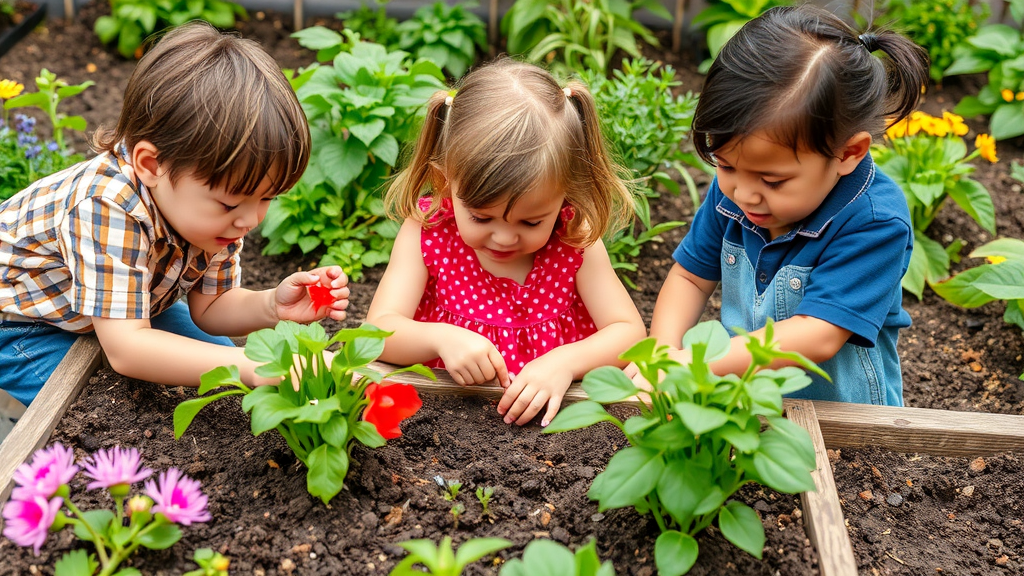
Scientific curiosity is one of those qualities that educators celebrate constantly and define almost never. Everyone agrees that young children are natural scientists, endlessly poking, prodding, and asking why, yet the moment researchers try to pin down what curiosity actually looks like in a real classroom, the concept dissolves into vagueness. A new study published in the Early Childhood Education Journal takes on that challenge directly, and its setting could not be more charming: a vegetable and flower garden tended by five- and six-year-old children in an Arabic-speaking public kindergarten in Israel. What the researchers found there suggests that curiosity is not some ineffable spark but an observable, describable behavior that can be deliberately cultivated through the right kind of learning environment.
The study, conducted by Naji Kortam and Soheer Nabil-Hanna of the Biology Education Department at the Academic Arab College for Education in Haifa, was designed as a single-site interpretive qualitative case study. The researchers worked with a kindergarten class of 35 children, from whom 20 focal participants were selected for closer observation. Over the course of a researcher-facilitated, inquiry-oriented learning-garden unit, the team gathered data through semi-structured group interviews and through both participant and non-participant observations conducted before, during, and after the unit. This triangulated approach allowed them to track not just what children said about plants, but how their talk and actions changed as the garden unit unfolded.
The analytical engine of the study was inductive, interpretive qualitative content analysis, focused on three interlocking dimensions: plant-related sensemaking, inquiry practices, and curiosity episodes. Rather than testing a predefined hypothesis, the researchers let patterns emerge from the data, coding children’s explanations, questions, predictions, and moments of wonder as they appeared in transcripts and field notes. This methodological choice matters, because curiosity research in early childhood has long suffered from a definitional problem. As earlier work by Jirout and Klahr famously noted, children’s scientific curiosity has been an elusive concept in search of an operational definition. By watching curiosity happen in real time, in a real garden, Kortam and Nabil-Hanna offer one of the most concrete answers yet.
The findings are striking in their specificity. As the garden unit progressed, the children’s explanations of how plants live and grow became measurably more sophisticated. Early in the unit, explanations tended to be generic and vague. By the end, children were grounding their accounts in specific growth conditions: soil, air, heat, and season. A child who might once have said simply that plants need water could now articulate that a seedling in shaded soil grows differently from one in full sun, or that seasonal temperature changes affect what the garden can produce. This shift from generic to evidence-referenced reasoning is exactly the kind of conceptual development that early science educators hope to see, and it emerged not from formal instruction but from sustained, hands-on engagement with living things.
Equally important, the study documented how genuine inquiry practices became visible in children’s everyday talk and action. The researchers identified four signature behaviors: making predictions about what would happen in the garden, asking child-initiated why and how questions, comparing outcomes across different conditions, and taking simple measurements. These are not trivial accomplishments for five-year-olds. Prediction requires holding a mental model and committing to its consequences. Comparison requires recognizing that conditions can be varied deliberately. Measurement, even in its simplest forms, introduces the idea that claims about the world can be quantified. The garden, in other words, functioned as an authentic laboratory where the core epistemic practices of science arose naturally from the task of keeping plants alive.
Curiosity itself, the study’s central construct, showed up in three observable forms. Children displayed overt wonder, moments of visible surprise and delight at what the garden revealed. They sustained their engagement with uncertainty, returning repeatedly to questions they could not immediately answer rather than abandoning them. And they connected their garden experiences to prior experiences and to information resources, drawing on family gardening, books, and conversations to make sense of what they observed. This tripartite picture gives researchers and teachers something they have lacked: a practical rubric for recognizing curiosity when it happens, rather than merely assuming it exists because children seem engaged.
The study’s design principles may prove to be its most immediately useful contribution. Kortam and Nabil-Hanna distilled their findings into three design principles for inquiry-oriented kindergarten science. First, planned contrasts across conditions: children should encounter plants growing in deliberately different circumstances, such as sun versus shade or watered versus dry soil, because contrast makes causal variables perceptible. Second, repeated revisits over time: because plants change slowly, children need multiple encounters with the same garden across days and weeks, allowing their predictions to be tested against unfolding evidence. Third, open-ended questioning supported by simple tools: adults should ask questions that invite exploration rather than recall, and children should have access to simple instruments such as rulers and magnifiers that extend their senses. None of these principles requires expensive equipment or specialist training, which makes them genuinely scalable.
The theoretical stakes of the work extend beyond the kindergarten fence. Curiosity has become a hot topic in cognitive science, with recent reviews in outlets such as Nature Reviews Psychology cataloguing how curiosity drives learning across ages and contexts. But most of that literature studies curiosity in controlled settings, far from the messy environments where children actually live. This study flips the perspective, asking not how curiosity can be measured in the lab but how it is enacted in the wild of everyday classroom activity. The answer, it turns out, is that curiosity is deeply social and deeply situated. It depends on talk with peers and adults, on materials that invite manipulation, and on questions that remain genuinely open rather than leading to predetermined answers.
The choice of a learning garden as the research site is also significant within a growing international movement. Garden-based learning has attracted increasing research attention, with studies examining everything from teacher roles in kindergarten foraging activities to the connections between risky nature play and science learning in Australian bush kinders. What this new study adds is a fine-grained account of the cognitive and epistemic work happening beneath the surface of garden activity. Where earlier research often emphasized affective and social benefits, such as connection to nature and well-being, Kortam and Nabil-Hanna demonstrate that a garden can be a site of rigorous scientific sensemaking, provided it is organized as structured small-group inquiry rather than free play alone.
For educators and policymakers, the message is both encouraging and demanding. Encouraging, because the study shows that the foundations of scientific literacy, evidence-based explanation, prediction, comparison, and measurement, can be built in ordinary kindergartens with nothing more exotic than seeds, soil, and thoughtful adult questioning. Demanding, because those outcomes did not appear spontaneously. They required deliberate design: contrasts planned into the garden layout, schedules that allowed revisiting, and facilitators skilled at keeping questions open. Curiosity, the study suggests, is not a fixed trait that some children bring to school and others lack. It is a practice that environments either nourish or starve. In a sunlit patch of ground in an Israeli kindergarten, twenty children showed what nourished curiosity looks like: wonder in their eyes, evidence in their explanations, and questions that kept pulling them back to the garden day after day.
Subject of Research: How five- to six-year-old children enact scientific curiosity, inquiry, and plant-related sensemaking in a kindergarten learning garden.
Article Title: Enacting Scientific Curiosity in a Kindergarten Learning Garden: Children’s Inquiry, Talk, and Plant Sensemaking
Article References: Kortam, N., & Nabil-Hanna, S. (2026). Enacting Scientific Curiosity in a Kindergarten Learning Garden: Children’s Inquiry, Talk, and Plant Sensemaking. Early Childhood Education Journal. https://doi.org/10.1007/s10643-026-02348-9
Image Credits: AI Generated
DOI: 10.1007/s10643-026-02348-9
Keywords: scientific curiosity, kindergarten science, learning garden, early childhood education, inquiry-based learning, plant sensemaking, garden-based learning, science education, qualitative case study, children's inquiry, preschool learning, wonder and exploration
Cite Scienmag News
Courtney Benton. (September 12, 2026). Kindergarten Garden Study Reveals How Five-Year-Olds Do Real Science. Scienmag. https://scienmag.com/kindergarten-garden-study-reveals-how-five-year-olds-do-real-science/
Courtney Benton. "Kindergarten Garden Study Reveals How Five-Year-Olds Do Real Science." Scienmag, 12 September 2026, https://scienmag.com/kindergarten-garden-study-reveals-how-five-year-olds-do-real-science/. Accessed 16 October 2026.
Courtney Benton. "Kindergarten Garden Study Reveals How Five-Year-Olds Do Real Science." Scienmag. September 12, 2026. https://scienmag.com/kindergarten-garden-study-reveals-how-five-year-olds-do-real-science/


