


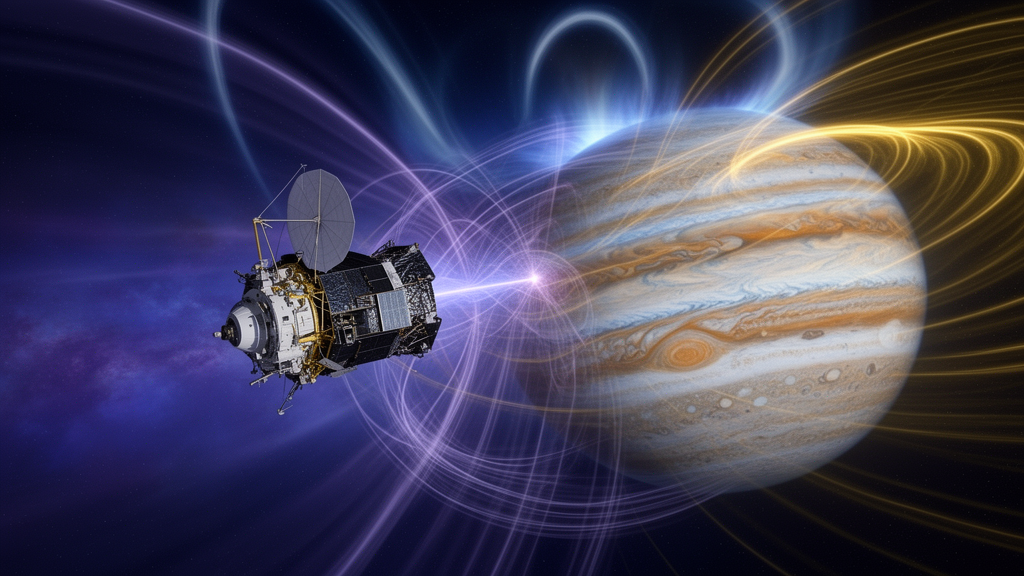
Jupiter’s bow shock uses a more complex system to slow and deflect the solar wind than Earth’s, according to the most detailed observations yet reported of the boundary around the gas giant. A University of Iowa-led team analyzed measurements collected by NASA’s Juno spacecraft in December 2024 and found that Jupiter’s shock involves stronger plasma waves with multiple frequencies, as well as smaller regions called shocklets that process the incoming flow before it reaches the main bow shock. Together, these features offer a nearby laboratory for examining how energetic plasma flows lose energy and how that energy is converted into heat and energetic particles.
The bow shock is an invisible boundary between the Sun and a planet’s magnetic field. It is where the supersonic flow of energetic particles known as the solar wind meets the planetary magnetic environment. The solar wind is slowed, heated and redirected around the planet at this boundary. On Earth, the shock is the main barrier preventing the solar wind from reaching the atmosphere. Because Jupiter’s bow shock has a different structure from Earth’s, it provides an opportunity to study shock physics in a more complex planetary setting without requiring scientists to observe an extremely distant astronomical object directly.
The new observational study found that Jupiter’s response is not dominated by a single plasma-wave frequency. Instead, the waves exhibit richer harmonic structures, meaning that several frequencies occur within them. The researchers compared this arrangement to playing multiple chords during one sweep of a guitar: adding frequencies gives the waves more ways to interact with the moving particles. According to the study, the multi-frequency structure at Jupiter can heat more particles in the solar wind and slow them before they encounter the planet’s main bow shock. By contrast, plasma waves at Earth’s bow shock use mostly one frequency, which the research team described as sufficient to handle the solar wind there.
Juno also detected a series of shocklets before the solar wind reached Jupiter’s primary bow shock. These localized regions engage with the incoming plasma and slow the flow before the main boundary. The arrangement means that Jupiter does not rely solely on one abrupt interaction between the solar wind and the planet’s magnetic environment. Instead, the shocklets provide an additional stage of processing, followed by the stronger and harmonically richer wave activity associated with the main shock. The study therefore presents Jupiter’s defense as a layered system rather than a single, isolated barrier.
Bill Kurth, a research scientist in the University of Iowa Department of Physics and Astronomy, study co-author and member of the Juno mission team since the spacecraft launched in 2011, said the extra structures reflect the conditions at Jupiter. “Earth does not need to take these extra steps to handle the solar wind because the impact isn’t as powerful,” Kurth said. The comparison identifies a clear difference in how the two bow shocks operate: Earth’s shock is principally the main barrier, while Jupiter’s shock includes intervening shocklets and more complex plasma-wave activity. The observations show how those processes appear during the sampled passage of Juno through the Jovian environment.
Jayasri Joseph, a postdoctoral researcher in the Iowa department and the study’s corresponding author, said Jupiter has developed a distinct way of dealing with the solar wind. “Jupiter has found its own way to deal with the solar wind, through plasma waves that are stronger and exhibit richer harmonic structures,” Joseph said. “That’s important because if you have multiple frequencies, you can heat more particles in the solar wind and slow them down.” The measured wave structure, together with the shocklets observed upstream of the main boundary, provides the physical basis for that difference from Earth.
The findings came from data gathered by Juno in December 2024, while the spacecraft was orbiting Jupiter, a mission it has conducted since July 2016. Iowa physicists designed and built the Juno Waves instrument, which was key to collecting the measurements used in the analysis. Before Juno, previous spacecraft had detected the presence of Jupiter’s bow shock but had not adequately measured the complexity of plasma waves there. The new work is an observational study of the Jovian bow shock based on the conditions sampled by Juno. It does not directly observe the formation or internal evolution of an individual shocklet, nor does it test the behavior of bow shocks around other planets or stars.
The researchers said Jupiter’s bow shock could help explain how stars and other distant astronomical bodies process the enormous energy released by supernova remnants, which the news release described as the cataclysmic final stages of dying stars. Joseph explained that even more powerful shocks occur around astrophysical objects such as supernova remnants, while Jupiter’s bow shock provides a nearby natural laboratory for understanding how nature converts large amounts of flow energy into heat and energetic particles. That connection is a potential use of the findings for future research into shock physics, not a direct measurement of a supernova remnant or a demonstration that Jupiter reproduces every condition present around such an object.
The peer-reviewed study, “Plasma wave observations from Juno spacecraft at the Jovian bow shock,” was published online on July 31, 2026, in Nature Communications. The University of Iowa-led team included researchers from NASA’s Goddard Space Flight Center, the Space Research Corporation, the Southwest Research Institute, the University of Texas at San Antonio, the University of Colorado Boulder, the University of Minnesota and the Johns Hopkins University Applied Physics Laboratory. NASA funded the research, and the authors reported no conflicts of interest. The central result is an observational picture of Jupiter’s bow shock as a multi-part system: smaller shocklets first engage with the solar wind, and stronger plasma waves with richer harmonic structures then help heat and slow more of the incoming particles around the planet’s main magnetic boundary.
Subject of Research: Juno observations of plasma waves and shocklets at Jupiter’s bow shock
Article Title: Jupiter uses surprisingly complex system to fend off particles from sun
Article References: Jupiter uses surprisingly complex system to fend off particles from sun. Original publication (Bibliographic details unavailable.)
Image Credits: AI Generated
DOI: Not provided
Keywords: Jupiter, Juno mission, bow shock, solar wind, plasma waves, shocklets, planetary magnetospheres, supernova remnants, shock physics, uses, surprisingly, complex
Cite Scienmag News
Bethany Barker. (October 26, 2026). Juno reveals Jupiter’s layered plasma-wave defense against solar wind. Scienmag. https://scienmag.com/juno-reveals-jupiters-layered-plasma-wave-defense-against-solar-wind/
Bethany Barker. "Juno reveals Jupiter’s layered plasma-wave defense against solar wind." Scienmag, 26 October 2026, https://scienmag.com/juno-reveals-jupiters-layered-plasma-wave-defense-against-solar-wind/. Accessed 26 October 2026.
Bethany Barker. "Juno reveals Jupiter’s layered plasma-wave defense against solar wind." Scienmag. October 26, 2026. https://scienmag.com/juno-reveals-jupiters-layered-plasma-wave-defense-against-solar-wind/


