

Monday, October 26, 2026
Science
No Result
View All Result
  • Login
  • HOME
  • SCIENCE NEWS
  • CONTACT US
  • HOME
  • SCIENCE NEWS
  • CONTACT US
No Result
View All Result
Scienmag
No Result
View All Result
Home Science News Chemistry

Electric field shifts the bottleneck in oxide-interface superconductivity

October 26, 2026
in Chemistry
Bethany Barker
By Bethany Barker Scienmag Editorial Profile - Catalysis
Reading Time: 2 mins read
0
Electric field shifts the bottleneck in oxide-interface superconductivity

Electric field shifts the bottleneck in oxide-interface superconductivity

65
SHARES
587
VIEWS
Share on FacebookShare on Twitter
ADVERTISEMENT

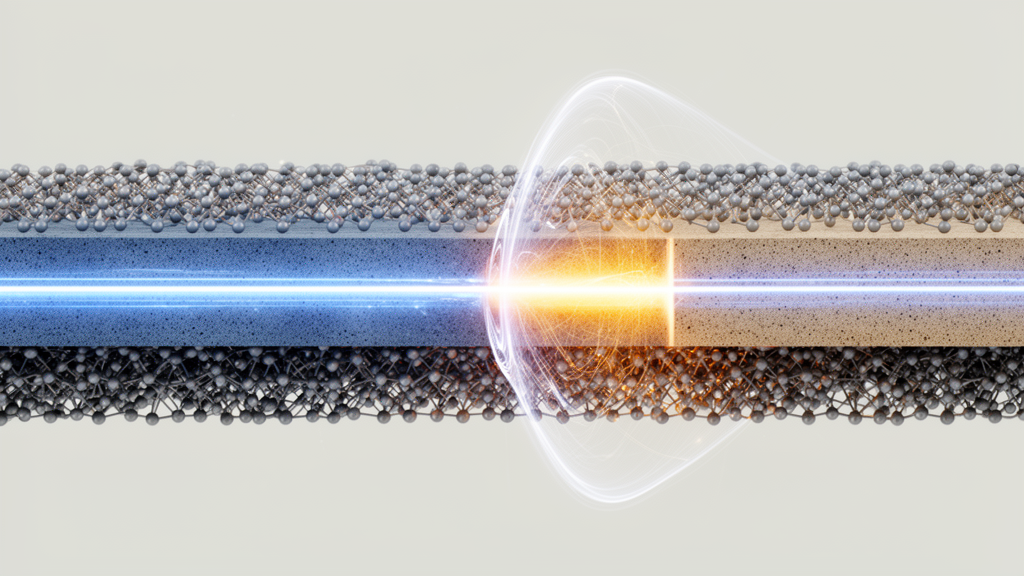
An electric field can change which process limits superconductivity at a layered oxide interface, according to an experimental study in Science Bulletin. Researchers found that when the superconducting state was weak, the transition temperature tracked the material’s superfluid stiffness, indicating that collective phase coherence was the main constraint. At higher stiffness, the transition temperature became largely independent of that measure, suggesting that electron-pair formation had become the principal limitation. The result points to a possible way for gate voltage to tune superconductivity within an exceptionally thin electronic layer.

The investigation focused on the interface between lanthanum aluminate, LaAlO3, and potassium tantalate, KTaO3, with the interface oriented along the (111) plane. Superconductivity in this LaAlO3/KTaO3(111) structure is confined to a layer approximately four nanometers thick. Such a two-dimensional system has relatively few charge carriers and limited thickness through which superconducting regions can interact. Electron pairing is therefore necessary but insufficient: the paired carriers must also establish a shared quantum phase, allowing the entire superconducting region to behave coherently rather than as a collection of unrelated patches.

To measure this collective behavior, the team developed a highly sensitive two-coil mutual-inductance apparatus designed for ultralow temperatures. One coil produced an alternating magnetic field, and the second detected changes in how effectively the sample screened that field. The weak magnetic signature of the ultrathin interface made conventional measurements difficult. By varying the gate voltage from minus 900 to plus 900 volts, the researchers compared the temperature at which a diamagnetic response became detectable with the superfluid stiffness, a measure of how robustly the system maintains phase coordination. In the low-stiffness regime, that transition temperature increased almost linearly with stiffness, consistent with Bose–Einstein-condensate-like behavior in which the onset of phase coherence sets the limit. In the higher-stiffness regime, the transition temperature was nearly independent of stiffness, consistent with Bardeen–Cooper–Schrieffer-like behavior in which pair formation dominates.

The magnetic response supplied additional evidence for a granular superconducting landscape. Under small static magnetic fields, the researchers detected a paramagnetic Meissner effect close to the transition, meaning that the response enhanced rather than screened part of the measured magnetic flux. The sample also showed saturated diamagnetic screening under weak alternating fields. Together, these observations support a model in which superconducting “islands” are linked by weak Josephson coupling, although the term refers here to spatial variation in the electronic state rather than necessarily to structural grains. In this interpretation, the applied electric field strengthens the connections among the islands. Once those links are sufficiently robust, maintaining a common phase is no longer the main obstacle, and the process of forming electron pairs becomes the limiting factor. The observations motivate measurements at related oxide interfaces and spatially resolved studies of the superconducting gap and stiffness, which the researchers say could test the proposed island-network picture.

Subject of Research: Gate-controlled superconductivity at LaAlO3/KTaO3(111) interfaces

Article Title: What is the secret ingredient for interface superconductivity?

Article References: What is the secret ingredient for interface superconductivity?. Original publication (Bibliographic details unavailable.)

Image Credits: AI Generated

DOI: Not provided

Keywords: interface superconductivity, LaAlO3/KTaO3, superfluid stiffness, electron pairing, phase coherence, Josephson coupling, gate voltage, mutual inductance, oxide heterostructures, secret, ingredient, interface

Cite Scienmag News

Bethany Barker. (October 26, 2026). Electric field shifts the bottleneck in oxide-interface superconductivity. Scienmag. https://scienmag.com/electric-field-shifts-the-bottleneck-in-oxide-interface-superconductivity/

Bethany Barker. "Electric field shifts the bottleneck in oxide-interface superconductivity." Scienmag, 26 October 2026, https://scienmag.com/electric-field-shifts-the-bottleneck-in-oxide-interface-superconductivity/. Accessed 26 October 2026.

Bethany Barker. "Electric field shifts the bottleneck in oxide-interface superconductivity." Scienmag. October 26, 2026. https://scienmag.com/electric-field-shifts-the-bottleneck-in-oxide-interface-superconductivity/


Tags: charge carrier interactions in thin superconducting layerselectric field tuning of superconductivityelectron pairingelectron-pair formation constraintsgate voltagegate voltage control of superconductivityinfluence of electric fields on superconducting bottlenecksingredientInterfaceinterface superconductivityJosephson couplingLaAlO3/KTaO3LaAlO3/KTaO3 (111) interfacelayered oxide heterostructuresmutual inductanceoxide heterostructuresoxide interface superconductivityphase coherencequantum phase coherence in superconductorsSecretsuperfluid stiffnesssuperfluid stiffness and transition temperaturetwo-dimensional superconducting systemsultralow temperature measurement techniques
Share26Tweet16
Previous Post

Scoping review finds no integrated anxiety–stimulant pathway in undergraduates

Next Post

Three psychological flexibility profiles linked to medical student well-being

Related Posts

Review finds ZIF-67 supports synergistic flame-retardant polymer strategies
Chemistry

Review finds ZIF-67 supports synergistic flame-retardant polymer strategies

October 26, 2026
Juno reveals Jupiter’s layered plasma-wave defense against solar wind
Chemistry

Juno reveals Jupiter’s layered plasma-wave defense against solar wind

October 26, 2026
Ultrasound produces faster-dissolving simvastatin particles in laboratory study
Chemistry

Ultrasound produces faster-dissolving simvastatin particles in laboratory study

October 26, 2026
Spaceborne laser reveals how monsoon storms and winds shape cirrus clouds over the Arabian Sea
Athmospheric

Spaceborne laser reveals how monsoon storms and winds shape cirrus clouds over the Arabian Sea

October 26, 2026
Two Isocyanurate Resins, One Lesson: Strongest Binding Is Not Best Column Performance
Chemistry

Two Isocyanurate Resins, One Lesson: Strongest Binding Is Not Best Column Performance

October 26, 2026
Chromium Additive Boosts Sensitivity of 1,1-ADEQUATE NMR Fourfold
Chemistry

Chromium Additive Boosts Sensitivity of 1,1-ADEQUATE NMR Fourfold

October 26, 2026
Next Post
Three psychological flexibility profiles linked to medical student well-being

Three psychological flexibility profiles linked to medical student well-being

  • Mothers who receive childcare support from maternal grandparents show more optimized

    Mothers who receive childcare support from maternal grandparents show more parental warmth, finds NTU Singapore study

    27656 shares
    Share 11059 Tweet 6912
  • University of Seville Breaks 120-Year-Old Mystery, Revises a Key Einstein Concept

    1061 shares
    Share 424 Tweet 265
  • Bee body mass, pathogens and local climate influence heat tolerance

    682 shares
    Share 273 Tweet 171
  • Researchers record first-ever images and data of a shark experiencing a boat strike

    546 shares
    Share 218 Tweet 137
  • Groundbreaking Clinical Trial Reveals Lubiprostone Enhances Kidney Function

    531 shares
    Share 212 Tweet 133
Science

Embark on a thrilling journey of discovery with Scienmag.com—your ultimate source for cutting-edge breakthroughs. Immerse yourself in a world where curiosity knows no limits and tomorrow’s possibilities become today’s reality!

RECENT NEWS

  • Profilin coordinates actin network assembly during cell-edge protrusion
  • MCGE-Net joins image, text and labels to enhance imaging
  • Student-Led Clinic Shows Functional Gains in Disadvantaged Community
  • Review maps polystyrene nanoplastic reproductive risks in experimental models

Categories

  • Agriculture
  • Anthropology
  • Archaeology
  • Athmospheric
  • Biology
  • Biotechnology
  • Blog
  • Bussines
  • Cancer
  • Chemistry
  • Climate
  • Earth Science
  • Editorial Policy
  • Marine
  • Mathematics
  • Medicine
  • Pediatry
  • Policy
  • Psychology & Psychiatry
  • Science Education
  • Science News
  • Social Science
  • Space
  • Technology and Engineering

Subscribe to Blog via Email

Enter your email address to subscribe to this blog and receive notifications of new posts by email.

Join 5,151 other subscribers

© 2025 Scienmag - Science Magazine

Welcome Back!

Login to your account below

Forgotten Password?

Retrieve your password

Please enter your username or email address to reset your password.

Log In
No Result
View All Result
  • HOME
  • SCIENCE NEWS
  • CONTACT US

© 2025 Scienmag - Science Magazine

Discover more from Science

Subscribe now to keep reading and get access to the full archive.

Continue reading