


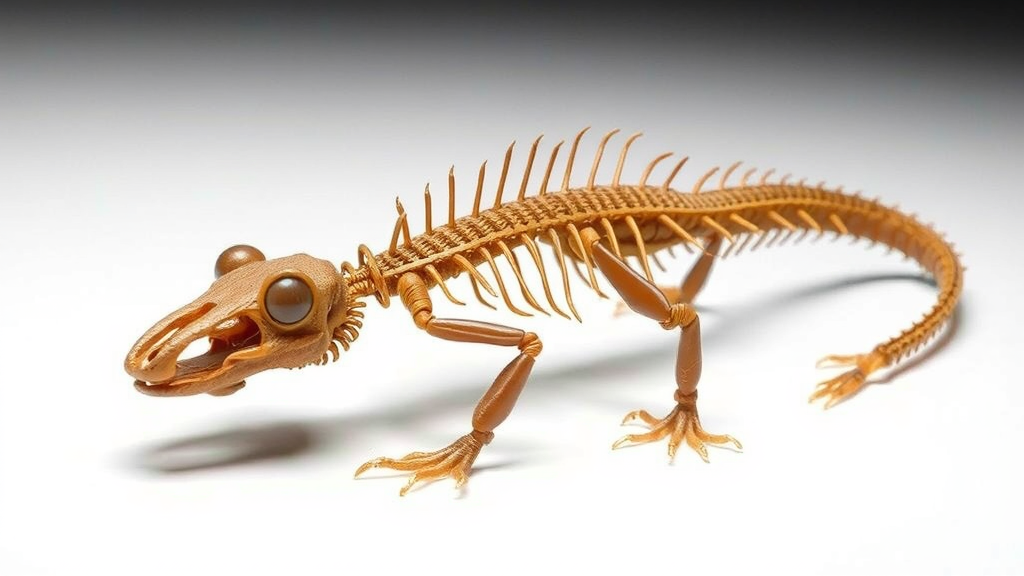
More than 300 million years before the first dinosaurs walked the Earth, the land that would one day become the Chicago region was a very different world. During the late Carboniferous period, roughly 309 million years ago, the area was a vast, humid river delta, a labyrinth of distributary channels, muddy floodplains, and shallow swamps teeming with early land-dwelling vertebrates, gigantic insects, and strange swimming creatures unlike anything alive today. That ancient ecosystem, so productive in life and so efficient at burying its dead in fine sediment, would go on to become one of the richest fossil deposits of the entire Carboniferous. Now, that deposit has yielded a new scientific name: Jeanerpeton mazonensis, a squat, chubby proto-amphibian described by two student scientists at the Field Museum and named, in a gesture that has charmed paleontologists and the public alike, in honor of their mothers, both of whom are named Jean.
The new species, whose name translates to Jean’s crawler from Mazon Creek, is described in the Journal of Vertebrate Paleontology. Jeanerpeton mazonensis belongs to a group of early tetrapods that sit close to the ancestry of modern amphibians. To picture the animal, imagine a salamander in general body plan, but compressed and rotund, more like a frog in proportions. It was a small predator of the coal swamps, part of the sprawling evolutionary experiment in terrestrial and semi-aquatic life that followed the first vertebrates onto land. Its formal description, authored by co-lead scientists Payton Kohlberg and Allison Sefcovic along with postdoctoral researcher Cam So, formally establishes the animal as anatomically distinct from the species to which it had long been assigned.
The exceptional quality of the specimen owes everything to the geology of Mazon Creek. During the Carboniferous, the delta environment buried dead animals and plants rapidly under layers of fine sediment, a perfect recipe for fossilization. Rapid burial in anoxic conditions limited scavenging and decay, allowing delicate structures to survive the hundreds of millions of years between death and discovery. Today, Mazon Creek is recognized as one of the world’s premier fossil sites, a Konservat-Lagerstätte of the kind that preserves records of soft tissues and fine anatomical details normally lost to the fossil record. Where most fossil sites yield bones and shells alone, Mazon Creek can preserve body outlines, skin surfaces, and internal soft anatomy, giving scientists an unusually complete window into a 300-million-year-old ecosystem.
That preservation is precisely what makes the new species so scientifically valuable. What’s really cool about Mazon Creek is that it preserves all of these unusual details, things like toe pads and body outlines, says Allison Sefcovic, co-lead author of the paper and a 2025 Women in Science intern at the Field Museum. In the fossil of Jeanerpeton, researchers can see some of the scales on its back and tiny belly ribs called gastralia. Even the impressions of the eyes are visible. These features, preserved in remarkable fidelity, point to a deep origin for classic traits seen in today’s frogs and salamanders, anchoring the anatomy of modern amphibian lineages to a specific moment in the late Carboniferous.
The story of the fossil itself is a familiar one in paleontology. The specimen was found many years ago by an amateur collector and donated to the Field Museum, where at a glance it was classified as Amphibamus grandiceps, a species with a well-established presence in the region. For decades, the fossil sat in the collection under that label, its true distinctiveness masked by an old taxonomic habit. In paleontology, poorly understood specimens are sometimes lumped together into what scientists call a waste bin taxon, a metaphorical dumping ground for fossils that seem related but have not been carefully studied. Such taxa are convenient shorthand, but they can hide genuine diversity, quietly absorbing distinct species into a single catch-all name until someone takes a closer look.
That closer look is exactly what the new study provides. What we’re finding from the Field Museum’s collection are a bunch of things that historically were grouped together into this waste bin taxon known as Amphibamus grandiceps, says Cam So, co-author on the study and a postdoctoral researcher at the Field Museum. Jeanerpeton is one of those species. And now, we’ve found enough evidence to support it being an anatomically distinct animal. With this publication, we officially pull Jeanerpeton out of this waste bin taxon. The formal designation of a new genus and species is more than a naming exercise; it is a correction to the fossil record’s accounting, restoring a lineage that had been hiding in plain sight within museum drawers.
The research also carries a human story that has resonated widely. The study’s co-lead authors, Payton Kohlberg and Allison Sefcovic, were part of last year’s cohort of Women in Science Interns at the Field Museum, a program that champions young women pursuing careers in science and museums. Both worked under the mentorship of Arjan Mann, the Field’s assistant curator of fossil fishes and early tetrapods in the Negaunee Integrative Research Center, alongside So, who is also part of the Mann lab group. That a new species was described, named, and published by student scientists early in their careers is a testament to the model of hands-on research training, in which interns take genuine ownership of scientific questions rather than serving only as assistants.
For Kohlberg, the project was transformative as much as it was scientific. Before working in the Mann Lab, I didn’t know much about paleontology, she says. My experience at the Field and in the Women in Science program has made me more confident in my abilities to try something new. It is scary to take on a project when you feel like you don’t know as much as you should, but I learned with my practical experience that it is possible to overcome that fear with hard work. The choice of the name Jeanerpeton, honoring two mothers named Jean, reflects the personal significance of that journey, and it gives the ancient animal a warm and memorable identity in the scientific literature.
Scientifically, the description of Jeanerpeton mazonensis opens a door for researchers as they continue to chronicle the biodiversity that once lived at Mazon Creek. Amphibamiforms, the group to which the new species belongs, are central to debates about the origins of modern amphibians, the lissamphibians comprising frogs, salamanders, and caecilians. Every anatomically distinct species added to the group refines the character data that phylogenetic analyses use to reconstruct those relationships. The exceptionally preserved features of Jeanerpeton, from its dorsal scales to its gastralia to its eye impressions, supply exactly the kind of fine-grained anatomical evidence that such analyses require, and its removal from the Amphibamus grandiceps waste bin taxon cleans up a source of noise in previous comparisons.
Each new species described from Mazon Creek adds another piece to a detailed mosaic of what life looked like in Illinois more than 300 million years ago, a time when the foundations of modern terrestrial ecosystems were being laid. The Carboniferous world of Jeanerpeton was one of rising forests, oxygen-rich air, and evolutionary experimentation among the first four-limbed vertebrates to make a living on land and in fresh water. That a pair of student interns could pull a new animal out of a century-old museum collection and give it a name rooted in family gratitude is a reminder that paleontology’s greatest discoveries are often not made in remote badlands, but in the careful re-examination of fossils already in our care, waiting for the right eyes.
Subject of Research: A new exceptionally preserved Carboniferous proto-amphibian species from Mazon Creek and its taxonomic reclassification
Article Title: Mother of amphibians: New species of proto-amphibian described by two student scientists, named in honor of their moms
Article References: Mother of amphibians: New species of proto-amphibian described by two student scientists, named in honor of their moms. (n.d.). Original publication
Image Credits: AI Generated
DOI: Not provided
Keywords: Jeanerpeton mazonensis, Mazon Creek, Carboniferous, paleontology, amphibians, Field Museum, tetrapods, fossil preservation, waste bin taxon, Women in Science, Amphibamus grandiceps, early tetrapod evolution
Cite Scienmag News
Violet Maxwell. (September 25, 2026). Jean’s crawler: Student scientists name new 309-million-year-old proto-amphibian after their moms. Scienmag. https://scienmag.com/jeans-crawler-student-scientists-name-new-309-million-year-old-proto-amphibian-after-their-moms/
Violet Maxwell. "Jean’s crawler: Student scientists name new 309-million-year-old proto-amphibian after their moms." Scienmag, 25 September 2026, https://scienmag.com/jeans-crawler-student-scientists-name-new-309-million-year-old-proto-amphibian-after-their-moms/. Accessed 4 October 2026.
Violet Maxwell. "Jean’s crawler: Student scientists name new 309-million-year-old proto-amphibian after their moms." Scienmag. September 25, 2026. https://scienmag.com/jeans-crawler-student-scientists-name-new-309-million-year-old-proto-amphibian-after-their-moms/


