

Tuesday, September 1, 2026
Science
No Result
View All Result
  • Login
  • HOME
  • SCIENCE NEWS
  • CONTACT US
  • HOME
  • SCIENCE NEWS
  • CONTACT US
No Result
View All Result
Scienmag
No Result
View All Result
Home Science News Athmospheric

Iso-propagation vortices: optical multiplexing for unprecedented information capacity

May 17, 2024
in Athmospheric
Russell Cooper
By Russell Cooper Scienmag Editorial Profile - Environmental Pollution
Reading Time: 3 mins read
0
Iso-propagation vortices: optical multiplexing for unprecedented information capacity
67
SHARES
608
VIEWS
Share on FacebookShare on Twitter
ADVERTISEMENT

The future of optical communications just got brighter. In a groundbreaking development reported in Advanced Photonics, researchers from Nanjing University have introduced iso-propagation vortices (IPVs), a novel concept that offers a solution to a long-standing challenge faced by scientists and engineers: how to increase information processing capacity while overcoming the limitations of traditional vortex beams.

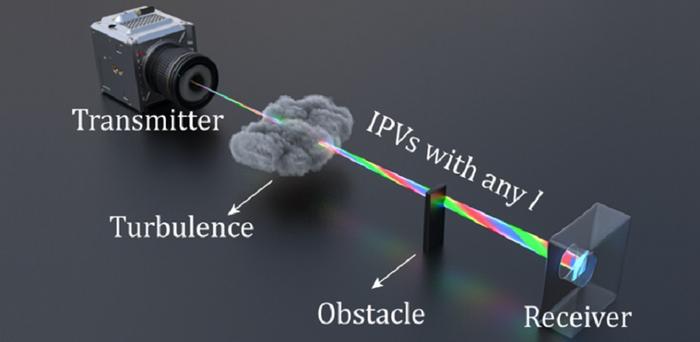
Iso-propagation vortices promise faster optical communication with enhanced resilience.

Credit: Yan et al., doi 10.1117/1.AP.6.3.036002.

The future of optical communications just got brighter. In a groundbreaking development reported in Advanced Photonics, researchers from Nanjing University have introduced iso-propagation vortices (IPVs), a novel concept that offers a solution to a long-standing challenge faced by scientists and engineers: how to increase information processing capacity while overcoming the limitations of traditional vortex beams.

Challenge: divergence and beam size

Multiplexing of optical degrees of freedom, such as polarization and wavelength, has been a staple in enhancing communication capacity. However, spatial mode-division multiplexing, which uses orthogonal spatial modes like orbital angular momentum (OAM) modes (also known as vortex beams), faces a significant hurdle. As these vortex beams propagate through free space, their beam size invariably diverges with OAM, posing constraints on capacity due to the need for larger receivers.

Enter IPVs

IPVs represent a paradigm shift. Unlike conventional vortex beams, IPVs exhibit OAM-independent propagation. In other words, their beam size remains consistent during free-space propagation, regardless of the OAM mode. This breakthrough opens exciting possibilities for spatial mode multiplexing communication, fiber optic data transmission, and even particle manipulation.

Key advantages of IPVs:

  • OAM-independent propagation: IPVs maintain a constant beam size, irrespective of the OAM mode. This feature allows for efficient utilization of spatial modes without requiring excessively large receivers.
  • Resilience to atmospheric turbulence: IPVs demonstrate enhanced transmission dynamics with reduced quality factors. Even under atmospheric turbulence, they remain robust, making them ideal for real-world applications.
  • Experimental capacity improvements: The research team conducted thorough comparisons between IPV multiplexing and existing optical schemes. The results were astounding, with capacity improvements ranging from 300 percent to an astonishing 808 percent.
     

Applications and future prospects

The impact of IPVs extends beyond communication. Imagine faster data transmission rates, more efficient particle manipulation in scientific experiments, and improved fiber optic networks. As we delve deeper into the potential of IPVs, industries ranging from telecommunications to scientific instrumentation stand to benefit significantly.

Dr. Jianping Ding, corresponding author and senior researcher, expressed optimism: “Iso-propagation vortices represent a leap forward in our quest for greater information capacity. We’re excited to explore their applications and collaborate with industry partners.”

Stay tuned for updates as IPVs revolutionizes optical communication.

For details, see the original Gold Open Access article by W. Yan et al., “Iso-propagation vortices with OAM-independent size and divergence toward future faster optical communications,” Adv. Photon. 6(3) 036002 (2024), doi 10.1117/1.AP.6.3.036002.


Journal

Advanced Photonics

DOI

10.1117/1.AP.6.3.036002

Article Title

Iso-propagation vortices with OAM-independent size and divergence toward future faster optical communications

Article Publication Date

17-May-2024

Subject of Research: Athmospheric

Article Title: Iso-propagation vortices: optical multiplexing for unprecedented information capacity

Article References: Original research article

Image Credits: AI Generated

DOI: Not provided

Keywords: Not provided

Cite Scienmag News

Russell Cooper. (May 17, 2024). Iso-propagation vortices: optical multiplexing for unprecedented information capacity. Scienmag. https://scienmag.com/iso-propagation-vortices-optical-multiplexing-for-unprecedented-information-capacity/

Russell Cooper. "Iso-propagation vortices: optical multiplexing for unprecedented information capacity." Scienmag, 17 May 2024, https://scienmag.com/iso-propagation-vortices-optical-multiplexing-for-unprecedented-information-capacity/. Accessed 1 September 2026.

Russell Cooper. "Iso-propagation vortices: optical multiplexing for unprecedented information capacity." Scienmag. May 17, 2024. https://scienmag.com/iso-propagation-vortices-optical-multiplexing-for-unprecedented-information-capacity/

Share27Tweet17
Previous Post

The price of hope: CAR-T therapy in pediatric leukemia

Next Post

What is “time” for quantum particles?

Related Posts

Extreme temperatures may raise heart failure hospitalization risk
Athmospheric

Extreme temperatures may raise heart failure hospitalization risk

August 29, 2026
Warmer tropical waters briefly slow Antarctic ice melt
Athmospheric

Warmer tropical waters briefly slow Antarctic ice melt

August 29, 2026
New England Team Wins $5.9 Million to Study Snow and Outdoor Economy
Athmospheric

New England Team Wins $5.9 Million to Study Snow and Outdoor Economy

August 28, 2026
El Niño Intensified More in 40 Years Than Any Previous Millennium
Athmospheric

El Niño Intensified More in 40 Years Than Any Previous Millennium

August 28, 2026
Despite growing livestock-climate research, applying science on farms remains challenging
Athmospheric

Despite growing livestock-climate research, applying science on farms remains challenging

August 26, 2026
Rain May Turn Wildfire Smoke Pollution Into Fertilizer
Athmospheric

Rain May Turn Wildfire Smoke Pollution Into Fertilizer

August 25, 2026
Next Post
What is “time” for quantum particles?

What is "time" for quantum particles?

  • Mothers who receive childcare support from maternal grandparents show more optimized

    Mothers who receive childcare support from maternal grandparents show more parental warmth, finds NTU Singapore study

    27656 shares
    Share 11059 Tweet 6912
  • University of Seville Breaks 120-Year-Old Mystery, Revises a Key Einstein Concept

    1061 shares
    Share 424 Tweet 265
  • Bee body mass, pathogens and local climate influence heat tolerance

    682 shares
    Share 273 Tweet 171
  • Researchers record first-ever images and data of a shark experiencing a boat strike

    546 shares
    Share 218 Tweet 137
  • Groundbreaking Clinical Trial Reveals Lubiprostone Enhances Kidney Function

    531 shares
    Share 212 Tweet 133
Science

Embark on a thrilling journey of discovery with Scienmag.com—your ultimate source for cutting-edge breakthroughs. Immerse yourself in a world where curiosity knows no limits and tomorrow’s possibilities become today’s reality!

RECENT NEWS

  • Most Australian women wearing shoes that don’t match their feet, study finds
  • Ant colonies show varied disease susceptibility and grooming across social levels
  • Leptospira bacteria detected in cattle and rodents across Papua New Guinea provinces
  • Do Parents and Teachers Agree on Preschool Dual Language Learners’ Social Skills?

Categories

  • Agriculture
  • Anthropology
  • Archaeology
  • Athmospheric
  • Biology
  • Biotechnology
  • Blog
  • Bussines
  • Cancer
  • Chemistry
  • Climate
  • Earth Science
  • Editorial Policy
  • Marine
  • Mathematics
  • Medicine
  • Pediatry
  • Policy
  • Psychology & Psychiatry
  • Science Education
  • Social Science
  • Space
  • Technology and Engineering

Subscribe to Blog via Email

Success! An email was just sent to confirm your subscription. Please find the email now and click 'Confirm Follow' to start subscribing.

Join 5,150 other subscribers

© 2025 Scienmag - Science Magazine

Welcome Back!

Login to your account below

Forgotten Password?

Retrieve your password

Please enter your username or email address to reset your password.

Log In
No Result
View All Result
  • HOME
  • SCIENCE NEWS
  • CONTACT US

© 2025 Scienmag - Science Magazine