


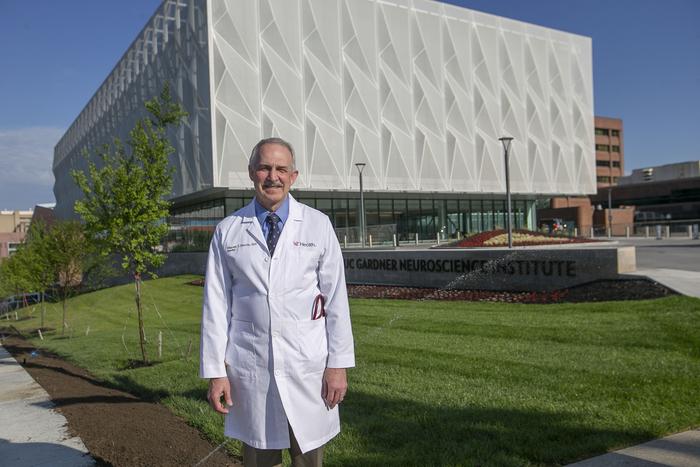
As temperatures rise, so do chances for migraine attacks, according to a new study from a team of researchers at the University of Cincinnati College of Medicine, Icahn School of Medicine at Mount Sinai, Errex Inc. and Teva Pharmaceuticals USA. Inc.

Credit: Photo courtesy of the University of Cincinnati
As temperatures rise, so do chances for migraine attacks, according to a new study from a team of researchers at the University of Cincinnati College of Medicine, Icahn School of Medicine at Mount Sinai, Errex Inc. and Teva Pharmaceuticals USA. Inc.
“Weather change is one of the most common trigger factors for migraine,” says Vincent Martin, MD, director of the Headache and Facial Pain Center at UC’s Gardner Neuroscience Institute and UC Health physician. He is the study’s lead author and president of the National Headache Foundation.
These findings from the study, which looked at use of Fremanezumab and whether it could prevent headaches caused by temperature increases, will be presented at the American Headache Society’s 66th Annual Scientific Meeting, June 13-16 in San Diego, California.
Produced by Teva Pharmaceuticals USA. Inc., Fremanezumab is sold under the brand name AJOVY®, administered by injection under the skin, and is part of a set of monoclonal antibodies that have hit the market in the past six years to treat migraine in patients. This class of drugs blocks a protein known as CGRP (calcitonin gene-related peptide) which is responsible for transmission of pain in the brain and nervous system.
Researchers cross-referenced 71,030 daily diary records of 660 migraine patients with regional weather data and found that for every temperature increase of 10 degrees Fahrenheit daily, there was a 6% increase in occurrence of any headache. However, during the time periods of Fremanezumab treatment the association completely disappeared.
“This study is the first to suggest that migraine specific therapies that block CGRP may treat weather associated headaches,” says Fred Cohen, a study co-author and assistant professor of medicine at Icahn School of Medicine at Mount Sinai in New York, NY.
Martin adds that if the results are confirmed in future studies the drug therapy has the potential to help many people with weather triggered migraine.
“What we found was that increases in temperature were a significant factor in migraine occurrence across all regions of the United States,” says Martin, also a professor within UC’s College of Medicine. “It’s pretty amazing because you think of all the varying weather patterns that occur across the entire country that we’re able to find one that is so significant.”
Al Peterlin, who retired as chief meteorologist at the U.S. Department of Agriculture and co-author of the study, added another thought.
“Hippocrates, the father of medicine, believed that weather and medicine were intimately linked,” he says. “A couple thousand of years later, we are proving that weather matters in human health.”
Other authors include Di Zhang, Mario Ortega and Ying Zhang, PhD.
The research study was funded by Teva Pharmaceuticals USA. Inc. Medical writing support was provided by Niamh Scott of Ashfield MedComms, an Inizio company, and editorial support was provided by Laura Colbran of Ashfield MedComms, an Inizio company, and funded by Teva Pharmaceuticals USA, Inc.
Disclosures: Vincent Martin has received consulting fees from Eli Lilly, Tonix and Pfizer, along with speaking fees from Pfizer and AbbVie. Martin has research funding from Eli Lilly, Teva Pharmaceuticals USA, Inc. and AbbVie.
Fred Cohen has received consulting fees from Pfizer, AbbVie and Eli Lilly along with honoraria from Springer Nature and MedLink Neurology.
Ying Zhang, Di Zhang and Mario Ortega are employees of Teva Pharmaceuticals USA, Inc. and Teva Branded Pharmaceutical Products R&D, Inc. (collectively, “Teva”).
Method of Research
Observational study
Subject of Research
People
Cite Scienmag News
Russell Cooper. (June 15, 2024). Is there a link between increased headaches and hotter temperatures for individuals with migraines? Scienmag. https://scienmag.com/is-there-a-link-between-increased-headaches-and-hotter-temperatures-for-individuals-with-migraines/
Russell Cooper. "Is there a link between increased headaches and hotter temperatures for individuals with migraines?" Scienmag, 15 June 2024, https://scienmag.com/is-there-a-link-between-increased-headaches-and-hotter-temperatures-for-individuals-with-migraines/. Accessed 7 September 2026.
Russell Cooper. "Is there a link between increased headaches and hotter temperatures for individuals with migraines?" Scienmag. June 15, 2024. https://scienmag.com/is-there-a-link-between-increased-headaches-and-hotter-temperatures-for-individuals-with-migraines/

