


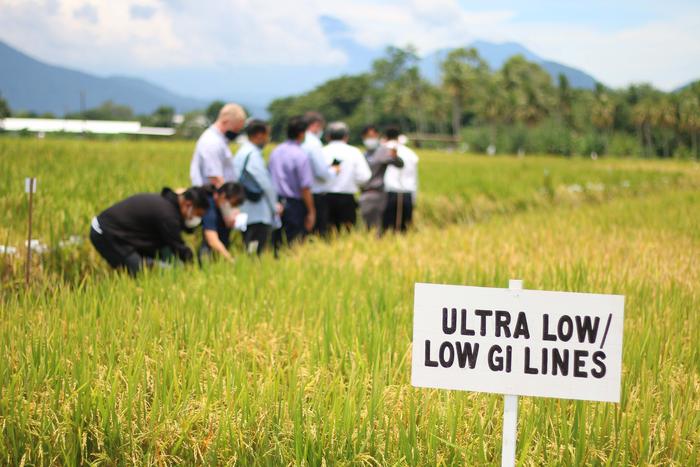
LOS BAÑOS, Philippines – A team of researchers at the International Rice Research Institute (IRRI) has identified genes and markers responsible for low glycemic index (GI) and high protein content in rice, using genetics and artificial intelligence classification methods.

Credit: International Rice Research Institute (IRRI)
LOS BAÑOS, Philippines – A team of researchers at the International Rice Research Institute (IRRI) has identified genes and markers responsible for low glycemic index (GI) and high protein content in rice, using genetics and artificial intelligence classification methods.
Their study, recently published in the Proceedings of the National Academy of Sciences (PNAS), revealed a superior set of lines that exhibited ultra-low GI (below 45%) with an unprecedented protein level (15.99), which is twice the content usually found in conventional milled rice. Rice varieties with higher protein content may contribute to slower digestion and absorption rates, potentially helping control blood glucose levels, further enhancing its ultra-low GI characteristics.
“Collectively, these findings underscore the stacked potential and benefits of low GI and high protein rice to offer a substantial source of protein and essential amino acids such as lysine for consumers, particularly in regions where rice is a dietary staple,” said Dr. Nese Sreenivasulu, corresponding author of the paper and Principal Scientist at the IRRI Grain Quality and Nutrition Center. He adds that the lines included in the study also generated yields comparable to existing high-yielding rice varieties.
The healthier rice lines were developed by intercrossing an inbred variety from Samba Mahsuri and the amylose extender of IR36. The results could help address the growing incidence of diabetes and the need for adequate protein intake for hundreds of millions of people at risk.
Globally, about 537 million adults suffer from diabetes, and the number is expected to grow to 783 million by 2045. Low- and middle-income countries account for more than three-quarters of diabetes incidences, with Asia accounting for 60 percent of the global diabetic population. High-protein rice may help boost the diets and health of half a billion protein-deficient consumers, many of whom live in South Asia and Central Africa.
“Considering that rice is a staple food for a substantial portion of the global population, it is crucial to deploy high-yielding rice cultivars with milled rice samples possessing high-quality protein and ultra-low glycemic index to address the triple burden of nutritional challenges among low- and middle-income communities,” said Dr. Gurdev S. Khush of the University of California, Davis, and co-corresponding author of the paper.
Dr. Sreenivasulu’s team and partners now seek to incorporate these genes into future breeding programs and popular varieties grown across Asia and Africa.
“With its remarkably low GI and protein content surpassing traditional rice varieties, these high-yielding nutritious rice varieties will pave the way to addressing critical food and nutritional security targets,” said IRRI Director General Dr. Yvonne Pinto.
The study was conducted in collaboration with the University of California, Davis, the United States of America, the Max Planck Institute of Molecular Plant Physiology in Germany, and the Center of Plant Systems Biology in Bulgaria.
Journal
Proceedings of the National Academy of Sciences
Article Title
Multiomics of a rice population identifies genes and genomic regions that bestow low glycemic index and high protein content
Article Publication Date
27-Aug-2024
Cite Scienmag News
Alan Morgan. (August 30, 2024). IRRI researchers identify genes for low glycemic index and high protein in rice. Scienmag. https://scienmag.com/irri-researchers-identify-genes-for-low-glycemic-index-and-high-protein-in-rice/
Alan Morgan. "IRRI researchers identify genes for low glycemic index and high protein in rice." Scienmag, 30 August 2024, https://scienmag.com/irri-researchers-identify-genes-for-low-glycemic-index-and-high-protein-in-rice/. Accessed 5 September 2026.
Alan Morgan. "IRRI researchers identify genes for low glycemic index and high protein in rice." Scienmag. August 30, 2024. https://scienmag.com/irri-researchers-identify-genes-for-low-glycemic-index-and-high-protein-in-rice/

