


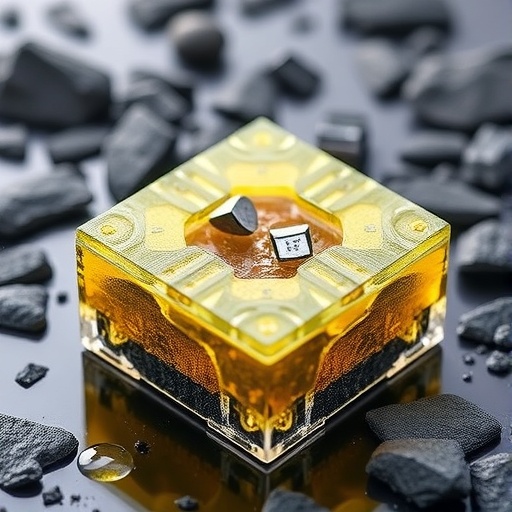
For decades, sulfide-bearing wastewater has been treated as a problem to neutralize rather than a resource to recover. That approach may be poised for a major rethink. A study by Ren, He, Ba and colleagues, published in Nature Communications in 2026, presents an iron-derived solid redox system designed to convert dissolved sulfide into recoverable sulfur while reducing the environmental and operational burdens associated with conventional treatment.
Sulfide is common in wastewater from industries including petroleum refining, mining, pulp and paper production, food processing, and sewage treatment. In water, it can occur as hydrogen sulfide or as sulfide ions, depending on pH. The compound is notorious for its rotten-egg odor, toxicity, corrosiveness, and ability to disrupt biological treatment systems. When released into the atmosphere, hydrogen sulfide can also pose serious health risks. Yet sulfur itself is a valuable industrial material, widely used in fertilizer production, chemical manufacturing, pharmaceuticals, and energy technologies.
The central idea behind the reported system is to use iron as a solid redox mediator. Redox reactions involve the transfer of electrons between chemical species. In this case, iron can cycle between oxidation states, primarily ferrous iron, Fe(II), and ferric iron, Fe(III). That cycling creates a chemical pathway for sulfide oxidation. Instead of allowing sulfide to remain dissolved or converting it fully into sulfate, the system is intended to guide the reaction toward elemental sulfur, a solid product that can potentially be separated and reused.
This distinction is technically important. Complete oxidation of sulfide to sulfate generally requires substantial chemical or biological input and produces a highly soluble product that remains in the water. Recovering elemental sulfur, by contrast, offers the possibility of removing sulfur from the wastewater in a concentrated form. The iron-based material acts as an electron-transfer platform, helping control the direction and efficiency of the reaction while remaining in a solid phase. That configuration could simplify separation, reduce chemical consumption, and make the treatment process more compatible with continuous wastewater operations.
The use of a solid redox system also addresses a long-standing weakness of many sulfide-removal technologies: the difficulty of maintaining stable performance while handling reactive dissolved chemicals. Liquid oxidants can be costly, hazardous, or difficult to dose precisely. Some biological systems require carefully controlled conditions and may be vulnerable to toxic shocks or changes in wastewater composition. A solid iron-derived material could provide a more robust reaction surface, allowing sulfide to interact with iron-containing active sites as contaminated water passes through or contacts the treatment medium.
At the molecular level, the process depends on carefully balancing electron transfer. Sulfide is oxidized as it loses electrons, while the iron-based redox couple is reduced and subsequently regenerated. If the reaction is controlled correctly, sulfur atoms can combine into elemental sulfur rather than proceeding toward sulfate. The chemistry is sensitive to conditions such as pH, oxidation potential, sulfide concentration, water composition, and the surface structure of the iron material. These factors determine whether sulfur forms as a recoverable solid, remains as dissolved polysulfide species, or becomes over-oxidized.
The study’s significance lies not only in removing a hazardous contaminant but also in reframing wastewater treatment as resource recovery. Conventional treatment often ends with sludge, dissolved salts, or gases that require additional disposal or management. A process that captures sulfur in solid form could create a more circular system, in which a pollutant becomes a feedstock. Iron is also among the most abundant and widely available elements on Earth, making iron-based chemistry attractive for large-scale environmental applications compared with systems dependent on scarce or expensive metals.
The approach may be particularly relevant for facilities that generate wastewater with high sulfide loads and limited access to sophisticated treatment infrastructure. If the solid redox material can operate over repeated cycles without rapid deactivation, it could potentially be integrated into fixed-bed reactors, filtration units, or modular treatment systems. The practical challenge will be preserving the material’s reactive surface. Sulfur deposition, mineral scaling, competing ions, and changes in wastewater chemistry can block active sites or alter iron’s oxidation state, reducing performance over time.
Before the technology can move from laboratory research to widespread industrial use, researchers will need to evaluate its long-term stability, regeneration requirements, sulfur purity, energy demand, and behavior in complex real-world wastewater. Economic comparisons with biological desulfurization, chemical oxidation, precipitation, and other sulfur-recovery methods will also be essential. Nevertheless, the iron-derived solid redox concept offers a compelling combination of pollution control and material recovery. By turning sulfide from a toxic wastewater component into a potentially valuable sulfur product, the system points toward a future in which treatment plants do more than clean water—they recover the chemistry hidden inside it.
Cite Scienmag News
Denise Maddox. (August 11, 2026). Iron-Based Solid Redox System Enables Sustainable Sulfur Recovery from Sulfide Wastewater. Scienmag. https://scienmag.com/iron-based-solid-redox-system-enables-sustainable-sulfur-recovery-from-sulfide-wastewater/
Denise Maddox. "Iron-Based Solid Redox System Enables Sustainable Sulfur Recovery from Sulfide Wastewater." Scienmag, 11 August 2026, https://scienmag.com/iron-based-solid-redox-system-enables-sustainable-sulfur-recovery-from-sulfide-wastewater/. Accessed 4 September 2026.
Denise Maddox. "Iron-Based Solid Redox System Enables Sustainable Sulfur Recovery from Sulfide Wastewater." Scienmag. August 11, 2026. https://scienmag.com/iron-based-solid-redox-system-enables-sustainable-sulfur-recovery-from-sulfide-wastewater/


