

Wednesday, July 15, 2026
Science
No Result
View All Result
  • Login
  • HOME
  • SCIENCE NEWS
  • CONTACT US
  • HOME
  • SCIENCE NEWS
  • CONTACT US
No Result
View All Result
Scienmag
No Result
View All Result
Home Science News Technology and Engineering

Invisible Skin Sensors Bring Breakthrough Health Monitoring Into Wearables

July 15, 2026
in Technology and Engineering
Reading Time: 2 mins read
0
Invisible Skin Sensors Bring Breakthrough Health Monitoring Into Wearables

Invisible Skin Sensors Bring Breakthrough Health Monitoring Into Wearables

65
SHARES
587
VIEWS
Share on FacebookShare on Twitter
ADVERTISEMENT

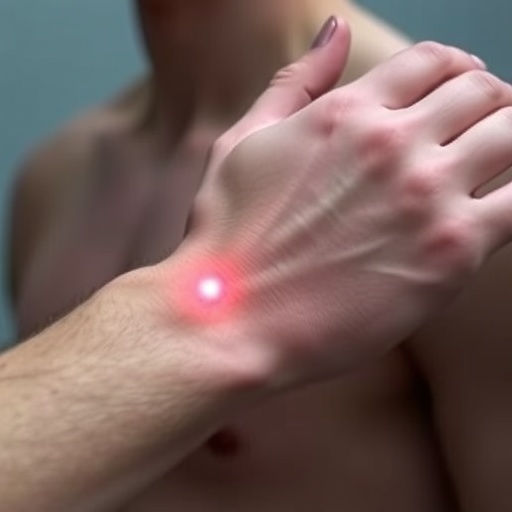
Invisible skin-mount sensors are moving wearable health monitoring out of the spotlight—and into everyday life. Conventional facial electrodes can feel intrusive, attract attention, and distort the very behavior researchers aim to measure. These “appearance artifacts” can alter self-consciousness and user interaction, undermining both comfort and data reliability.

A team led by the Institute of Industrial Science at The University of Tokyo reports ultrathin, stretchable on-skin electrodes designed to be effectively undetectable by sight and touch. The work, published in Science Advances, focuses on making electronics disappear into the background rather than demanding that wearers accommodate the device.

The core of the approach is a film-engineered electrode stack: an elastic layer roughly 200 nanometers thick paired with transparent conductive nanowires. By matching skin’s optical and tactile characteristics, the device reduces reflections and eliminates the glossy, conspicuous look typical of wearable prototypes. The result is a conformal interface intended to behave like part of the skin rather than a foreign attachment.

Performance matters as much as invisibility. The researchers showed that their electrodes can capture key biosignals used in neurotechnology and human–machine interaction. They recorded electrooculography from eye movements, electromyography from facial muscle activity, and electroencephalography from brain signals—all while keeping the electrodes visually and physically unobtrusive.

A standout technical advantage is interface impedance. The ultrathin, low-impedance skin contact improved signal quality for multiple modalities compared with traditional gel electrodes. Lower impedance can stabilize recordings and enhance the usable bandwidth for features such as saccades, muscle onset timing, and neural rhythms.

Comfort and breathability were also central to the design goals. In experiments, neither wearers nor outside observers could reliably detect the electrodes by sight or touch, and the devices remained suitable across a range of skin tones and surface features.

Beyond monitoring, the team envisions subtle inference of emotional and cognitive state using facial and ocular cues. In the longer term, invisible sensors could enable new control schemes for assistive technologies and virtual-reality systems without requiring bulky headsets or conspicuous face-mounted hardware.

More broadly, the study argues for a shift in wearable design philosophy: devices should adapt to people instead of demanding social compliance. If “invisibility” can be engineered without sacrificing data quality, health sensing may become both more accurate and more widely acceptable.

The article is titled “Reduction of appearance artifacts in wearable on-skin electronics” and appears in Science Advances.

Subject of Research: Wearable on-skin biosensing; appearance-artifact reduction
Article Title: Reduction of appearance artifacts in wearable on-skin electronics
News Publication Date: 15-Jul-2026
Web References: https://doi.org/10.1126/sciadv.aee6417
References: 10.1126/sciadv.aee6417
Image Credits: Institute of Industrial Science, The University of Tokyo

Keywords

on-skin electrodes; wearable biosensors; electrooculography; electromyography; electroencephalography; nanowires; ultrathin elastic film; appearance artifacts; bioimpedance; human–machine interaction

Tags: advanced materials for invisible wearable electronicsflexible skin sensorsflexible wearable health monitoring technologyinvisibleinvisible biomedical sensors for human–machine interactionminimal-impact health sensors for daily lifeskin-like electronic interfacesskin-mount biosignal recordingstretchable on-skin electrodestransparent nanowire biosensorsultrathin wearable health monitoring devicesunobtrusive neurotechnology sensors
Share26Tweet16
Previous Post

Gut Chemical Helps Scientists Control Seizures and Repair Damaged Brains

Next Post

Teleworking Cuts Carbon Emissions Only When Done Right

Related Posts

Reheating Power Cycles Could Boost Electricity from LNG’s Wasted Cold Energy
Technology and Engineering

Reheating Power Cycles Could Boost Electricity from LNG’s Wasted Cold Energy

July 15, 2026
Braiding and Fusion Enable Universal Gates for Anyons on Quantum Hardware
Medicine

Braiding and Fusion Enable Universal Gates for Anyons on Quantum Hardware

July 15, 2026
Cluster analysis reveals distinct motor deficit risk profiles in preterm infants
Technology and Engineering

Cluster analysis reveals distinct motor deficit risk profiles in preterm infants

July 15, 2026
Food System Transformation Could Reshape Global Agriculture, Experts Say
Medicine

Food System Transformation Could Reshape Global Agriculture, Experts Say

July 15, 2026
Designing Rational Home-Based Studies to Assess Infants’ Sleep Patterns
Technology and Engineering

Designing Rational Home-Based Studies to Assess Infants’ Sleep Patterns

July 15, 2026
GPS satellite data calibrated for improved space weather research
Technology and Engineering

GPS satellite data calibrated for improved space weather research

July 15, 2026
Next Post
Teleworking Cuts Carbon Emissions Only When Done Right

Teleworking Cuts Carbon Emissions Only When Done Right

  • Mothers who receive childcare support from maternal grandparents show more

    Mothers who receive childcare support from maternal grandparents show more parental warmth, finds NTU Singapore study

    27656 shares
    Share 11059 Tweet 6912
  • University of Seville Breaks 120-Year-Old Mystery, Revises a Key Einstein Concept

    1061 shares
    Share 424 Tweet 265
  • Bee body mass, pathogens and local climate influence heat tolerance

    682 shares
    Share 273 Tweet 171
  • Researchers record first-ever images and data of a shark experiencing a boat strike

    546 shares
    Share 218 Tweet 137
  • Groundbreaking Clinical Trial Reveals Lubiprostone Enhances Kidney Function

    531 shares
    Share 212 Tweet 133
Science

Embark on a thrilling journey of discovery with Scienmag.com—your ultimate source for cutting-edge breakthroughs. Immerse yourself in a world where curiosity knows no limits and tomorrow’s possibilities become today’s reality!

RECENT NEWS

  • Perseverance rover captures unprecedented record of ancient Mars asteroid impacts
  • Reheating Power Cycles Could Boost Electricity from LNG’s Wasted Cold Energy
  • ECOG-ACRIN ENDURANCE Trial Publishes Randomized Evidence on Lenalidomide Maintenance Duration in Multiple Myeloma
  • Tiny Water Droplets May Unlock Solutions for Global Plastic Waste Dissolving

Categories

  • Agriculture
  • Anthropology
  • Archaeology
  • Athmospheric
  • Biology
  • Biotechnology
  • Blog
  • Bussines
  • Cancer
  • Chemistry
  • Climate
  • Earth Science
  • Editorial Policy
  • Marine
  • Mathematics
  • Medicine
  • Pediatry
  • Policy
  • Psychology & Psychiatry
  • Science Education
  • Social Science
  • Space
  • Technology and Engineering

Subscribe to Blog via Email

Enter your email address to subscribe to this blog and receive notifications of new posts by email.

Join 5,146 other subscribers

© 2025 Scienmag - Science Magazine

Welcome Back!

Login to your account below

Forgotten Password?

Retrieve your password

Please enter your username or email address to reset your password.

Log In
No Result
View All Result
  • HOME
  • SCIENCE NEWS
  • CONTACT US

© 2025 Scienmag - Science Magazine

Discover more from Science

Subscribe now to keep reading and get access to the full archive.

Continue reading
