


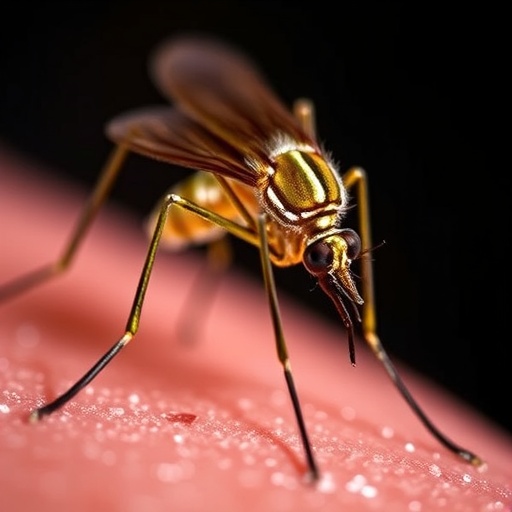
Researchers at the University of California, San Diego, have unveiled groundbreaking insights into how mosquitoes detect the carbon dioxide emitted by humans, an ability that facilitates their role as vectors for deadly diseases. These insights come from meticulous studies conducted in the School of Biological Sciences and the School of Medicine, focusing specifically on the physiological mechanisms that enable mosquitoes to locate and target their blood hosts efficiently. This research is particularly relevant as it addresses a critical aspect of mosquito behavior that not only contributes to their survival but also directly impacts public health.
The ability of mosquitoes to home in on their hosts by sensing carbon dioxide is not just instinctual; it involves specialized sensory structures known as sensilla that are equipped with olfactory receptor neurons. Earlier studies acknowledged the mosquitoes’ impressive carbon dioxide detection capabilities, but lacked clarity regarding the intricate anatomical and structural features that underpin this sensory function. This study addresses that gap by utilizing advanced imaging techniques to generate detailed three-dimensional models of the neurons involved.
Employing serial block-face electron microscopy, researchers constructed these intricate models, which allow for unprecedented visualization of mosquito anatomy at a nanoscale level. This advanced imaging technique slices through tissue in a systematic manner, generating serial images that culminate in a comprehensive view of the carbon dioxide-sensing neurons. Such detailed morphological models shed light on how mosquitoes have evolved specialized adaptations that enhance their ability to detect and track human hosts.
The specific species examined in this study, Aedes aegypti, is notorious for being a vector for serious diseases, including yellow fever, dengue, chikungunya, and Zika virus. Understanding how these mosquitoes detect their hosts through carbon dioxide is vital for developing effective strategies to minimize transmission of these diseases. According to the research leader, Professor Chih-Ying Su, the scientific community has previously speculated about the mechanisms behind mosquito CO2 detection, but this study provides the first comprehensive visualization that illustrates the specialized anatomical configurations involved in this process.
The results show that within the sensilla, the anatomical specialization of sensory dendrites is particularly striking. The researchers found that within certain neurons, known as capitate peg neurons, there are pronounced adaptations designed to maximize the surface area for CO2 detection. These adaptations include a unique arrangement of axons and an abundance of mitochondria, which suggests that these sensory neurons require significant energy to maintain their heightened sensitivity to carbon dioxide. Such modifications underline the metabolic and structural evolution that has occurred to support the insects’ essential host-seeking behavior.
What sets these findings further apart is the comparative analysis made with structurally analogous components found in fruit flies. The researchers discovered that the fruit fly’s sensory response to CO2 is much less pronounced than that of mosquitoes. For fruit flies, carbon dioxide serves primarily as an alarm signal prompting avoidance behaviors, whereas for mosquitoes, CO2 acts as an arousal cue that drives them toward potential blood sources. This divergence highlights the distinct evolutionary pathways these insect species have taken, informed by their different survival strategies.
The significance of this research is underscored by the continuing threat that mosquitoes pose to global health. With millions of people affected by diseases transmitted by mosquitoes, any contribution to understanding their biology could potentially inform public health initiatives and vector control strategies. The study’s insights into the carbon dioxide-sensing capabilities not only expand the knowledge base regarding mosquito physiology but also open avenues for further research aimed at interrupting the blood-feeding behavior that facilitates disease transmission.
In assessing the broader implications of the research, the potential for developing targeted interventions becomes evident. If researchers can pinpoint the exact mechanisms by which mosquitoes detect CO2, this could lead to novel strategies for repelling them or even disrupting their host-seeking behaviors. Current mosquito control measures often focus on killing adult mosquitoes, but understanding their sensory capabilities can indicate more specific and potentially less harmful interventions.
Moreover, the increasing threat posed by insecticide resistance brings urgency to this research. As mosquitoes evolve to resist commonly used insecticides, reimagining our approach to mosquito control becomes crucial. This study suggests that a new vector control paradigm could focus on sensory modalities, making the mosquito unable to detect its hosts rather than simply attempting to kill or trap them.
Overall, the findings from this research are not just scientific milestones; they bear implications for real-world applications that could mitigate the impact of mosquito-borne diseases. The researchers express hope that this pioneering work will inspire further investigation into the anatomical features of mosquitoes and how they relate to their pathogenic potential. As the world grapples with the growing incidence of mosquito-transmitted diseases, understanding the biology of these vectors gains prominence.
In conclusion, as science continually advances, the elucidation of such intricate biological systems exemplifies the intersection of research and practical application. The techniques employed, the discoveries made, and the implications discussed not only enrich the scientific community’s understanding of mosquitoes but also provide a pathway toward enhanced public health strategies. This research signifies a step forward in the intricate battle against diseases transmitted by one of humanity’s oldest adversaries: the mosquito.
Keywords
Life sciences, Neuroscience, Neurophysiology, Sensory systems, Sensory receptors, Olfactory receptors, Mosquitos, Carbon dioxide, Neurons
Cite Scienmag News
Denise Maddox. (October 30, 2025). Investigators Reveal New Insights into Mosquitoes’ Unique Detection Mechanisms. Scienmag. https://scienmag.com/investigators-reveal-new-insights-into-mosquitoes-unique-detection-mechanisms/
Denise Maddox. "Investigators Reveal New Insights into Mosquitoes’ Unique Detection Mechanisms." Scienmag, 30 October 2025, https://scienmag.com/investigators-reveal-new-insights-into-mosquitoes-unique-detection-mechanisms/. Accessed 4 September 2026.
Denise Maddox. "Investigators Reveal New Insights into Mosquitoes’ Unique Detection Mechanisms." Scienmag. October 30, 2025. https://scienmag.com/investigators-reveal-new-insights-into-mosquitoes-unique-detection-mechanisms/


