


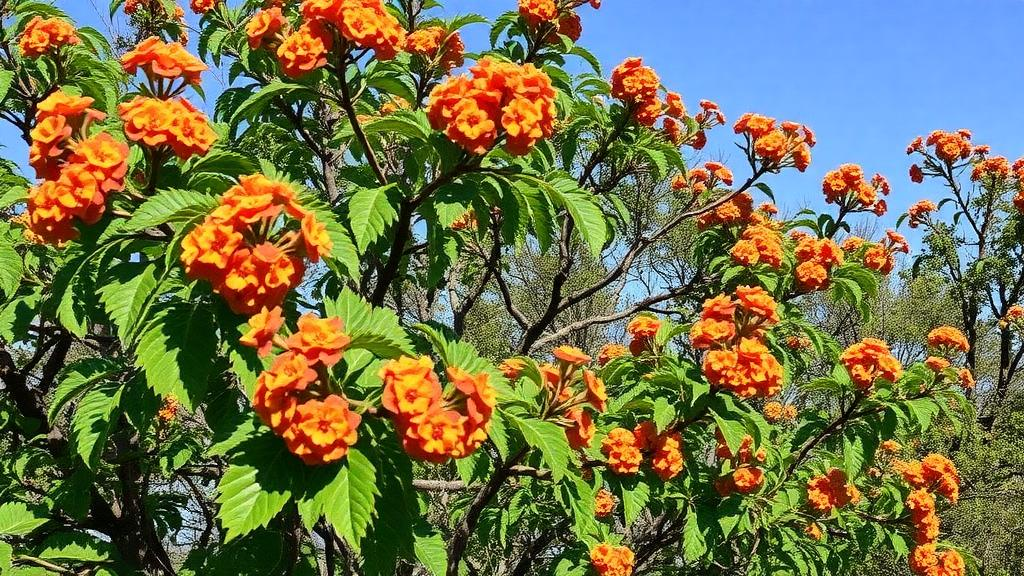
In the tropical dry deciduous forests of Central India, a pretty ornamental shrub with clusters of orange and pink flowers is quietly waging chemical warfare against the native trees around it. Lantana camara, one of the world’s worst invasive plant species, does not simply crowd out its neighbors by growing faster or shading them. It also releases potent biochemical compounds into the soil and leaf litter that suppress the germination and early growth of native species, a phenomenon ecologists call allelopathy. A new study published in Plant Biosystems has now tested exactly how strong this chemical suppression is against five economically and ecologically important native tree species, and the results offer a practical roadmap for restoring forests that lantana has already overrun.
The research, led by Neeraj Prajapati and colleagues at the Tropical Forest Research Institute in Jabalpur, Madhya Pradesh, with collaborators from the Forest Research Institute in Dehradun, the Central University of Punjab, and the Institute of Forest Genetics and Tree Breeding in Coimbatore, focused on five native trees: white siris (Albizia procera), siris (Albizia lebbeck), the golden shower tree (Cassia fistula), tamarind (Tamarindus indica), and the mountain ebony (Bauhinia variegata). All five are staples of Indian reforestation programs, valued for timber, fodder, medicine, and ornamental appeal. The team’s central question was deceptively simple: if you plant these species in soil laced with lantana’s chemical residues, which ones survive the assault?
To answer it, the researchers prepared aqueous extracts from both lantana leaves and roots, simulating the chemical environment that seeds and seedlings would encounter beneath an established lantana stand. Rainwater percolating through lantana foliage and root systems carries dissolved allelochemicals into the topsoil, so water-based extracts are a reasonable laboratory proxy for field conditions. The extracts were applied at five concentrations: 0 percent as a control, and 25, 50, 75, and 100 percent. Extract type and concentration were treated as fixed experimental factors, allowing the team to disentangle whether leaves or roots carry the stronger chemical punch and how dose shapes the outcome.
The germination assays tracked three classic parameters drawn from standard seed testing protocols: total germination percentage, the germination index, which captures both the number and the speed of germinating seeds, and mean germination time. These metrics matter because in the wild, speed is survival. A seed that germinates quickly can establish roots before the next dry spell, outcompete microbes, and escape predation. Slowed germination, even when the final germination percentage looks acceptable, can doom a seedling in the seasonal rainfall regime of Central India, where the monsoon window for establishment is brief and unforgiving.
The results were unambiguous. Statistical analysis showed that every germination and growth parameter measured was significantly influenced by both the type of extract and its concentration. As concentration climbed, germination and seedling vigor fell consistently across all five species, a textbook dose-dependent phytotoxic response. The most severe inhibition appeared in tamarind at the full 100 percent extract concentration, where the combined chemical stress crushed both germination and early growth. To quantify this stress in a single number, the team calculated phytotoxicity as the relative reduction in seedling growth under extract treatments compared with untreated controls, providing an integrated measure of how hard each species was hit.
Perhaps the study’s most useful methodological contribution is a new composite performance index, or CPI, that merges germination percentage and seedling growth reduction into one tolerance score. Restoration practitioners rarely have the luxury of running dozens of separate trials for every candidate species, so a single index that ranks overall resilience is a practical tool. When the five species were ranked by CPI, a clear hierarchy emerged. Albizia procera and Cassia fistula proved the most tolerant of lantana’s chemistry, followed by Albizia lebbeck. Tamarind and Bauhinia variegata sat at the bottom as highly sensitive species, meaning that planting them in heavily invaded sites would likely be an exercise in expensive failure.
The chemical basis of this suppression has been building in the literature for decades. Earlier work identified phenolic compounds in lantana leaves using high-performance liquid chromatography, and subsequent studies have shown that these phenolics can disrupt fundamental plant processes. Allelochemicals are known to act at multiple sites within a target plant: they can interfere with cell division, inhibit key enzymes, disrupt mitochondrial respiration and photosynthesis, and generate oxidative stress through the accumulation of reactive oxygen species such as hydrogen peroxide. One study on water hyacinth, for example, documented exactly that pattern, with lantana leaf extract suppressing superoxide dismutase activity while hydrogen peroxide accumulated in leaf tissue. In effect, the target seedling drowns in its own metabolic byproducts while its antioxidant defenses are disabled.
The ecological stakes in Central India are enormous. Lantana camara, introduced to India as an ornamental in the early nineteenth century, now dominates understories across vast tracts of tropical dry forest, altering species composition, reducing native tree diversity, and even changing ecosystem-level carbon pools. Recent research from Central Indian forests has documented how lantana invasion reshapes both flora and soils, and its effects ripple up the food web, with studies showing altered bird assemblages in invaded reserves. The shrub’s success has been attributed in part to the novel weapons hypothesis, the idea that invasive species carry chemical defenses that native competitors have never evolved resistance to. The new findings give that hypothesis a concrete, species-by-species dimension: the chemical weapon is real, measurable, and unevenly lethal depending on which native tree is in the crosshairs.
What makes this study genuinely actionable is its direct link to restoration practice. Reforestation in lantana-invaded habitats has often proceeded on the assumption that removing the shrub is enough, only for planted seedlings to languish and die as residual allelochemicals persist in soil and leaf litter. By identifying Albizia procera, Cassia fistula, and Albizia lebbeck as candidate species with demonstrated chemical tolerance, the study gives forest managers a shortlist for the toughest sites. The sensitive species, tamarind and Bauhinia variegata, are not written off entirely; they may still succeed in heavily managed plantings or in sites cleared and restored for longer periods before introduction. The work was funded by the National Authority CAMPA under India’s Ministry of Environment, Forest and Climate Change, signaling that the results are intended for immediate use in compensatory afforestation programs.
There are, of course, caveats that the authors and the broader literature acknowledge. Laboratory bioassays with aqueous extracts cannot fully reproduce field conditions, where soil microbes may degrade allelochemicals, rainfall dilutes them, and soil chemistry binds them. Concentrations in the real world fluctuate with invasion intensity, season, and litter dynamics. Yet the dose-dependent pattern observed here, with inhibition rising steadily from 25 to 100 percent, mirrors the gradient of invasion severity that restoration teams actually encounter on the ground, which strengthens the case that the laboratory rankings translate into field-relevant guidance. As lantana continues its global expansion under a changing climate, studies like this one shift the conversation from simply fighting the invader to strategically choosing which natives can hold the line. In the chemical battlefield of Central India’s forests, the first casualties have been identified, and so have the survivors.
Subject of Research: Allelopathic effects of the invasive shrub Lantana camara on germination and seedling growth of native tree species used in forest restoration in Central India
Article Title: Germination and seedling growth responses of tree species to Lantana camara (Verbenaceae) allelopathy: implications for forest restoration in Central India
Article References: Prajapati, N., Vijay, M. K., Rohilla, S., Kumar, A., Dhaka, S. S., Rajasekaran, A., & Singh, N. (2026). Germination and seedling growth responses of tree species to Lantana camara (Verbenaceae) allelopathy: implications for forest restoration in Central India. Plant Biosystems, 160(5), Article 275. https://doi.org/10.1007/s44473-026-00284-5
Image Credits: AI Generated
DOI: 10.1007/s44473-026-00284-5
Keywords: Lantana camara, allelopathy, invasive species, forest restoration, seed germination, phytotoxicity, Central India, native trees, seedling growth, reforestation, plant ecology, composite performance index
Cite Scienmag News
Alan Morgan. (October 2, 2026). Invasive Lantana’s Chemical Warfare Reveals Which Native Trees Can Fight Back. Scienmag. https://scienmag.com/invasive-lantanas-chemical-warfare-reveals-which-native-trees-can-fight-back/
Alan Morgan. "Invasive Lantana’s Chemical Warfare Reveals Which Native Trees Can Fight Back." Scienmag, 2 October 2026, https://scienmag.com/invasive-lantanas-chemical-warfare-reveals-which-native-trees-can-fight-back/. Accessed 4 October 2026.
Alan Morgan. "Invasive Lantana’s Chemical Warfare Reveals Which Native Trees Can Fight Back." Scienmag. October 2, 2026. https://scienmag.com/invasive-lantanas-chemical-warfare-reveals-which-native-trees-can-fight-back/


