


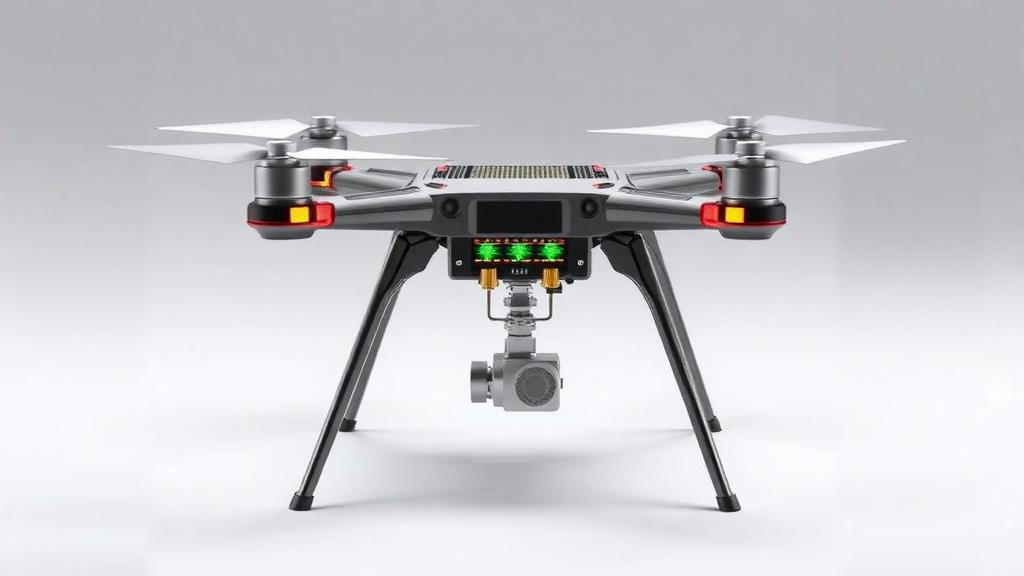
Lithium-sulfur batteries have long promised a leap in energy density that could transform everything from electric aircraft to wearable electronics, but they have stubbornly refused to leave the flat, rigid world of conventional cells. Now a team of researchers from the Korea Advanced Institute of Science and Technology, Chungnam National University, Charles University, and Chalmers University of Technology has demonstrated a cathode architecture that survives being bent, wrapped, and fixed onto curved structures without falling apart. Writing in Advanced Composites and Hybrid Materials, the group led by Il-Kwon Oh and Leif E. Asp describes a monolithically integrated nickel cobalt selenide nanowire scaffold grown directly on woven carbon cloth, a design that allows lithium-sulfur pouch cells to retain nearly all of their capacity even after being shaped into cylinders, ovals, squares, and even a drone-leg form factor.
The appeal of lithium-sulfur chemistry lies in its theoretical energy density, which far exceeds that of today’s lithium-ion cells because sulfur can in principle exchange two electrons per atom at a lightweight atomic mass. That promise has made Li-S batteries a favorite candidate for structural energy storage, an emerging field in which the battery itself doubles as a load-bearing component of an aircraft fuselage, a car chassis, or a robot’s limb. The problem is that sulfur cathodes are mechanically and chemically fragile. When a sulfur-loaded electrode is bent around a curved surface, the active material cracks, the interface between the cathode and the current collector delaminates, and electrical contact is progressively lost. Under repeated curvature changes and external loading, these failure modes compound, and the cell’s performance collapses.
The KAIST-led team attacked this problem at the level of materials architecture rather than cell packaging. Their starting point is ordinary woven carbon cloth, a flexible, conductive textile made of carbon fibers. Onto this fabric they grew dense arrays of nickel-cobalt precursor nanowires directly, without any polymer binder, and then converted the nanowires into nickel cobalt selenide, NiCo2Se4, through a selenization process. The result is a single monolithic scaffold in which polar, polysulfide-grabbing NiCo2Se4 surfaces are seamlessly fused to a continuous carbon-fiber network that shuttles electrons throughout the electrode. Because the nanowires are grown rather than glued, there is no weak interface between the active material and the conductive substrate, which is precisely where conventional composite cathodes tend to fail under mechanical stress.
The chemistry of the selenide coating matters as much as its mechanical integration. During discharge in a lithium-sulfur cell, sulfur is converted through a series of intermediate polysulfide species that dissolve into the electrolyte and migrate between the electrodes, a phenomenon known as the polysulfide shuttle that erodes capacity and fouls the lithium anode. Polar transition-metal compounds such as NiCo2Se4 chemically adsorb these polysulfides, anchoring them near the conductive network where they can be reconverted instead of wandering off. In comparative tests, the sulfur-loaded nanowire scaffold, designated S/NCSe@CC, showed markedly stronger polysulfide adsorption than sulfur deposited on plain carbon cloth or on a precursor-coated cloth lacking the selenide conversion, confirming that the selenide surface is the active ingredient in taming the shuttle problem.
Electrochemically, the scaffold delivered impressive numbers. At a modest rate of 0.1 C, the S/NCSe@CC cathode achieved a discharge capacity of 1,544 milliampere-hours per gram of sulfur, close to the theoretical limit of the chemistry, with a voltage polarization of only 0.13 volts between charge and discharge plateaus. Reduced charge-transfer resistance and accelerated sulfur-redox kinetics, measured against the control electrodes, indicate that the interconnected nanowire-fiber network provides both fast electron transport and efficient ionic access deep inside the electrode. In practical terms, the scaffold functions simultaneously as a current collector, a polysulfide trap, and a mechanical backbone, collapsing three functions that normally require separate layers into one integrated textile.
The most striking result, however, concerns mechanical durability. The researchers subjected the cathode scaffold to 1,000 curvature-conditioning cycles at a bending radius of just 2.5 millimeters, an aggressive deformation that would destroy most conventional electrodes. Microscopic examination afterward showed that the nanowire-fiber integration remained intact, with no catastrophic cracking or delamination of the active layer. Even more importantly, pouch cells assembled with electrodes that had already endured this conditioning displayed discharge behavior comparable to pristine, never-bent cells. This suggests that the scaffold does not merely survive bending in a laboratory test; it can be pre-shaped into a curved geometry and still deliver full electrochemical performance once installed in a real device.
To test that idea under realistic conditions, the team assembled pouch cells and bent them around cylindrical mandrels. Cells held in the curved state retained 94.0 percent of their flat-state discharge capacity, a loss of only six percent attributable to the curvature itself. The researchers then went further, integrating the pouch cells into cylindrical, oval, and square geometries, and finally wrapping them around a drone-leg structure to mimic the kind of non-planar component a structural battery would actually inhabit. In every case the cells remained electrically operational after geometric insertion and fixation, demonstrating that the materials-to-architecture strategy holds up not just on a bending jig but in the awkward, compound-curved shapes that real engineering demands.
Why does this matter beyond the laboratory? Structural batteries promise to eliminate the dead weight of dedicated battery packs by making the airframe or chassis itself an energy store, and for lightweight platforms such as drones, eVTOL aircraft, and small satellites, every gram saved translates directly into range or payload. Lithium-sulfur chemistry is particularly attractive here because of its low areal density, but until now nobody had shown a Li-S cathode that could be reliably integrated into a non-planar structural element. The carbon-cloth substrate is itself a textile, which means it can in principle be draped, stitched, or laminated into composite structures using processes familiar to the aerospace industry, and the binder-free growth process avoids the polymer additives that add weight and creep under load.
The work also offers a template that extends beyond nickel cobalt selenide. The core insight, that a polar conversion compound grown monolithically on a flexible conductive textile can simultaneously solve the chemical and mechanical failure modes of a sulfur cathode, could be adapted to other transition-metal chalcogenides or phosphides as polysulfide hosts. The KAIST and Chalmers collaboration, which bridges mechanical engineering, materials science, and structural-battery expertise, is well positioned to push the concept toward full structural composites in which the cathode textile is embedded within a load-bearing laminate. The research was supported by the National Research Foundation of Korea and the Korean Institute for Advancement of Technology, reflecting sustained national investment in next-generation energy-storage materials.
Challenges remain before curved lithium-sulfur structural cells fly on real aircraft. The reported results focus on cathode performance and curvature tolerance; full structural-battery systems must also address lithium-metal anode stability, electrolyte containment under load, and the trade-off between mechanical stiffness and ionic transport that defines the entire structural-power field. Cycle-life data at the pouch-cell level under sustained mechanical stress will be essential, and scaling the nanowire growth process to meter-scale textiles is an open engineering question. Still, the demonstration that a Li-S pouch cell can be wrapped around a drone leg and keep working, retaining 94 percent of its capacity under cylindrical curvature, is a vivid proof of concept. It suggests a future in which the battery is not a box bolted onto a machine but a material woven into its very shape, flexible enough to follow the designer’s geometry and tough enough to carry the load.
Subject of Research: Monolithic NiCo2Se4 nanowire-carbon cloth cathode scaffolds for non-planar lithium-sulfur structural battery integration
Article Title: Monolithically integrated NiCo2Se4 nanowire–carbon cloth cathode scaffolds for non-planar lithium-sulfur structural-battery integration
Article References: Ha, J., Garai, M., Ullah, Z., Ardhi, R. E. A., Kim, C., Kim, A., Mahato, M., Kim, H. Y., Asp, L. E., & Oh, I.-K. (2026). Monolithically integrated NiCo2Se4 nanowire–carbon cloth cathode scaffolds for non-planar lithium-sulfur structural-battery integration. Advanced Composites and Hybrid Materials. https://doi.org/10.1007/s42114-026-02093-y
Image Credits: AI Generated
DOI: 10.1007/s42114-026-02093-y
Keywords: lithium-sulfur batteries, structural batteries, nickel cobalt selenide, nanowires, carbon cloth, polysulfide shuttle, flexible electrodes, energy storage, curvature tolerance, pouch cells, drone integration, KAIST
Cite Scienmag News
Faith Mcneil. (October 2, 2026). Bendable Battery Breakthrough: Nanowire Cathode Lets Lithium-Sulfur Cells Wrap Around Drone Legs. Scienmag. https://scienmag.com/bendable-battery-breakthrough-nanowire-cathode-lets-lithium-sulfur-cells-wrap-around-drone-legs/
Faith Mcneil. "Bendable Battery Breakthrough: Nanowire Cathode Lets Lithium-Sulfur Cells Wrap Around Drone Legs." Scienmag, 2 October 2026, https://scienmag.com/bendable-battery-breakthrough-nanowire-cathode-lets-lithium-sulfur-cells-wrap-around-drone-legs/. Accessed 4 October 2026.
Faith Mcneil. "Bendable Battery Breakthrough: Nanowire Cathode Lets Lithium-Sulfur Cells Wrap Around Drone Legs." Scienmag. October 2, 2026. https://scienmag.com/bendable-battery-breakthrough-nanowire-cathode-lets-lithium-sulfur-cells-wrap-around-drone-legs/


