


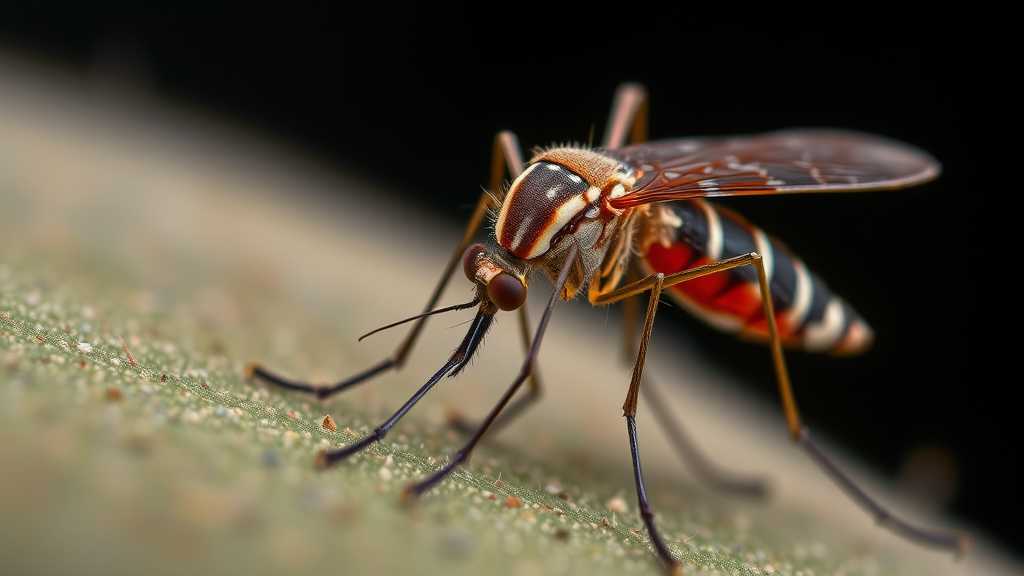
The invasive Asian malaria mosquito Anopheles stephensi, which has been spreading steadily across the Horn of Africa since its first detection in Djibouti in 2012, is just as capable of sustaining Plasmodium falciparum infection as Anopheles arabiensis, the principal native malaria vector in Ethiopia. That is the central conclusion of a new study conducted in Metehara, central Ethiopia, where researchers carried out paired direct membrane feeding assays using fresh blood from symptomatic patients carrying P. falciparum gametocytes. The findings, published in the journal Parasites & Vectors, carry significant weight for malaria control programs across Africa, where the arrival of this urban-adapted vector has raised fears of a resurgence in transmission.
The global malaria picture remains grim. In 2024, an estimated 282 million cases and 610,000 deaths were reported worldwide, an increase of nine million cases over the previous year. Sub-Saharan Africa bears roughly 94 percent of the global burden, and control efforts are increasingly threatened by insecticide-resistant vectors, parasites that evade rapid diagnostic tests, and the emergence of resistance to artemisinin-based combination therapies. Into this already fragile landscape has stepped An. stephensi, a vector native to the Indian subcontinent and the Persian Gulf that thrives in man-made water containers and urban environments, raising the specter of malaria re-emerging in African cities that had previously been relatively protected.
Since its detection in Djibouti, An. stephensi has been reported in Ethiopia in 2016, Sudan and Eritrea in 2019, Somalia in 2019, Nigeria in 2020, Yemen in 2021, Kenya and Ghana in 2022, and Niger in 2025. Reports have linked its introduction to malaria resurgence in Djibouti and Ethiopia, and modeling studies suggest that its expansion could expose vast urban populations to transmission risk. Yet a critical biological question remained unresolved: how efficiently does this Asian vector transmit African strains of P. falciparum, a parasite that evolved on the continent and adapted to a different suite of mosquito hosts during its global spread?
Earlier evidence had hinted at the answer. A 2021 study using direct membrane feeding assays found that An. stephensi was permissive to both P. vivax and P. falciparum relative to An. arabiensis, but the limited number of P. falciparum observations precluded firm conclusions. The new research, led by scientists at the Armauer Hansen Research Institute in Addis Ababa together with collaborators at Arba Minch University, Addis Ababa University, Radboud University Medical Center, the London School of Hygiene and Tropical Medicine, and Wollo University, was designed to close that gap with a robust, paired comparison focused specifically on the deadliest human malaria parasite.
The study was conducted in Metehara, a town in Oromia Regional State lying at roughly 947 meters above sea level along the major transportation corridor connecting Ethiopia with Djibouti, where An. stephensi has been established since 2019. Malaria transmission in the area is seasonal, peaking from August to December after the main rains, and P. falciparum accounts for about 75 percent of clinical infections. Between August 2024 and January 2025, the team recruited 43 patients with microscopy-confirmed P. falciparum gametocytes at two health centers, Dire Gobu and Haro Adi, collecting five-milliliter venous blood samples before participants received treatment with artemether-lumefantrine.
The mosquitoes themselves came from the Adama Malaria Research and Training Center, which has maintained An. arabiensis colonies since the 1970s and established an An. stephensi colony in April 2023. By the time the feeding assays began, the stephensi colony had reached its twenty-fifth generation. For each experiment, 120 three-to-five-day-old females of each species were starved for six to eight hours and then fed in parallel on the same patient blood through water-jacketed glass feeders maintained at 37 degrees Celsius. Ten days after feeding, mosquitoes were dissected and their midguts stained and examined under a microscope for oocysts, the developmental stage of the parasite that forms on the mosquito gut wall.
The results were striking in their symmetry. Feeding efficiency was the only measure in which the native vector clearly outperformed the invader: 85 percent of An. arabiensis took a full blood meal compared with 78.3 percent of An. stephensi, a difference the authors attribute to the longer history of laboratory adaptation in the arabiensis colony. But when it came to actual susceptibility, the two species were nearly indistinguishable. Roughly 68 to 70 percent of feeds on patient blood infected at least one mosquito of either species, and the proportion of dissected mosquitoes carrying oocysts was identical at 30.7 percent in both species. Infection rates in paired feedings were strongly correlated between the two colonies, with a Spearman correlation coefficient of 0.85.
Oocyst intensity told a similar story. The researchers counted nearly 20,000 oocysts in infected An. stephensi midguts and more than 28,000 in infected An. arabiensis midguts, with median densities of 13.5 and 26.3 oocysts per infected mosquito respectively, a difference that did not reach statistical significance. A Bland-Altman analysis confirmed that patient blood was equally infectious to both species, with no meaningful bias toward either one. In the subset of experiments with low oocyst prevalence, where microscopy is most prone to error, molecular testing of mosquito carcasses on day fourteen showed that both species could carry infections through to the sporozoite stage, the form that is infectious to humans, with 14.2 percent of An. stephensi and 10 percent of An. arabiensis testing positive.
The authors caution that their assays were conducted under controlled insectary conditions that do not capture the environmental variability mosquitoes face in nature, and that all blood donors were symptomatic patients with relatively high parasite densities. In sub-Saharan Africa, most onward transmission of P. falciparum is thought to arise from asymptomatic individuals carrying lower parasite burdens, so future work will need to test whether the equivalence between the two vectors holds under those more representative conditions. Gametocyte biology itself complicates such studies, since the transmissible stages take nine to twelve days to mature, making the recruitment of gametocyte-positive donors a considerable logistical challenge.
Nevertheless, the message for public health is clear. Anopheles stephensi, newly arrived in Africa, is as permissive to local P. falciparum strains as the continent’s established primary vector, meaning it can sustain transmission at equivalent levels under controlled conditions. Combined with its preference for urban habitats and its documented association with malaria resurgence in the Horn of Africa, the finding underscores the urgency of early surveillance and targeted vector control in cities across the continent before this invasive mosquito becomes fully entrenched in new ecological settings.
Subject of Research: Comparative susceptibility of invasive Anopheles stephensi and native Anopheles arabiensis mosquitoes to Plasmodium falciparum gametocytes in Ethiopia.
Article Title: Comparative permissiveness of Anopheles stephensi colony mosquito with an Anopheles arabiensis colony to Plasmodium falciparum gametocytes in Metehara, Ethiopia
Article References: Comparative permissiveness of Anopheles stephensi colony mosquito with an Anopheles arabiensis colony to Plasmodium falciparum gametocytes in Metehara, Ethiopia. (n.d.). https://doi.org/10.1186/s13071-026-07463-5
Image Credits: AI Generated
DOI: 10.1186/s13071-026-07463-5
Keywords: Anopheles stephensi, Anopheles arabiensis, Plasmodium falciparum, malaria, Ethiopia, direct membrane feeding assay, vector competence, invasive mosquito species, oocyst density, sporozoite, malaria transmission, vector surveillance
Cite Scienmag News
Drew Townsend. (September 22, 2026). Invasive Asian Malaria Mosquito Proves as Susceptible to African Parasites as Native Vectors. Scienmag. https://scienmag.com/invasive-asian-malaria-mosquito-proves-as-susceptible-to-african-parasites-as-native-vectors/
Drew Townsend. "Invasive Asian Malaria Mosquito Proves as Susceptible to African Parasites as Native Vectors." Scienmag, 22 September 2026, https://scienmag.com/invasive-asian-malaria-mosquito-proves-as-susceptible-to-african-parasites-as-native-vectors/. Accessed 5 October 2026.
Drew Townsend. "Invasive Asian Malaria Mosquito Proves as Susceptible to African Parasites as Native Vectors." Scienmag. September 22, 2026. https://scienmag.com/invasive-asian-malaria-mosquito-proves-as-susceptible-to-african-parasites-as-native-vectors/


