

Tuesday, July 14, 2026
Science
No Result
View All Result
  • Login
  • HOME
  • SCIENCE NEWS
  • CONTACT US
  • HOME
  • SCIENCE NEWS
  • CONTACT US
No Result
View All Result
Scienmag
No Result
View All Result
Home Science News Chemistry

International Team Synthesizes Unexpectedly Stable Strongly Bent Sandwich Molecule

July 14, 2026
in Chemistry
Reading Time: 2 mins read
0
International Team Synthesizes Unexpectedly Stable Strongly Bent Sandwich Molecule

International Team Synthesizes Unexpectedly Stable Strongly Bent Sandwich Molecule

65
SHARES
587
VIEWS
Share on FacebookShare on Twitter
ADVERTISEMENT

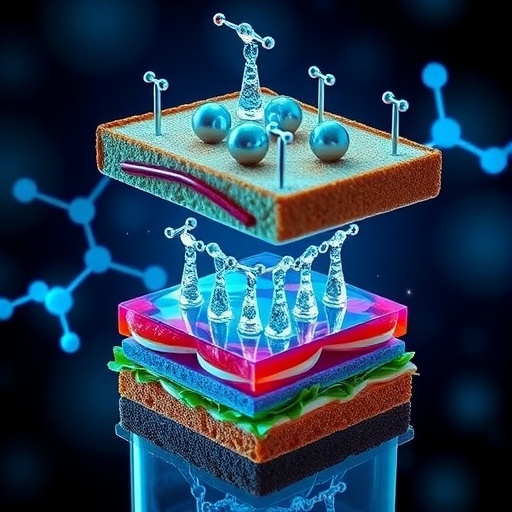
An international team of chemists at Saarland University has shattered long-standing beliefs in inorganic chemistry by successfully synthesizing a novel ferrocenophane molecule featuring a single bridging carbon atom. Ferrocenophanes, a subset of metallocenes—or “sandwich molecules”—are composed of two cyclopentadienyl rings holding a metal atom, typically iron, much like a sandwich filling. While various ferrocenophanes with silicon, boron, or sulfur bridges have been identified, the creation of one with a carbon bridge was historically deemed impossible due to anticipated extreme ring strain and instability.

The challenge centered on the unprecedented bending of two carbon rings forced by the diminutive size of a single carbon atom bridge. Earlier assumptions suggested such intense ring strain would destabilize the molecule, precluding its isolation or practical application. However, doctoral researcher Aylin Feuerstein, under the guidance of Dr. André Schäfer, combined theoretical modeling and meticulous synthetic chemistry to overturn this dogma. Early computational designs indicated that slight modifications in molecular architecture could mitigate ring strain, making the carbon-bridged ferrocenophane not only feasible but thermally robust.

Laboratory synthesis involved initially incorporating a magnesium atom as a stand-in metal, followed by substitution with iron, ultimately resulting in a red crystalline powder confirmed to be the carbon-bridged ferrocenophane. Notably, this molecule demonstrated exceptional thermal stability, withstanding temperatures surpassing 200°C without decomposition—a discovery that defied initial expectations about ring strain limits.

This breakthrough extends far beyond mere molecular novelty. The new ferrocenophane opens pathways to novel metallopolymers, materials that integrate metal atoms into polymer backbones to combine metallic and organic properties. Such materials promise advances in fields ranging from electrically switchable surfaces to smart membranes and optical devices, heralding a new class of functional polymers with tailor-made electronic and mechanical features.

The multidisciplinary team’s effort, which included quantum chemical calculations conducted by Dr. Sergi Danés Pibernat from the Institut Català d’Investigació Química, revealed why this molecular framework exhibits such stability despite its high ring strain. The work provides insight into fine-tuning metal-organic architectures and expands the toolbox for designing metal-containing polymers that harness previously inaccessible molecular shapes.

Published in Angewandte Chemie, this milestone in ferrocenophane chemistry not only challenges preconceived limitations but also sparks exciting prospects for material science innovation, potentially revolutionizing polymer chemistry by incorporating stressed, bent metallocene structures.

Subject of Research: Chemistry—Metallocenes and Metallopolymers
Article Title: The Missing Link in Ferrocenophane Chemistry: Isolation of a Carba[1]Ferrocenophane
News Publication Date: July 12, 2026
Web References: http://dx.doi.org/10.1002/anie.2211037
Image Credits: Thorsten Mohr/UdS

Keywords

Ferrocenophane, Metallocenes, Metallopolymers, Ring Strain, Organometallic Chemistry, Molecular Stability, Polymer Chemistry, Carbon Bridge

Tags: advanced organometallic molecule synthesiscarbon-bridged metallocenecomputational modeling in chemical synthesisimplications for inorganic molecule stabilityinorganic chemistry breakthroughinternational collaboration in chemical researchiron-based sandwich moleculesnovel ferrocenophane synthesisring strain in molecule designring strain stabilization strategiesStable strongly bent sandwich moleculesynthetic chemistry of ferrocenophanes
Share26Tweet16
Previous Post

Dolphins Spotted Returning to the Sea of Japan

Next Post

New Study Links Muscle Health to Diabetes Risk

Related Posts

Segmented Thermoelectric Module Reaches 12.7% Efficiency in Energy Harvesting
Chemistry

Segmented Thermoelectric Module Reaches 12.7% Efficiency in Energy Harvesting

July 14, 2026
Advances and Challenges of Triboelectric Nanogenerators in Military Applications
Chemistry

Advances and Challenges of Triboelectric Nanogenerators in Military Applications

July 14, 2026
Scientists reveal how water-saving irrigation increases cadmium in rice plants
Chemistry

Scientists reveal how water-saving irrigation increases cadmium in rice plants

July 14, 2026
Atomic Structure in Metals Forms Corrosion Pathways in Nuclear Reactors
Chemistry

Atomic Structure in Metals Forms Corrosion Pathways in Nuclear Reactors

July 14, 2026
Scientists reverse “silly sprinklers” to solve decades-old physics mystery
Chemistry

Scientists reverse “silly sprinklers” to solve decades-old physics mystery

July 14, 2026
CCNY Researchers Unveil Breakthrough in Quantum Materials Science
Chemistry

CCNY Researchers Unveil Breakthrough in Quantum Materials Science

July 13, 2026
Next Post
New Study Links Muscle Health to Diabetes Risk

New Study Links Muscle Health to Diabetes Risk

  • Mothers who receive childcare support from maternal grandparents show more

    Mothers who receive childcare support from maternal grandparents show more parental warmth, finds NTU Singapore study

    27656 shares
    Share 11059 Tweet 6912
  • University of Seville Breaks 120-Year-Old Mystery, Revises a Key Einstein Concept

    1061 shares
    Share 424 Tweet 265
  • Bee body mass, pathogens and local climate influence heat tolerance

    682 shares
    Share 273 Tweet 171
  • Researchers record first-ever images and data of a shark experiencing a boat strike

    546 shares
    Share 218 Tweet 137
  • Groundbreaking Clinical Trial Reveals Lubiprostone Enhances Kidney Function

    531 shares
    Share 212 Tweet 133
Science

Embark on a thrilling journey of discovery with Scienmag.com—your ultimate source for cutting-edge breakthroughs. Immerse yourself in a world where curiosity knows no limits and tomorrow’s possibilities become today’s reality!

RECENT NEWS

  • Segmented Thermoelectric Module Reaches 12.7% Efficiency in Energy Harvesting
  • Multicenter Study Reveals New Strategies for ICU Rehabilitation and Nutrition
  • Advances and Challenges of Triboelectric Nanogenerators in Military Applications
  • Reducing Muscle Stiffness Could Help Myotonic Dystrophy Patients

Categories

  • Agriculture
  • Anthropology
  • Archaeology
  • Athmospheric
  • Biology
  • Biotechnology
  • Blog
  • Bussines
  • Cancer
  • Chemistry
  • Climate
  • Earth Science
  • Editorial Policy
  • Marine
  • Mathematics
  • Medicine
  • Pediatry
  • Policy
  • Psychology & Psychiatry
  • Science Education
  • Social Science
  • Space
  • Technology and Engineering

Subscribe to Blog via Email

Enter your email address to subscribe to this blog and receive notifications of new posts by email.

Join 5,146 other subscribers

© 2025 Scienmag - Science Magazine

Welcome Back!

Login to your account below

Forgotten Password?

Retrieve your password

Please enter your username or email address to reset your password.

Log In
No Result
View All Result
  • HOME
  • SCIENCE NEWS
  • CONTACT US

© 2025 Scienmag - Science Magazine

Discover more from Science

Subscribe now to keep reading and get access to the full archive.

Continue reading
