


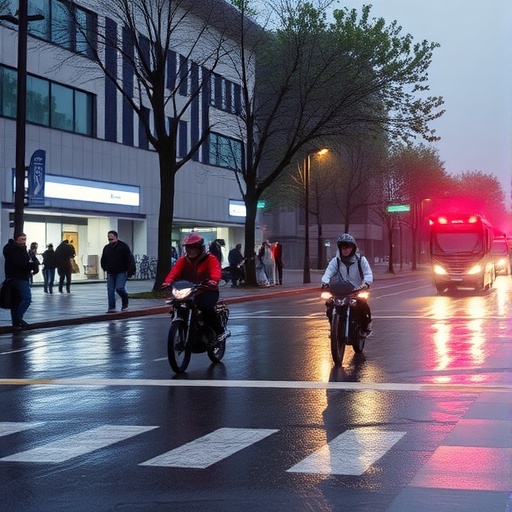
As extreme rainfall events become more frequent and severe under climate change, boosting disaster resilience is no longer optional—it is urgent. In a new study published in Nature Climate Change, researchers use large-scale mobility data to probe how connections between cities shape how quickly people and activities bounce back after extreme weather. Their focus is not only on the immediate impacts of flooding and heavy rain, but on recovery dynamics captured through a mobility-based functional proxy.
The team applies a multitreatment deep learning model (DML) with fixed effects to estimate conditional associations between intercity connectivity and post-disaster mobility performance. By doing so, they aim to distinguish robust relationships from spurious correlations that can arise from uneven geography, baseline differences, or confounding socioeconomic factors.
Across the observed range of rainfall events, cities with higher network centrality—and stronger linkages to economically dominant “elite” cities—show consistently lower TPL. Crucially, the pattern points to faster short-term recovery rather than a reduction in initial harm. The researchers interpret mobility surges after events as potentially reflecting the movement of relief personnel and responders, though they caution that other post-disaster mobility motives may also contribute.
Mechanistically, the authors argue that centrality may reduce recovery bottlenecks by increasing functional redundancy—multiple alternative channels for interaction when one route or node is disrupted. Elite-city ties, meanwhile, may align with hierarchical diffusion, connecting heavily affected regions to high-capacity nodes able to mobilize resources quickly, such as specialized equipment and professional rescue teams.
The study also connects resilience outcomes to how the intercity network evolves under different macro conditions. Historical socioeconomic growth periods correspond to lower TPL, while rollback and policy-induced restrictions are linked to larger losses. These shifts manifest differently across network dimensions: socioeconomic rollback weakens linkages, whereas restrictions tend to lower overall centrality.
Finally, scenario simulations highlight an infrastructure channel that is often overlooked. Sustained railway expansion toward a fully connected network is associated with lower TPL, translating into mobility-related avoided indirect economic losses of billions of CNY per year by midcentury. The results suggest that prioritizing weaker initial infrastructure may yield disproportionate resilience benefits.
Together, the findings position intercity connectivity as a critical—but underappreciated—dimension of urban climate resilience. The work suggests that city-centered adaptation should be complemented with network-oriented planning that explicitly improves how regions recover under extreme rainfall.
Cite Scienmag News
Sloane Callahan. (July 17, 2026). Intercity links boost urban mobility resilience during extreme rainfall. Scienmag. https://scienmag.com/intercity-links-boost-urban-mobility-resilience-during-extreme-rainfall/
Sloane Callahan. "Intercity links boost urban mobility resilience during extreme rainfall." Scienmag, 17 July 2026, https://scienmag.com/intercity-links-boost-urban-mobility-resilience-during-extreme-rainfall/. Accessed 3 September 2026.
Sloane Callahan. "Intercity links boost urban mobility resilience during extreme rainfall." Scienmag. July 17, 2026. https://scienmag.com/intercity-links-boost-urban-mobility-resilience-during-extreme-rainfall/


