


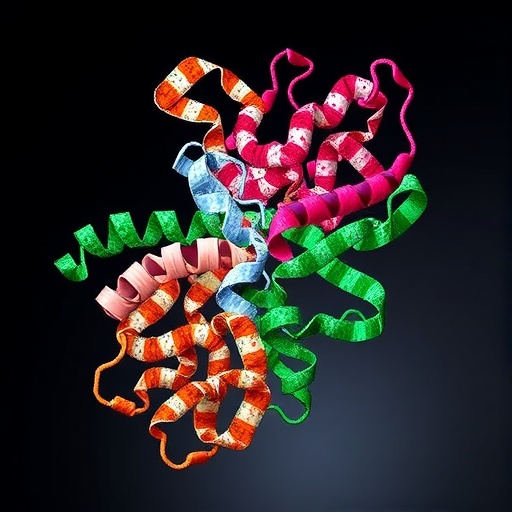
In a groundbreaking departure from previous conceptions, recent advances have unveiled that the epidermal growth factor receptor (EGFR) does not merely exist as solitary molecules embedded within the plasma membrane but rather assembles into sophisticated nanoscale clusters. These clusters are not the result of random aggregation; they represent finely tuned higher-order architectures that play a pivotal role in modulating receptor activation, ligand sensitivity, and signaling output. This conceptual revolution broadens our understanding of how EGFR functions at the molecular level, emphasizing the significance of spatial organization within the membrane milieu as a determinant of signal fidelity and efficiency.
The membrane environment surrounding EGFR is far from a passive backdrop. Instead, the receptor’s structure and functional dynamics are profoundly influenced by its incorporation into distinct lipid microdomains. Rather than float in a homogeneous lipid bilayer, EGFR preferentially localizes within specific membrane compartments rich in cholesterol and phosphoinositides such as PIP₂. These domains impart unique biophysical properties that can modulate the conformation of the transmembrane domain (TMD) and juxtamembrane regions, thereby impacting receptor dimerization and activation. Structural studies utilizing membrane-mimetic systems have revealed that lipid composition variably affects EGFR’s spatial arrangement and mobility, highlighting an underappreciated layer of regulation orchestrated by the lipid environment itself.
EGFR nanoclustering is not static but highly dynamic, responding to a plethora of cellular cues including ligand engagement, point mutations, and changing physiological conditions. Ligand binding has been shown to induce reorganization of EGFR molecules into functional signaling platforms, thereby modulating receptor responses in both magnitude and duration. Mutations associated with oncogenic transformation may disrupt or enhance nanocluster formation, altering downstream signaling cascades. This dynamism grants the cell exquisite control over the spatial and temporal aspects of EGFR signaling, allowing a diversified and context-dependent cellular response repertoire.
At the heart of these nanoscale clusters lies a mechanism of signal amplification and cooperative activation. Proximity among individual receptors enables conformational changes or activation events to propagate across neighboring molecules, elevating overall kinase activity. This emergent cooperation converts receptor clusters into potent signaling hubs where signal transduction efficiency is exponentially enhanced compared to isolated receptors. Such a framework offers mechanistic insights into how cells achieve high sensitivity to growth factors while maintaining signal specificity — a balance critical in processes ranging from development to oncogenesis.
Recent advances in cryo-electron tomography have allowed the visualization of EGFR clusters in situ within native membrane environments, capturing their physiological organization with exceptional resolution. These imaging studies reveal that EGFR receptors organize into ordered arrays characterized by precise inter-receptor distances and orientations essential for effective signaling. The clustering depends on a complex interplay of protein–protein interactions and selective lipid-mediated contacts, where lipids such as PIP₂ and cholesterol-rich membrane domains contribute to the stabilization of these supramolecular assemblies. This cooperative engagement underscores the intricate synergy between protein structure and lipid bilayer composition in dictating receptor behavior.
Beyond dimers, EGFR forms higher-order oligomers including tetramers and larger assemblies, adding another dimension to the regulatory architecture of receptor signaling. These oligomers exhibit enhanced activation efficiency and signal cooperativity, influencing key cellular outcomes such as receptor endocytosis, trafficking, and the temporal profile of signaling responses. Structural studies suggest that these oligomers are stabilized through multiple interaction interfaces spanning extracellular domains, transmembrane helices, and cytoplasmic kinase regions. This multilayered architecture implies that higher-order oligomerization functions as a sophisticated regulatory checkpoint modulating the receptor’s functional state.
Multiscale molecular dynamics simulations have provided atomistic insights into how the juxtamembrane domain of EGFR interacts selectively with PIP₂-containing lipid bilayers, revealing the importance of ionic and hydrophobic contacts in maintaining receptor conformation. These interactions modulate the dynamics of the TMD and JM regions, which are critical for dimerization and subsequent kinase activation. Changes in the lipid environment can therefore trigger conformational plasticity within EGFR molecules, highlighting the receptor’s inherent adaptability to its membrane context. Such findings emphasize the emerging role of the membrane as an active participant in modulating receptor function rather than a mere structural scaffold.
The specific lipid milieu not only stabilizes individual receptors but also orchestrates their clustering. Cholesterol-rich domains, often termed lipid rafts or caveolae, preferentially recruit EGFR and other signaling proteins, creating localized signaling nexuses. These membrane platforms segregate and coordinate signaling molecules, facilitating efficient transmission of extracellular cues into intracellular responses. Disruptions in lipid composition, whether due to pathological conditions or experimental interventions, can alter EGFR clustering and impair downstream signaling fidelity, offering potential avenues for therapeutic intervention.
Mutations impacting the interfaces involved in EGFR oligomerization have demonstrated differential effects on receptor function. Certain cancer-associated mutations increase receptor clustering tendency, enhancing kinase activity and downstream oncogenic signaling pathways. Conversely, mutations disrupting oligomer interfaces can reduce the ability of receptors to form competent signaling platforms, attenuating cellular responses to growth factors. This dualistic nature of mutations highlights the critical balance maintained by receptor oligomerization in cellular homeostasis and disease progression.
Functional studies have delineated how ligand binding serves as a trigger for EGFR cluster formation and propagation. Ligand-engaged EGFR molecules initiate allosteric conformational changes that stabilize kinase-active dimers and promote the nucleation of larger oligomeric assemblies. This process is key to transforming transient receptor activation events into sustained signaling outputs. Consequently, ligand binding not only shifts receptor conformational equilibria but also redefines the nanoscale landscape of receptor organization, underscoring the interdependence of biochemical and biophysical mechanisms in receptor biology.
Emerging experimental evidence suggests that the spatial organization of EGFR clusters may regulate the recruitment and assembly of downstream adaptor proteins and effectors. By arranging receptor molecules in ordered arrays, the membrane confines signaling complexes within defined nanodomains, increasing local concentrations of interactors and facilitating sequential signal relay. This nanoscale compartmentalization may also protect signaling components from phosphatases and other negative regulators, thus fine-tuning the balance between activation and attenuation of signal transduction pathways.
The interplay between receptor clustering and endocytic trafficking is increasingly recognized as a determinant of signaling duration and intensity. Oligomerized EGFR tends to display altered internalization kinetics, impacting its residence time on the cell surface and subsequent signaling profiles. Internalization of receptor clusters into endosomes can sustain or modify downstream signaling cascades, suggesting that nanoscale receptor organization extends its regulatory reach beyond the plasma membrane into intracellular compartments.
These integrative studies combining structural biology, biophysics, and cell biology paint a complex yet coherent picture of EGFR function that transcends classical monomer-dimer frameworks. The receptor emerges as a dynamic, membrane-associated entity whose activity is governed by multiscale interactions involving protein conformation, lipid environment, and nanoscale spatial organization. Such an enriched understanding sets the stage for developing novel therapeutic strategies targeting receptor clustering and membrane domain composition to modulate EGFR-driven pathologies.
Overall, these insights not only revise fundamental models of receptor tyrosine kinase activation but also emphasize the centrality of membrane biophysics in cell signaling. The recognition that EGFR clustering constitutes a critical regulatory paradigm invites new exploration into how nanoscale membrane organization influences diverse signaling networks and cellular outcomes across physiological and pathological contexts. This paradigm shift heralds an era where spatial biology and structural dynamics converge to unravel the sophisticated choreography that governs cellular communication, adaptability, and fate determination.
Cite Scienmag News
Nathaniel Bowman. (June 5, 2026). Integrative Structural and Dynamics Insights into EGFR. Scienmag. https://scienmag.com/integrative-structural-and-dynamics-insights-into-egfr/
Nathaniel Bowman. "Integrative Structural and Dynamics Insights into EGFR." Scienmag, 5 June 2026, https://scienmag.com/integrative-structural-and-dynamics-insights-into-egfr/. Accessed 6 September 2026.
Nathaniel Bowman. "Integrative Structural and Dynamics Insights into EGFR." Scienmag. June 5, 2026. https://scienmag.com/integrative-structural-and-dynamics-insights-into-egfr/


