


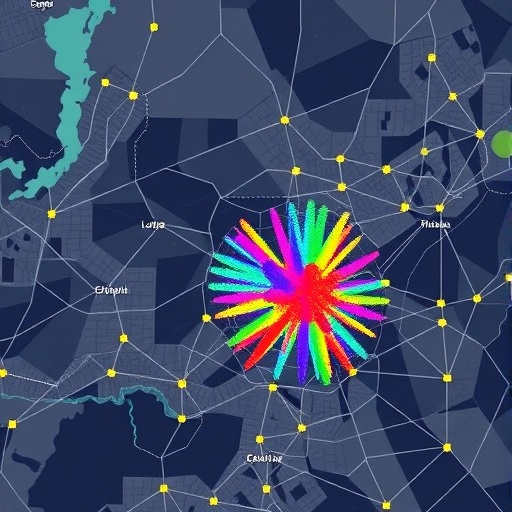
In the evolving landscape of biomedical research, the integration of geospatial data represents a transformative frontier, promising to unlock deeper insights into health and disease dynamics. The recent publication by Jentsch, Polemiti, Renner, and their colleagues, titled “CLUES: A Comprehensive Workflow for Integrating Geospatial Data in Biomedical Research,” heralds a significant leap forward by presenting a robust and scalable framework specifically designed for this integration. Featured in Nature Communications, this work outlines an innovative pipeline that enables researchers to systematically incorporate diverse spatial datasets into the biomedical domain, setting the stage for breakthroughs in epidemiology, public health, and personalized medicine.
One of the critical challenges that have historically limited the use of geospatial data in biomedical fields is the heterogeneity and complexity of spatial data sources. These datasets often vary widely in resolution, format, and coverage, ranging from satellite imagery and environmental sensors to public health registries and electronic health records. The CLUES workflow thoughtfully addresses this diversity by introducing modular, interoperable processing components capable of harmonizing disparate data types. This harmonization not only facilitates the consistent representation of spatial information but also enhances the reproducibility and scalability of analyses across different biomedical contexts.
The strength of CLUES lies not only in its technical sophistication but also in its user-centric design. By balancing powerful computational tools with accessible workflows, the platform enables biomedical researchers without advanced geospatial expertise to leverage complex spatial analytics effectively. The workflow encompasses critical stages, including data ingestion, quality control, integration methodologies, spatial analysis, and visualization—all orchestrated within an automated framework that reduces manual intervention and error-prone steps. This design empowers researchers to focus more on scientific inquiry while reducing technical overhead.
Central to the CLUES methodology is its capacity to integrate geospatial environmental exposures with individual health data, creating a multidimensional map of disease risk and resilience factors. Environmental determinants—such as pollution levels, green space proximity, climate variables, and urban infrastructure—are increasingly recognized as vital contributors to health outcomes. By quantifying these factors with high spatial and temporal resolution and linking them to biomedical data at the individual level, CLUES facilitates novel investigations into the causal pathways of complex diseases.
Furthermore, the platform’s adaptability allows it to be applied across various scales, from local neighborhood analyses to global health surveillance. For instance, in infectious disease modeling, CLUES can integrate mobility patterns, climatic fluctuations, and socio-economic indicators to anticipate outbreak hotspots more accurately. This scalability ensures relevance to diverse biomedical challenges, ranging from chronic diseases influenced by environmental exposures to emerging public health threats requiring real-time spatial monitoring.
Behind the scenes, the authors have implemented advanced geospatial data techniques such as spatial interpolation, geocoding, and spatial smoothing within the CLUES pipeline. These methods enable accurate spatial alignment and enhancement of data quality, addressing common issues such as missing data points and locational inaccuracies. Moreover, the workflow incorporates machine learning algorithms that can detect spatial clusters and trends, thereby enriching the interpretability of complex biomedical datasets.
An equally important dimension of the CLUES workflow is its commitment to data privacy and ethical considerations, which are paramount when handling sensitive biomedical and location-based data. The platform incorporates secure data management practices, ensuring that individual identities remain protected while still allowing detailed geospatial analyses. This ethical grounding sets a standard for future work at the intersection of spatial data science and biomedical research, where concerns over data misuse often arise.
The researchers also emphasize reproducibility and transparency, promoting open-source availability of the CLUES software and thorough documentation. This openness enables other scientists to validate, extend, and tailor the workflow to their specific research questions. In doing so, CLUES encourages a collaborative research environment, fostering innovation by bridging disciplines such as computer science, epidemiology, environmental science, and clinical research.
Visualization represents another pillar of the CLUES framework. By generating high-resolution spatial maps and dynamic visual analytics, researchers can intuitively explore complex relationships between environmental factors and health outcomes. These visual tools not only aid scientific discovery but also support communication with policymakers and the general public, bridging the gap between data complexity and real-world decision-making.
More broadly, the introduction of CLUES signals an important shift towards spatially informed precision medicine. As healthcare moves toward more personalized and context-aware approaches, understanding the geospatial dimension of health risks becomes critical. CLUES equips researchers and clinicians with the tools to integrate location-based insights into patient assessments and population health strategies, potentially transforming disease prevention and management paradigms.
Moreover, the CLUES workflow opens avenues for novel epidemiological hypotheses by revealing spatial patterns that might otherwise remain obscured. For example, identifying environmental exposure gradients or socio-demographic clusters can generate hypotheses about the mechanisms of disease initiation and progression. Such insights are invaluable for targeting interventions and allocating health resources more efficiently.
The work also foresees future integrations with emerging data streams such as real-time environmental sensors, mobile health applications, and genomics. By embracing flexible data architectures, CLUES is well positioned to evolve alongside technological advancements, continuously enhancing its impact on biomedical research. This forward-thinking design ensures that CLUES remains relevant in a rapidly changing data ecosystem.
In sum, the comprehensive workflow presented by Jentsch and colleagues represents a landmark contribution to the burgeoning field of spatial biomedicine. By offering a sophisticated yet accessible platform to integrate geospatial data with biomedical research, CLUES promises to deepen our understanding of the environment’s role in health and disease. Its potential to inform targeted interventions, improve epidemiological models, and advance personalized medicine underscores the transformative power of spatial data integration in the biomedical sciences.
As research communities worldwide grapple with increasingly complex datasets and pressing health challenges, CLUES provides a much-needed blueprint for harnessing the wealth of spatial information available today. The future of biomedicine will undoubtedly be richer and more nuanced thanks to innovative tools like CLUES that bridge geography and biology in unprecedented ways. This groundbreaking work sets a new standard, inviting interdisciplinary collaboration and unlocking pathways to better health outcomes globally.
Cite Scienmag News
Phoebe Ingram. (May 13, 2026). Integrating Geospatial Data into Biomedical Research Workflow. Scienmag. https://scienmag.com/integrating-geospatial-data-into-biomedical-research-workflow/
Phoebe Ingram. "Integrating Geospatial Data into Biomedical Research Workflow." Scienmag, 13 May 2026, https://scienmag.com/integrating-geospatial-data-into-biomedical-research-workflow/. Accessed 6 September 2026.
Phoebe Ingram. "Integrating Geospatial Data into Biomedical Research Workflow." Scienmag. May 13, 2026. https://scienmag.com/integrating-geospatial-data-into-biomedical-research-workflow/


