


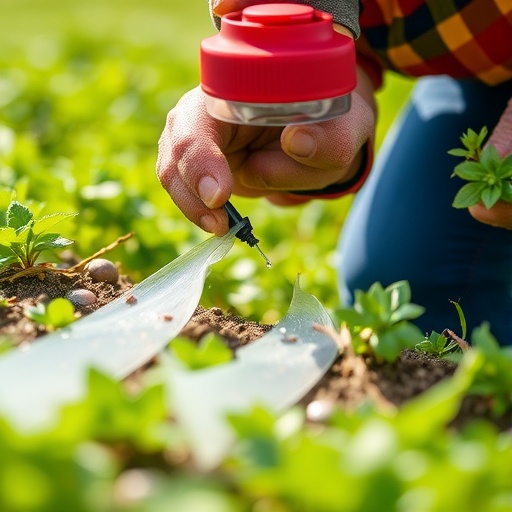
Water droplets effortlessly sliding off or bouncing away from a leaf’s surface are commonplace in nature, a phenomenon rooted in the leaf’s waxy hydrophobic coating that repels water. While this natural adaptation helps plants shed excess moisture, it simultaneously poses significant challenges in agricultural practices, specifically in the application of pesticides. When pesticide droplets strike plant surfaces, many fail to adhere, instead bouncing off and contaminating the surrounding environment, including soil and water bodies. This inefficiency not only diminishes the effectiveness of pest control but also contributes substantially to environmental pollution.
Rutvik Lathia, a former doctoral researcher at the Centre for Nano Science and Engineering (CeNSE) at the Indian Institute of Science (IISc), now conducting postdoctoral research at the Max Planck Institute for Polymer Research, highlights the severity of this issue. According to Lathia, approximately 50 percent of pesticides sprayed are lost due to the hydrophobic nature of plant surfaces, emphasizing the urgent need for improved deposition methodologies.
Addressing this widespread agricultural problem, Lathia has been part of an innovative research team led by Associate Professor Prosenjit Sen at CeNSE, which has pioneered a novel approach harnessing the unique properties of liquid marbles (LMs). Liquid marbles are essentially droplets encapsulated by a shell of hydrophobic particles, acting as miniature, self-contained vessels. Traditionally utilized in specialized chemical and biochemical reaction studies, LMs provide a promising platform for droplet deposition, offering an environmentally benign alternative to surfactants, polymers, and oils commonly employed to increase wettability, many of which pose environmental hazards.
By leveraging previous research involving droplet interactions on superhydrophobic surfaces, the team observed a critical behavior: liquid marbles do not rebound as readily as bare water droplets when impacting such surfaces. This phenomenon inspired the exploration of LMs as carriers for pesticides, aiming to increase droplet retention on hydrophobic plant leaves and thus enhance deposition efficiency.
To fabricate liquid marbles suitable for agricultural application, the research team developed a method involving the creation of a bed composed of selected hydrophobic particles. Pure water droplets were then rolled over this bed, acquiring a uniform particle coating effectively transforming them into liquid marbles. For experimental validation, hydrophobic substrates were prepared by coating glass and silicon surfaces with hydrophobic polymers such as Teflon and polydimethylsiloxane (PDMS), known for their water-repelling and chemically inert properties. Recognizing that plant surfaces are often flexible rather than rigid, the study extended to fabricating stainless steel cantilever beams of varying lengths, subsequently coated with Teflon to emulate the compliance and hydrophobicity of real leaves.
Crucially, the choice of hydrophobic particles lining the LMs presented a substantial challenge. Conventional laboratory materials like hydrophobic glass beads and Teflon particles, though effective, bear toxicity risks detrimental to plant health. To circumvent this, the researchers innovatively explored biodegradable and organic alternatives such as lycopodium spores and zein protein particles derived from corn. Zein stands out due to its insolubility in water and inherent film-forming capability, attributes that conferred enhanced adhesion and environmental compatibility to the LMs. Comparative tests demonstrated that these organic particle-coated LMs outperformed their glass bead counterparts, evidencing superior droplet adherence on rose plant leaves used in the trials.
From a mechanistic perspective, the unique deposition behavior of liquid marbles on hydrophobic surfaces stems from their dynamic energy dissipation process during impact. Upon collision, a liquid marble flattens and spreads over the surface before retracting. This retraction phase induces collisions among the hydrophobic particles forming the marble’s shell. These inter-particle interactions generate significant energy losses through fluid motion impeded by ‘jammed’ particles within the coating, drastically reducing the marble’s capacity to bounce back. Consequently, the liquid inside the marble remains on the surface, resulting in notably improved retention and deposition compared to untreated water droplets.
Beyond the agricultural context, the research team foresees versatile applications for this technology, such as precision printing on hydrophobic substrates, including certain hard plastics, thereby expanding the potential impact of liquid marble-mediated deposition processes across multiple industries.
Despite the proof-of-concept demonstrating the efficacy of liquid marbles for enhanced droplet deposition, significant hurdles remain before commercialization. Scaling up production to generate large volumes of uniform LMs during pesticide spraying operations is a major engineering challenge. “We must develop cost-effective and scalable methods to produce these liquid marbles on demand to meet agricultural application demands,” says Sen, emphasizing the necessity for innovation in manufacturing alongside the material science advancements.
Altogether, this pioneering work marks a substantial step forward in addressing pesticide wastage and environmental contamination. By exploiting the interfacial physics of liquid marbles coated with environmentally friendly hydrophobic particles, the research offers a practical strategy to maximize pesticide efficacy while minimizing harmful environmental effects. Given the global reliance on pesticides in agriculture, this breakthrough holds tremendous promise for sustainable farming practices worldwide.
News Publication Date:
29-Sep-2025
Web References:
10.1016/j.jcis.2025.139144
Cite Scienmag News
Alan Morgan. (November 5, 2025). Innovative Adhesive Formula Boosts Pesticide Deposition Efficiency. Scienmag. https://scienmag.com/innovative-adhesive-formula-boosts-pesticide-deposition-efficiency/
Alan Morgan. "Innovative Adhesive Formula Boosts Pesticide Deposition Efficiency." Scienmag, 5 November 2025, https://scienmag.com/innovative-adhesive-formula-boosts-pesticide-deposition-efficiency/. Accessed 4 September 2026.
Alan Morgan. "Innovative Adhesive Formula Boosts Pesticide Deposition Efficiency." Scienmag. November 5, 2025. https://scienmag.com/innovative-adhesive-formula-boosts-pesticide-deposition-efficiency/


