


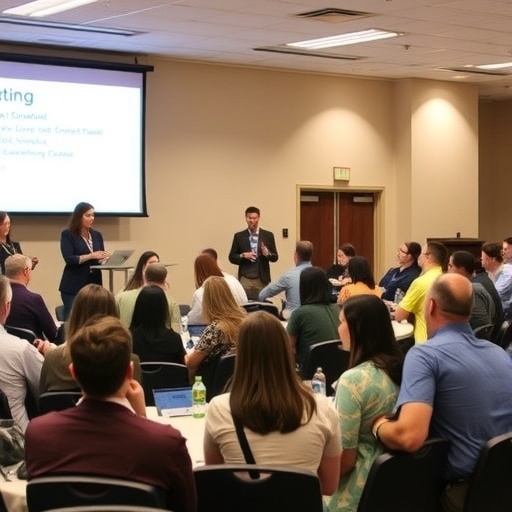
In the vibrant city of Knoxville, Tennessee, a remarkable convergence of innovators, entrepreneurs, investors, and federal leaders took place on May 13, 2026, at Covenant Health Park. This significant gathering, known as Demo Day 2026, highlighted the transformative power of the Department of Energy’s Lab-Embedded Entrepreneurship Program (LEEP). Organized by Oak Ridge National Laboratory’s (ORNL) Innovation Crossroads, Demo Day was a celebration of breakthrough technologies transitioning seamlessly from research labs into thriving startups, marking a pivotal moment in the energy and manufacturing sectors.
At the heart of this event lies Innovation Crossroads, a visionary program dedicated to empowering early career entrepreneurs in energy and manufacturing. Over the past decade, this initiative has fostered a collaborative ecosystem where scientists and business leaders join forces with ORNL’s cutting-edge infrastructure and expertise. The program is designed as a rigorous two-year journey, offering its fellows mentorship not only in technical innovation but also in marketing strategies and entrepreneurial management, thereby ensuring that scientific ideas reach commercial viability.
Innovation Crossroads’ ten-year legacy is profound. Since its inception in 2017, it has supported more than 51 startups, with a remarkable retention of over half choosing to remain in the East Tennessee region. These companies collectively have generated revenues exceeding $100 million and attracted over $326 million in follow-on investments. This sustained impact underscores the program’s ability to catalyze regional economic growth and enhance the local innovation landscape, transforming East Tennessee into a burgeoning hub for advanced technology commercialization.
One of the standout voices from this community, Brian Iezzi, founder of Fibarcode and an Innovation Crossroads fellow, exemplifies the technical advancements nurtured through the program. Leveraging the Carbon Fiber Technology Facility (CFTF) at ORNL, Iezzi has transitioned from batch processing methods to a more efficient continuous process for producing fiber-reinforced composites, showcasing how national laboratory capabilities can directly accelerate solution-oriented manufacturing technologies.
The direct correlation between Innovation Crossroads and the DOE’s Lab-Embedded Entrepreneurship Program (LEEP) highlights a striking triumph in entrepreneurial success rates. Nationally, startup ventures face daunting odds, with approximately half failing within five years and first-time founders experiencing an even lower success rate at 18 percent. LEEP-supported ventures defy these trends, boasting a remarkable 92 percent survival rate. This high degree of success is reflected not only in monetary growth—amounting to nearly $6 billion in follow-on funding—but also in substantial job creation, with more than 3,900 American jobs attributed to LEEP fellows.
This year’s Innovation Crossroads cohort continues this trajectory of excellence. The 2024 fellows are developing cutting-edge technologies with profound implications for energy efficiency and sustainable manufacturing. For example, Cassette Construction is tackling inefficiencies in conventional construction processes, while Circular Biosciences introduces pioneering approaches to accelerate plastic degradation, addressing persistent environmental issues. Elemental Composites focuses on expanding the supply chain for fiber-reinforced composites, a material crucial for lightweight, high-strength applications essential to modern manufacturing.
Further enriching this innovation cohort, Fibarcode’s novel textile labeling technology offers enhanced product authentication and lifecycle management, critical for quality assurance and anti-counterfeiting measures. AtomQ is advancing quantum computing by scaling the availability of qubits, the fundamental units of quantum information, thus pushing the boundaries of computational power. Meanwhile, Coulomb Technology innovates in battery cell manufacturing, aiming to improve energy storage solutions vital for electric vehicles and stationary applications.
The Demo Day environment was electric, bringing together a diverse audience eager to witness the future of American innovation. Attendees included local leaders like Knox County Mayor Glenn Jacobs, who emphasized the community-wide benefits of such programs, underscoring how innovation nurtured at ORNL and through these entrepreneurial networks fosters job creation and economic expansion. The event’s unique half-time pitch session at a OneKnox soccer game symbolized the merging of community engagement with technological progress, further elevating the visibility of these startups and their transformative ambitions.
Beyond the immediate sphere of startups, Innovation Crossroads benefits from robust support from several branches of the Department of Energy. Funding and guidance come from the Advanced Materials and Manufacturing Technologies Office, the Building Technologies Office, and the Office of Science’s Basic Energy Sciences program. Collaboration with the Tennessee Valley Authority further integrates regional resources, underscoring a comprehensive strategy to accelerate technology transfer from DOE national labs to market-ready innovations.
UT-Battelle’s management of ORNL underlines the national laboratory’s role as a critical engine for scientific advancement, particularly in physical sciences. ORNL’s status as the largest supporter of basic research in the U.S. Department of Energy’s Office of Science aligns with the strategic goal of addressing pressing societal and environmental challenges through scientific discovery and technological innovation. The synergy between ORNL’s research agenda and programs like Innovation Crossroads exemplifies a model of effective technology commercialization that other regions might emulate.
In summary, the LEEP Demo Day 2026 and the ongoing success of Innovation Crossroads highlight a transformative chapter in American entrepreneurship embedded within national laboratories. The fusion of technical rigor, strategic mentorship, and community engagement exemplifies a powerful framework that not only supports high-tech innovation but also drives substantial economic and job growth. As the program moves forward, it continues to set a high bar for how government resources can be leveraged to nurture the next generation of energy and manufacturing leaders.
News Publication Date: May 13, 2026
Web References:
- Innovation Crossroads: https://innovationcrossroads.ornl.gov/
- Carbon Fiber Technology Facility: https://www.ornl.gov/facility/cftf
- DOE Advanced Materials and Manufacturing Technologies Office: https://www.energy.gov/cmei/ammto/advanced-materials-and-manufacturing-technologies-office
- DOE Building Technologies Office: https://www.energy.gov/cmei/buildings/building-technologies-office
- DOE Office of Science Basic Energy Sciences program: https://www.energy.gov/science/bes/basic-energy-sciences
- Tennessee Valley Authority: https://www.tva.com/
- DOE Office of Technology Commercialization: https://www.energy.gov/technologycommercialization/office-technology-commercialization
- DOE Office of Science: https://energy.gov/science
Cite Scienmag News
Courtney Benton. (May 27, 2026). Innovation Crossroads Marks a Decade of Entrepreneurship at LEEP Demo Day. Scienmag. https://scienmag.com/innovation-crossroads-marks-a-decade-of-entrepreneurship-at-leep-demo-day/
Courtney Benton. "Innovation Crossroads Marks a Decade of Entrepreneurship at LEEP Demo Day." Scienmag, 27 May 2026, https://scienmag.com/innovation-crossroads-marks-a-decade-of-entrepreneurship-at-leep-demo-day/. Accessed 3 September 2026.
Courtney Benton. "Innovation Crossroads Marks a Decade of Entrepreneurship at LEEP Demo Day." Scienmag. May 27, 2026. https://scienmag.com/innovation-crossroads-marks-a-decade-of-entrepreneurship-at-leep-demo-day/


