


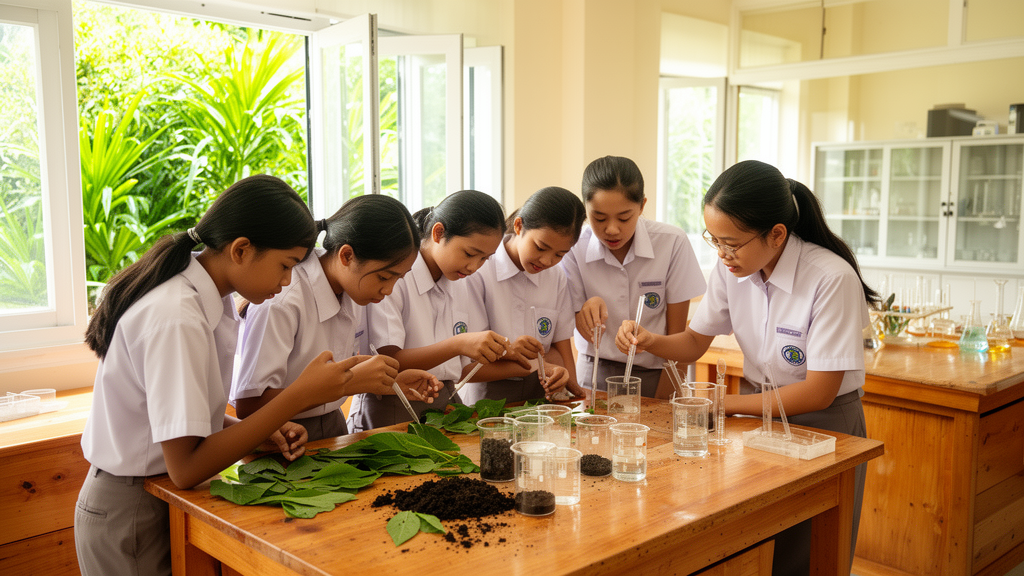
A systematic review of 32 studies on eco-enzyme activities in formal science education found that Project-Based Learning dominates classroom approaches, but the research provides little evidence that the approach outperforms alternatives. The studies, all conducted in Indonesia between 2021 and 2026, show growing interest in using fermented fruit and vegetable waste as an authentic context for chemistry, biology, environmental learning and character education. Yet only 15.6% used a comparison-group design, 25.0% reported no student learning outcomes, and 59.4% focused solely on the production procedure rather than the mechanisms that explain fermentation.
Eco enzyme is a fermented liquid made from organic waste, brown sugar or molasses, and water over an extended period that the source describes as approximately three months. It can be used as a cleaning agent, fertilizer or pest-control product, and has also been promoted for odor control, air freshening and soil conditioning. Citrus, pineapple and papaya peels tend to produce a more acidic liquid with a stronger citrus aroma, while vegetable waste is reported to ferment more slowly and develop a milder odor. Because the material is inexpensive, locally available and physically transformative, production can connect waste reduction with microbiology, organic chemistry and green chemistry in a classroom project.
The review followed PRISMA 2020 and PRISMA-S guidance, searching Scopus, Dimensions and Lens.org on 8 August 2026 without a publication-year restriction. The initial search produced 756 records. After document-type filtering, removal of 298 duplicates and several stages of title, abstract and full-text screening, 32 eligible peer-reviewed studies remained. Two reviewers independently screened the records, reaching 93% agreement at the title-and-abstract stage and 90% at full text; four disagreements were resolved by discussion with a third author. Methodological quality was appraised with the 2018 Mixed Methods Appraisal Tool, which permits heterogeneous quantitative, qualitative and mixed-methods studies to be evaluated without calculating a single composite score.
Project-Based Learning, abbreviated PjBL, appeared in 20 of the 32 studies, or 62.5% of the corpus. Its prominence is plausible because fermentation unfolds over weeks or months, produces a tangible result and naturally supports teamwork, investigation and monitoring. Hands-on practical work appeared in 18.8% of studies and demonstrations in 12.5%, while only one study used Problem-Based Learning in the distinct sense of organizing instruction around an authentic problem rather than an extended final product. The review treats PjBL’s frequency as evidence of its reporting popularity, not as proof of high implementation quality or educational effectiveness. Indeed, most design-based studies assessed the validity and practicality of newly developed teaching materials rather than changes in student learning.
Content representation was less developed than pedagogy. General fermentation principles and waste types each appeared in 31.3% of studies, but deeper concepts—including microbial roles, fermentation biochemistry, lactic-acid-bacteria isolation, product characterization and chemical analysis—featured in only one to three studies each. Green chemistry appeared in 6.3% of the corpus, despite the process’s direct relevance to waste valorization and green chemistry education. Biology was the most common subject pathway, while chemistry accounted for only 9.4%. The evidence therefore suggests that a chemically and microbiologically complex process is still taught mainly through a biological lens, often as a procedure for turning discarded peels into a usable product rather than as an inquiry into pH change, microbial activity or organic-acid formation.
Assessment was dominated by observation, reported in 46.9% of studies, followed by tests in 34.4% and questionnaires in 31.3%. Observation can capture engagement and process-related behavior, especially in early-childhood settings, but it can also be sensitive to observer judgment unless supported by explicit criteria and other forms of evidence. Pre-test and post-test designs were used in 31.8% of the studies, including one reported increase from a mean pre-test score of 62.4 to 91.2, corresponding to an N-gain of 0.77. That value describes within-group improvement and does not show that eco-enzyme instruction caused the change or performed better than another approach. By contrast, quasi-experimental studies with control groups provide the corpus’s strongest comparative evidence, but they remain a small minority.
Outcomes were varied but unevenly evidenced. Environmental literacy was reported in 15.6% of studies, while pro-environmental attitudes, conceptual understanding, science-process skills and problem-solving each appeared in 12.5%. Critical thinking was measured in only two studies and creative thinking in one. Eight articles reported no specific learning outcome at all, instead focusing on product validity, expert judgment or practical usability. The review also separates feasibility evidence from effectiveness evidence: a well-rated module can show that educators regard a resource as usable, but it cannot establish that learners gained knowledge, changed attitudes or developed higher-order skills. Most studies were short, generally lasting no more than a semester, leaving long-term retention and sustained environmental behavior unresolved.
Digital representation was notably sparse. Electronic modules were used in 21.9% of studies, and physical production materials remained central, appearing in 31.3%. Only one included study used augmented reality and artificial intelligence in a “Smart Digital Laboratory,” and it did not use those tools specifically to visualize, model or accelerate fermentation. No study used virtual reality or a simulation to represent the process. This absence matters because fermentation is dynamic and time-dependent: students cannot readily observe microbial transformations in real time or compress a multi-month sequence into an observable classroom episode. Interactive tools could therefore address a specific representational challenge, although the review presents their use as an opportunity rather than an intervention already shown to improve learning.
All included studies originated in Indonesia, where abundant fruit and vegetable waste, a tropical climate and national project-based learning initiatives provide favorable conditions for eco-enzyme activities. The concentration also limits generalizability: comparable curriculum, teacher preparation, material availability and environmental conditions have not been tested across other countries. Publication growth accelerated sharply in 2024, with 11 studies, and continued with 10 in 2025; the smaller 2026 count reflects a mid-year database search rather than evidence of a lasting decline. The 32 articles appeared across 32 different journals, suggesting dispersed uptake rather than consolidation around a specialized research community. The review therefore characterizes eco-enzyme education as a rapidly expanding but still geographically narrow field.
Using Subject-Specific Pedagogy as its analytical framework, the review links three elements that must work together: how eco-enzyme content is represented, how students learn from it, and how learning is assessed. It identifies an emerging pattern in which younger learners handle production and waste sorting, secondary students study fermentation and environmental concepts, and undergraduates engage in more analytical work. Because the studies were designed independently, however, this pattern is not a demonstrated learning progression. The review’s proposed sequence remains explicitly untested. To turn an appealing recycled-material activity into stronger scientific education, future studies will need comparison groups, structured performance measures, deeper mechanistic content and more rigorous ways to track learning over time.
Subject of Research: How eco-enzyme projects integrate content, pedagogy and assessment in Indonesian science education
Article Title: Eco enzyme in science education: a systematic literature review from a Subject-Specific Pedagogy perspective
Article References: Hindrasti, N. E. K., Sajidan, S., & Masykuri, M. (2026). Eco enzyme in science education: a systematic literature review from a Subject-Specific Pedagogy perspective. Discover Education, 5(1), Article 1202. https://doi.org/10.1007/s44217-026-02337-5
Image Credits: AI Generated
DOI: 10.1007/s44217-026-02337-5
Keywords: eco-enzyme education, science education, subject-specific pedagogy, project-based learning, green chemistry, fermentation, environmental literacy, systematic review, Indonesia, assessment, enzyme, science
Cite Scienmag News
Courtney Benton. (October 20, 2026). Indonesian eco-enzyme education review finds project learning outpaces evidence. Scienmag. https://scienmag.com/indonesian-eco-enzyme-education-review-finds-project-learning-outpaces-evidence/
Courtney Benton. "Indonesian eco-enzyme education review finds project learning outpaces evidence." Scienmag, 20 October 2026, https://scienmag.com/indonesian-eco-enzyme-education-review-finds-project-learning-outpaces-evidence/. Accessed 20 October 2026.
Courtney Benton. "Indonesian eco-enzyme education review finds project learning outpaces evidence." Scienmag. October 20, 2026. https://scienmag.com/indonesian-eco-enzyme-education-review-finds-project-learning-outpaces-evidence/


