


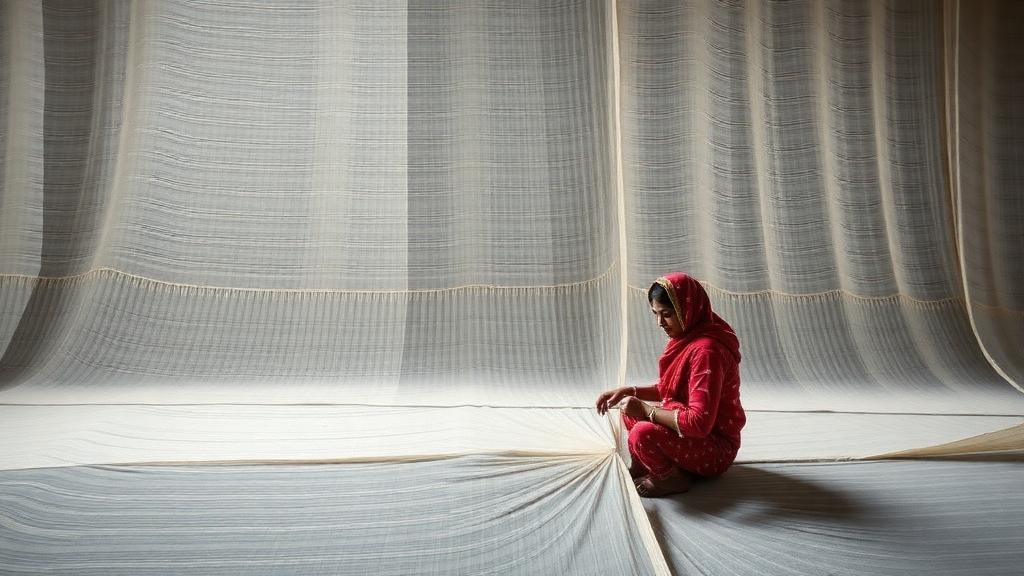
India’s handloom weavers may already be producing the most circular textiles on Earth, yet a new study warns that the global push for a circular economy could leave them behind. Research published in Discover Global Society introduces a stark new concept, the circular informalization trap, to describe how sustainability governance designed for factories and listed corporations can systematically bypass the very workers whose craft embodies circular principles. The study, led by Apurva Bandodcar of SES’s Sridora Caculo College of Commerce and Management Studies with colleagues Viana Hasan and Mrinal Valke, argues that unless policymakers deliberately connect two regulatory systems that currently operate in parallel, the transition to circular fashion will deepen the precarity of the women who make its most sustainable products.
The circular economy has become the dominant framework for reforming the fashion and textile industry, which produces an estimated 92 million tonnes of textile waste annually and recycles less than 1 percent of clothing into new fibres, according to the Ellen MacArthur Foundation’s landmark New Textiles Economy report. Policy instruments such as the European Union’s Ecodesign for Sustainable Products Regulation and India’s own Business Responsibility and Sustainability Reporting framework promise longer product life cycles, local material systems, and community-anchored production. But the dominant narrative centres on industrial transformation in the Global North: recycling infrastructure, take-back programmes, and fibre-to-fibre loops operated by formal, traceable, ESG-reportable firms. That assumption, the new paper contends, simply does not hold in India, where the craft textile sector employs an estimated 113 lakh workers, nearly 72 percent of them women, overwhelmingly in informal household production.
To measure the problem, the researchers built two original composite indices grounded entirely in verified, publicly available official data. The first, the GI-CE Institutional Alignment Score, measures how far the statutory provisions of India’s Geographical Indications Act of 1999 mandate circular-economy-compatible supply chains across 25 GI-registered textile products, from Kanchipuram silk to Banarasi brocades. The second, the Circular Informality Exposure Index, measures how vulnerable the artisans in those clusters are to the social risks of circular transition. The data sources are legally anchored and temporally consistent: the GI registry maintained by the Controller General of Patents, Designs and Trade Marks, the Fourth All India Handloom Census 2019-20, the Periodic Labour Force Survey Annual Report 2023-24, and the Securities and Exchange Board of India’s BRSR framework documents.
The results reveal a striking paradox. The GI-tagged craft textile clusters score consistently high on institutional circular alignment, with a mean score of 4.36 out of 5. This is no accident: the GI Act legally requires geographic input localisation, community-based producer organisation, and natural or traditional input specification, properties that structurally replicate every definitional criterion of a circular supply chain. Yet the workers inside these institutionally circular systems are among the most socially vulnerable in India’s manufacturing economy. Average daily earnings across the five-state handloom and handicraft economy surveyed by the Institute for Human Development and Crafts Council of India stand at just 270 rupees, well below minimum wage in every Indian state. Only 8.8 percent of weaver households access markets through cooperatives, and nine out of ten women in Indian manufacturing work in informal enterprises without contracts or social security.
Cross-referencing the two indices produces the study’s central empirical finding: nine of the 25 clusters, or 36 percent of the sample, fall squarely into the circular informalization trap, combining high institutional circular alignment with high informality exposure. These trapped clusters cluster geographically in two contexts: the North Indian plains, including Uttar Pradesh, Punjab, and Rajasthan, where cooperative market channel use falls below the national median and female part-time weaver concentration exceeds the average of 60.6 percent; and recently registered tribal textiles from the Northeast, such as Garo and Tangsa weaves, where the authorised user mechanism that should guarantee producer traceability has not yet been operationalised. No product fell into the low-alignment quadrants, reflecting how thoroughly the statute itself embeds circular design.
The deepest structural gap lies in environmental, social, and governance disclosure. SEBI’s BRSR framework, mandatory since the 2022-23 financial year for India’s top 1,000 listed companies by market capitalisation, requires comprehensive reporting across 140 questions, including human rights, labour practices, and supply chain conduct, with the BRSR Core adding 49 measurable key performance indicators and third-party assurance for the largest firms. But because the framework’s scope is defined by market capitalisation, no handloom cooperative, tribal craft association, or GI-registered producer group falls within it. All 25 clusters scored maximally on the ESG disclosure exclusion dimension of the informality index. The firms whose supply chains depend on artisan labour must disclose their ethics; the artisans who perform that labour remain entirely outside the disclosure perimeter, a disjunction the authors call the relative ESG discourse-labour asymmetry.
The gendered dimensions of this trap are particularly consequential. India’s female labour force participation rate has risen sharply, from 23.3 percent in 2017-18 to 41.7 percent in 2023-24, but the increase has been driven predominantly by rural self-employed women, more than 80 percent of them in agriculture or household-based production. The handloom sector, with its 72 percent female majority, part-time household structure, and chronic underemployment of 208 person-days per year, exemplifies this expansion of informal self-employment rather than gender-equalising formal job growth. The circular transition could carry a genuine gender dividend, since it raises the value of precisely the provenance, natural inputs, and durable craftsmanship that women artisans produce. But if circular premiums are captured by intermediaries and formal firms instead, women would bear the informality costs while the formal economy appropriates the circular value.
The trap also operates globally. European regulations, including Digital Product Passports under the Ecodesign regulation, corporate sustainability due diligence directives, and a proposed Forced Labour Regulation, are creating new traceability demands for textile imports. GI-registered Indian craft textiles are, by institutional design, exceptionally well positioned to meet them: authorised user registration provides producer identity, statutory collective applicant requirements provide community organisation, and Form GI-1 specifications document natural inputs. The authors argue that recognising GI registration as equivalent to Digital Product Passport compliance could satisfy EU requirements at a fraction of the cost industrial firms face, yet this compatibility remains invisible to European policymakers, Indian trade negotiators, and the corporations involved. Similar structural conditions, an origin-certification framework, a feminised informal workforce, and ESG rules scoped to formal entities, exist in Indonesia’s batik clusters, Peru’s Andean textile geographical indications, and among West African kente producers, suggesting the trap may be a global regularity rather than an Indian anomaly.
Crucially, the study insists that closing the gap requires no new legislation, infrastructure, or institutions, only the political will to connect systems that already exist. The authors advance four targeted recommendations. SEBI could amend BRSR Core leadership indicators by circular, making disclosure of GI-registered and informal artisan supply chain tiers mandatory rather than voluntary for large listed textile firms. The Department for Promotion of Industry and Internal Trade and the Ministry of Textiles could jointly issue a GI-CE Equivalence Framework, mapping statutory GI requirements onto circular procurement criteria and green finance access. The National Cooperative Development Corporation could extend cooperative market channel access from 8.8 percent to 25 percent of weaver households within five years, prioritising the trapped clusters and using existing artisan identity data for outreach. And in European Union-India free trade negotiations, GI-Digital Product Passport equivalence could be tabled as a technical annex, directly rewarding the institutional architecture India’s craft sector already possesses.
The broader lesson extends far beyond textiles. The circular economy is routinely framed as a redesign challenge, a matter of recycling plants and business models, but this research demonstrates that governance architecture, not technology, determines who benefits from sustainability transitions. India’s Geographical Indication system has already designed a circular supply chain; the Handloom Census has already documented the cooperative forms that could channel circular premiums to producers; and the BRSR framework has already built the disclosure infrastructure that could make artisan labour visible. What is missing is the linkage between them. Without it, the world’s most circular textiles will continue to be made by some of its most precarious workers, and the sustainability revolution will reproduce the very inequalities it claims to solve. The authors call for extending their dual-index framework to other developing economies and for primary cluster-level research to test whether cooperative organisation mediates between institutional alignment and artisan income, questions that the forthcoming Fifth All India Handloom Census will help answer.
Subject of Research: Circular economy governance and feminized informal labour in India's GI-registered textile clusters
Article Title: Institutional pressures link circular economy governance and feminized informality in India’s geographical indication registered textile clusters
Article References: Bandodcar, A., Hasan, V., & Valke, M. (2026). Institutional pressures link circular economy governance and feminized informality in India’s geographical indication registered textile clusters. Discover Global Society, 4(1), Article 266. https://doi.org/10.1007/s44282-026-00619-9
Image Credits: AI Generated
DOI: 10.1007/s44282-026-00619-9
Keywords: circular economy, geographical indications, handloom, feminized informality, ESG disclosure, BRSR, textile clusters, India, social sustainability, global value chains, artisan welfare, institutional theory
Cite Scienmag News
Courtney Benton. (October 6, 2026). India’s Most Circular Textile Workers Are Also Its Most Invisible, Study Finds. Scienmag. https://scienmag.com/indias-most-circular-textile-workers-are-also-its-most-invisible-study-finds/
Courtney Benton. "India’s Most Circular Textile Workers Are Also Its Most Invisible, Study Finds." Scienmag, 6 October 2026, https://scienmag.com/indias-most-circular-textile-workers-are-also-its-most-invisible-study-finds/. Accessed 17 October 2026.
Courtney Benton. "India’s Most Circular Textile Workers Are Also Its Most Invisible, Study Finds." Scienmag. October 6, 2026. https://scienmag.com/indias-most-circular-textile-workers-are-also-its-most-invisible-study-finds/


