


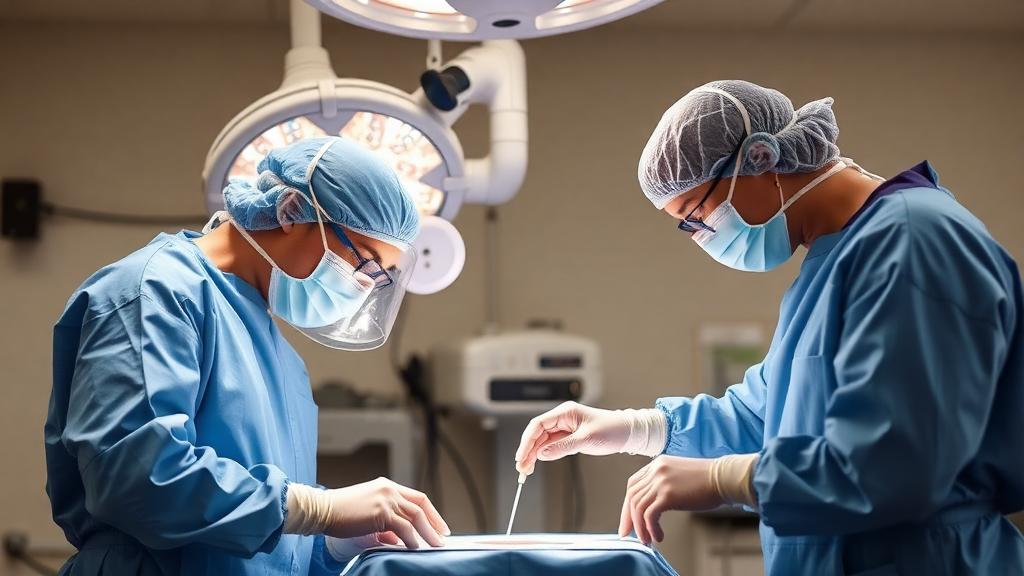
Robotic surgery has transformed the way complex liver and pancreas operations are performed, offering patients smaller incisions, faster recoveries, and fewer complications. Yet the surgeons expected to deliver these benefits may be graduating from their fellowships with strikingly unequal preparation. A new ten-year analysis of fellowship case logs, published in Global Surgical Education, the Journal of the Association for Surgical Education, reveals that the three main training pathways into hepatopancreatobiliary (HPB) surgery produce graduates with profoundly different levels of minimally invasive experience, and that none of them, on average, brings a trainee close to the operative volumes associated with robotic proficiency.
The study, led by Katharine E. Caldwell of the Medical University of South Carolina with Dominic E. Sanford of Mayo Clinic Arizona and Natasha Leigh of Washington University in Saint Louis, examined de-identified case logs from the Fellowship Council for fellows graduating between 2014 and 2023 who pursued certification through the Americas Hepatopancreatobiliary Association (AHPBA). The cohort comprised 146 fellows from dedicated HPB programs, 55 from complex general surgical oncology (CGSO) programs, and 51 from transplant (TXP) programs. Because CGSO and TXP fellowships are all two-year programs while HPB fellowships included both one-year and two-year tracks, the researchers compared total operative experience per fellowship rather than per year, ensuring that differences in program length did not distort the comparison.
The structural differences between the pathways are central to the story. Dedicated HPB fellowships immerse trainees almost entirely in liver, pancreas, and biliary operations, although fellows may spend up to one month per year on a transplant rotation. CGSO fellows pursuing an AHPBA-certified track may spend six to ten months across their two fellowship years on HPB-focused rotations, with the remainder devoted to broader surgical oncology. TXP fellows on HPB tracks may spend only three to six months on HPB services, and the exact duration varies considerably between programs, with some centers caring for non-transplant HPB cases alongside routine liver transplant work depending on the attending surgeons’ practice patterns. These competing clinical mandates, the authors hypothesized, would translate into different case mixes by the end of training.
The data confirmed that hypothesis in striking detail. HPB fellows completed the highest average total case volume at 187.4 cases, compared with 147.2 for CGSO and 160.9 for TXP fellows. HPB fellows also logged significantly more total pancreas operations, 82.0 on average, driven largely by open pancreaticoduodenectomy, the most technically demanding standard pancreatic resection, of which they performed 35.9 compared with 28.3 in CGSO and 29.8 in TXP fellows. Total liver resection volumes were broadly comparable across the three pathways, but the composition differed: transplant fellows led in open anatomic liver resections at 35.2 cases, reflecting the vascular and hepatic expertise central to transplantation, while HPB fellows performed the most non-anatomic resections at 67.3.
The most consequential divergence, however, emerged in robotic surgery. Across all three cohorts, average robotic case volume rose nearly elevenfold over the decade, from 1.7 to 18.7 cases, a signal of how rapidly the field has pivoted toward robotic platforms. But the distribution was starkly uneven. HPB fellows averaged 12.5 robotic HPB cases, CGSO fellows 8.5, and transplant fellows just 1.0, a statistically significant gap that persisted across nearly every operation type. HPB fellows logged 4.4 robotic pancreaticoduodenectomies and 3.8 robotic distal pancreatectomies on average, compared with 0.2 and 0.6 respectively for their transplant counterparts. Robotic anatomic liver resections, at 2.1 cases in the HPB track, were more than sixty times the transplant figure of 0.03.
Those numbers matter because of what is known about learning curves in robotic HPB surgery. Published analyses suggest that surgeons need roughly 40 robotic pancreaticoduodenectomies or 30 robotic major hepatectomies to reach proficiency, with learning curve estimates for these complex operations generally falling between 30 and 50 cases. Not a single fellow in the entire ten-year series exceeded those thresholds, although several HPB-track trainees came within five cases of them. In other words, even in the highest-volume pathway, the average graduate leaves fellowship well short of the published proficiency boundary, meaning the steepest part of the learning curve must be climbed in early independent practice, often without the structured mentorship, simulation, and coaching that fellowship uniquely provides.
The authors are careful to note that the fellowship’s goal is not to produce fully mastered robotic surgeons, which requires years of practice, feedback, and failure. Rather, fellowship should supply adequate exposure, autonomy, and mentorship so that graduates can continue developing safely in their first jobs. The concern is that the observed gaps, particularly the near-total absence of robotic experience among transplant-track fellows, may leave some graduates poorly positioned for a job market in which patient demand and clinical evidence increasingly favor minimally invasive approaches. Prior research cited in the study indicates that fellowship type independently influences early-career perioperative outcomes, with HPB-specific training associated with superior results, underscoring that these training differences have real clinical consequences.
The study also highlights a structural shift that may widen the disparity. Historically, high-volume HPB fellowships could compress all case requirements into a single year, and most of the high-robotic-volume programs in this dataset were one-year tracks. AHPBA certification requirements are now transitioning to mandate two full years for all fellowships, and current proposals plan to increase both total HPB case requirements and the number of required minimally invasive cases. Doubling the training duration at high-volume centers could give HPB fellows substantially more time to accumulate robotic experience, while many transplant fellowships, the authors note, would already fall below the proposed case volume increases, especially if minimally invasive requirements rise significantly. Canadian programs, which are predominantly two-year and have adopted robotics more slowly due to publicly funded health system structures and reimbursement differences, add further regional variability.
Importantly, the transplant pathway is not uniformly left behind. The authors acknowledge that some transplant programs are outliers with extensive robotic expertise spanning both HPB and transplant operations, and faculty experience, access to dual-console robotic systems, and local practice patterns all shape what an individual fellow encounters. The study also carries methodological limitations that temper its conclusions. The data are fellow-reported and retrospective, and inaccuracies in case logging are well documented, though they diminish with training year and are likely distributed evenly across pathways. Because the data were anonymized, the researchers could not link residency and fellowship experience, meaning each fellow’s cumulative operative exposure across their entire training lifespan is underestimated, nor could they control for the exact months spent on HPB services. The CGSO and TXP fellows studied represent only those programs that chose to offer AHPBA-certified HPB tracks, the most HPB-focused subset of their fields, so the true disparity for the average surgical oncology or transplant graduate is likely even larger than these figures suggest.
Perhaps the deepest question the study raises is whether case counts are the right measure at all. Volume, the authors argue, is an imperfect surrogate for competence: a fellow logged as primary surgeon may have performed very different proportions of an operation at different programs, and current case logs do not capture the degree of attending involvement. As surgical training shifts toward outcomes-based assessment and Entrustable Professional Activities, the traditional case log may need to give way to careful observational evaluation of genuine operative independence. Deliberate practice, coaching, simulation, and post-fellowship mentorship all shape the path to mastery in ways that raw numbers cannot capture. Still, the message for training programs is unambiguous: minimally invasive exposure is distributed unevenly across the pipelines that feed the HPB workforce, graduation volumes fall short of established learning curve thresholds for the most complex robotic operations, and standardized, platform-specific curricula with competency-based assessment are urgently needed. As more residency graduates than ever pursue fellowship and patient demand for robotic liver and pancreas surgery grows, the programs that train tomorrow’s HPB surgeons will need to decide, deliberately and soon, whether they can deliver expertise across transplant, oncology, and HPB domains and across open, laparoscopic, and robotic platforms within a single two-year fellowship.
Subject of Research: Variation in minimally invasive and robotic operative training across hepatopancreatobiliary fellowship pathways
Article Title: Training the next generation of minimally invasive HPB surgeons: are current fellowships crossing the learning curve?
Article References: Caldwell, K. E., Sanford, D. E., & Leigh, N. (2026). Training the next generation of minimally invasive HPB surgeons: are current fellowships crossing the learning curve?. Global Surgical Education – Journal of the Association for Surgical Education, 5(1), Article 186. https://doi.org/10.1007/s44186-026-00602-7
Image Credits: AI Generated
DOI: 10.1007/s44186-026-00602-7
Keywords: HPB surgery, robotic surgery, fellowship training, minimally invasive surgery, surgical education, learning curve, pancreaticoduodenectomy, liver resection, transplant surgery, surgical oncology, AHPBA, case logs
Cite Scienmag News
Ophelia Keating. (October 6, 2026). Robotic surgery training gap revealed across liver and pancreas fellowships. Scienmag. https://scienmag.com/robotic-surgery-training-gap-revealed-across-liver-and-pancreas-fellowships/
Ophelia Keating. "Robotic surgery training gap revealed across liver and pancreas fellowships." Scienmag, 6 October 2026, https://scienmag.com/robotic-surgery-training-gap-revealed-across-liver-and-pancreas-fellowships/. Accessed 6 October 2026.
Ophelia Keating. "Robotic surgery training gap revealed across liver and pancreas fellowships." Scienmag. October 6, 2026. https://scienmag.com/robotic-surgery-training-gap-revealed-across-liver-and-pancreas-fellowships/


