


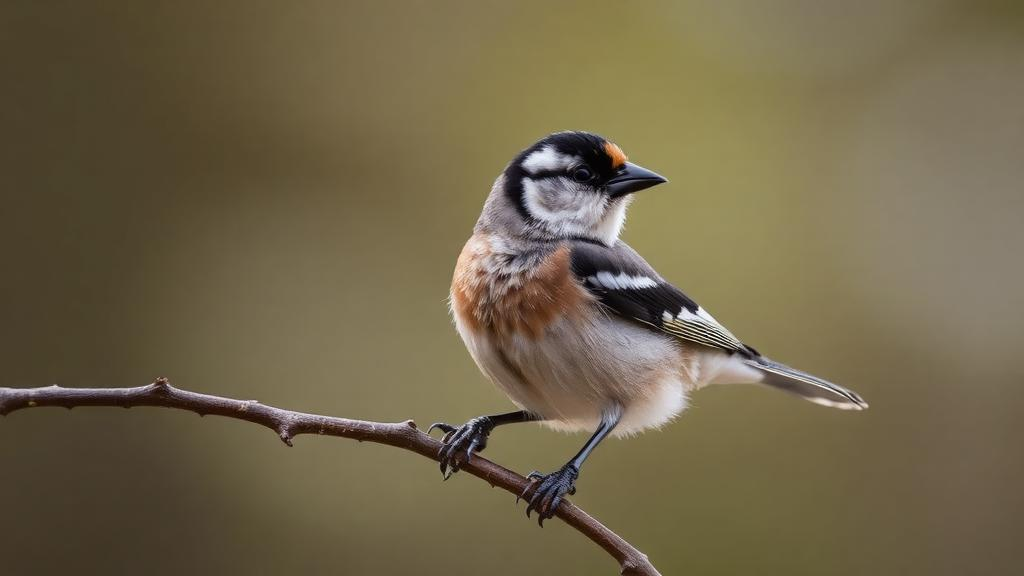
In the steppe zone of southern and eastern Ukraine, the Common Chaffinch sings in regional voices that scientists have spent years mapping and documenting. These are not random variations but genuine dialects: distinct, geographically bounded versions of the species’ song, differing in structure, syllable sequence, and rhythm from those of birds just a few hundred kilometres away. A new study has now asked a question that few researchers have had cause to ask before: what happens to such dialects when the forests that carry them are caught in a war? The answer, drawn from satellite imagery of 41 forest plots, is that while most of the sites remain intact, nearly a third have been damaged or destroyed by combat, and the type of forest determines how much is lost when the fighting reaches it.
The research, published in Biosphere: A Scientific Journal under the title Risks to Unique Dialects of Birdsong: The Case of Chaffinch (Fringilla coelebs) Song Dialects in Southern and Eastern Ukraine During the Russia–Ukraine War, was carried out by Eugenia Yablonovska-Grishchenko and Vitaly Grishchenko. Its starting point is a fundamental fact of songbird biology. Unlike the calls that birds produce instinctively from birth, the songs of many songbird species are learnt behaviours, passed down from one generation to the next through listening and imitation. Over time, local populations develop their own recognisable variants of a species’ song, and these variants persist because young birds learn from the older birds around them. The result is a form of non-hereditary cultural transmission that has evolved independently in birds just as it has in human language.
The Common Chaffinch is one of the best-studied examples of this phenomenon in Europe. Populations across its range maintain distinct, geographically bounded song dialects, and the steppe zone of southern and eastern Ukraine is home to several such regional vocal complexes that had been documented and mapped in previous scientific work. Those earlier maps are what made the new study possible. Because the geographic distribution of chaffinch dialects in the region had already been described, the researchers could identify the specific forest plots that had been used to characterise each regional vocal complex, and then check, plot by plot, whether those forests were still standing.
Since February 2022, active combat across southern and eastern Ukraine has destroyed forests, triggered large-scale fires, and displaced wildlife populations. The research team identified 41 forest plots that had been used in earlier work to describe and map the regional dialects, and assessed each one using satellite images from summer and autumn 2025. Every plot was classified into one of three conditions: normal, damaged, or destroyed. The classification was necessarily remote, because fieldwork inside active combat zones is impossible, but the satellite record allowed a systematic, plot-by-plot assessment of the habitat on which each dialect depends.
The results showed that 70.7 percent of the plots remained in normal condition, 19.5 percent had been damaged by proximity to combat activity, and 9.8 percent had been completely destroyed following the most intense fighting. In other words, just under a third of the sites that anchor the region’s documented chaffinch dialects have been degraded or erased. The geographic pattern of the damage was not uniform, and it is this unevenness that gives the study its most important ecological insight: the fate of a dialect under bombardment depends largely on what kind of trees grow in the forest that sustains it.
Plots located on the Donetsk Ridge, which is covered primarily by native deciduous forests of oak, ash, and other broadleaf species, showed comparatively lower rates of destruction. Deciduous forests are considerably more resistant to fire than coniferous ones. They retain more moisture, and fire does not carry as readily through their canopies. When combat or associated fires reached the ridge, the broadleaf woodland tended to survive, and with it the local populations of chaffinches that carry the Donetsk Ridge sub-dialect. The authors note that this dialect therefore faces a lower extinction risk than others in the region, precisely because its habitat is comparatively resilient.
The contrast comes from the Lower Dnipro floodplain. The coniferous plantations there are artificial, established decades ago to stabilise sandy soils, and they proved highly vulnerable. In plots within this zone where combat or associated fires occurred, destruction was severe or complete. Unlike the native broadleaf forests of the Donetsk Ridge, these pine plantations burn readily, carrying fire through their canopies and leaving little behind. The dialect associated with the Lower Dnipro floodplain consequently faces a substantially higher risk, given how severely its coniferous forests have burned. The same war, striking different forest types, produces sharply different outcomes for the cultural heritage of the birds living there.
The study draws a distinction that matters enormously for conservation: losing a forest is not the same as losing a dialect, but the two losses are closely linked. Chaffinch song dialects persist because birds living within a defined geographic area learn their local song variant from older birds around them. If the forest is destroyed and the local population is wiped out or scattered, the dialect dies with them. Replanting the forest decades later does not restore the dialect, because there are no local teachers left to transmit it. In this sense, the destruction documented in the study is not simply ecological damage but cultural damage in a biological sense: the erasure of learnt, transmitted behaviours that took generations to develop and that cannot be recovered once broken. A replanted pine stand may one day host chaffinches again, but the songs they sing will not be the songs that were lost.
The authors are careful about the limits of their evidence. The study is constrained by the resolution of available satellite imagery and by the impossibility of conducting fieldwork in active combat zones, meaning that the ground-level state of individual sites could not be directly verified. Satellite classification of normal, damaged, or destroyed condition is a proxy for habitat status, not a census of surviving birds. What the imagery can establish is which habitat patches remain, which have been degraded by proximity to fighting, and which have been erased altogether, and on that basis which dialects are most and least likely to have survived the war so far.
Given those constraints, the researchers call for post-war field surveys to assess which populations and dialects have survived, and for the documentation and recording of remaining dialects to be treated as a conservation priority before further losses occur. The logic is straightforward: a dialect that has been recorded can at least be studied and compared with future populations, while one that disappears unrecorded is gone without trace. The war in Ukraine has already inflicted severe and well-documented damage on the region’s ecosystems, but this study adds a subtler dimension to that accounting. Alongside the forests burned and the wildlife displaced, something intangible is being lost: regional traditions of learnt song, built up over generations of transmission from bird to bird, now at risk of falling silent before anyone can record them. Whether any of them can be heard again after the guns stop will depend on what the satellite images cannot yet show, and on the field surveys that must follow.
Subject of Research: Wartime destruction of forests hosting regional Common Chaffinch song dialects in southern and eastern Ukraine
Article Title: Risks to unique dialects of birdsong
Article References: Risks to unique dialects of birdsong. (n.d.). Original publication
Image Credits: AI Generated
DOI: Not provided
Keywords: chaffinch, birdsong dialects, Ukraine, Russia–Ukraine war, cultural transmission, satellite imagery, forest destruction, conservation, song learning, deciduous forests, coniferous plantations, Biosphere journal
Cite Scienmag News
Margaret Porter. (October 6, 2026). War in Ukraine Threatens Generations-Old Birdsong Dialects of the Chaffinch. Scienmag. https://scienmag.com/war-in-ukraine-threatens-generations-old-birdsong-dialects-of-the-chaffinch/
Margaret Porter. "War in Ukraine Threatens Generations-Old Birdsong Dialects of the Chaffinch." Scienmag, 6 October 2026, https://scienmag.com/war-in-ukraine-threatens-generations-old-birdsong-dialects-of-the-chaffinch/. Accessed 6 October 2026.
Margaret Porter. "War in Ukraine Threatens Generations-Old Birdsong Dialects of the Chaffinch." Scienmag. October 6, 2026. https://scienmag.com/war-in-ukraine-threatens-generations-old-birdsong-dialects-of-the-chaffinch/


