


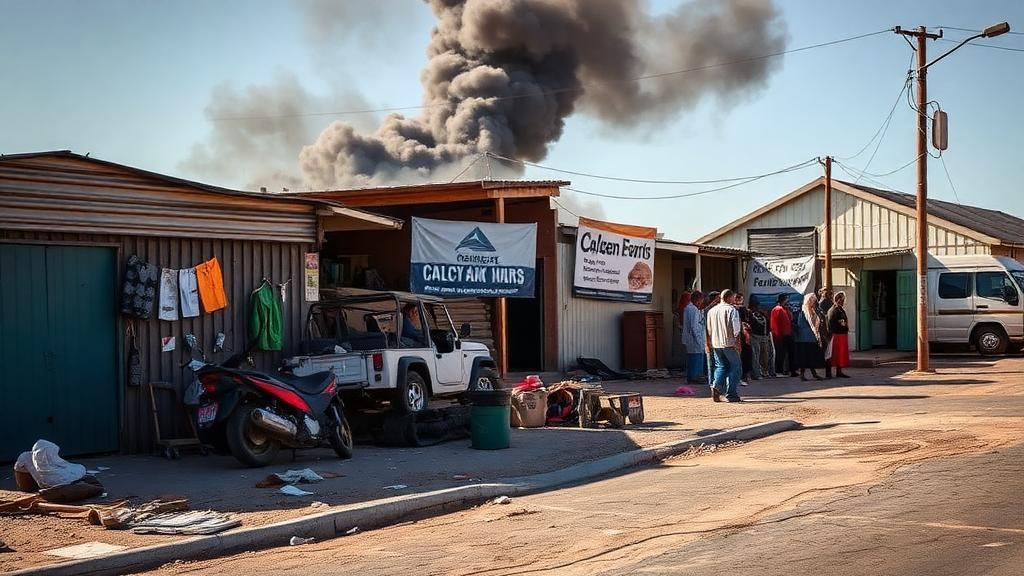
In the townships of South Africa, the small convenience stores known as spaza shops are more than retail outlets. They are lifelines for families, anchors of community commerce, and hard-won achievements of people who fled persecution in their home countries. A new qualitative study published in SN Social Sciences reveals in stark detail what happens to refugee entrepreneurs when xenophobic violence tears through these fragile livelihoods, documenting physical assaults, profound psychological trauma, family separation, and the collapse of businesses that took years to build.
The research, led by Sipho Sibanda of the University of Western Australia and the University of Pretoria, together with Poppy Masinga, Lekopo Alinah Lelope, and Francis Lynch, focused on Atteridgeville, a township roughly 12 kilometres west of Pretoria. Established in 1939 under apartheid spatial planning, Atteridgeville is home to approximately 64,425 people and reflects many of the social and economic pressures typical of South African urban settlements, including unemployment, crime, and strained public services. In recent years, it has also experienced recurring xenophobic incidents targeting foreign nationals, particularly those operating small businesses, with episodes frequently involving looting and physical violence.
The scale of the broader problem is sobering. According to the Xenowatch database cited in the study, between 1994 and March 2024 xenophobic incidents in South Africa reportedly resulted in 669 deaths, more than 5,310 looted businesses, and 127,572 displacements. The researchers frame these outcomes using Nancy Fraser’s multidimensional theory of social justice, which distinguishes economic maldistribution, cultural misrecognition, political misrepresentation, and misframing of the boundaries of justice. Xenophobic violence, the authors argue, embodies all of these injustices simultaneously: livelihoods are destroyed, refugees are dehumanised through derogatory labels, and their voices are excluded from political discourse that increasingly blames foreigners for the country’s socio-economic difficulties.
To understand the psychological roots of this hostility, the study also draws on Social Identity Theory, which holds that people derive self-worth from group membership and tend to favour their in-group while discriminating against outsiders. In the South African context, citizens are often positioned as a unified national in-group while migrants are cast as out-groups competing for scarce jobs, housing, and services. The researchers complement this psychosocial lens with a human rights-based approach, which treats refugees as rights-holders and host states as duty-bearers responsible for protecting fundamental rights regardless of nationality. Together, these frameworks illuminate both the structural and the interpersonal dynamics that make refugee entrepreneurs especially vulnerable.
Methodologically, the study employed a qualitative, exploratory design. Because no reliable records exist of refugee entrepreneurs in Atteridgeville, the researchers used snowball sampling, recruiting participants through existing social networks until data saturation was reached after ten in-depth interviews. All participants were men, averaging 38 years of age, who had lived in South Africa for an average of seven years. Five came from Ethiopia, two from Nigeria, two from the Democratic Republic of Congo, and one from Burundi. Every participant operated a spaza shop, the informal convenience stores whose name derives from an isiZulu word meaning hidden, reflecting their emergence during apartheid when formal economic participation for Black entrepreneurs was severely restricted. Data were collected between November 2018 and February 2019 through semi-structured, face-to-face interviews of roughly one hour each, conducted at participants’ business premises and analysed thematically following Creswell’s systematic approach to qualitative inquiry.
The findings paint a grim picture of the physical toll of xenophobic violence. Several participants reported being assaulted and injured during attacks on their shops. One described being beaten while perpetrators emptied his store of goods, clothing, and money, leaving him with nothing. Another recounted how looters broke his leg when he tried to stop them from stealing his stock, an injury that still prevents him from walking properly. These accounts align with documented patterns of extreme violence during xenophobic outbreaks elsewhere in South Africa, and the authors interpret them as evidence that such attacks extend beyond economic motives into deeper processes of dehumanisation and misrecognition within host communities.
The emotional consequences proved equally severe. Participants described lasting psychological distress, with some experiencing trauma so profound that they perceived death as an escape. One participant said he sometimes wished someone would stab him so he could die, while another described contemplating self-harm before his faith deterred him. The researchers note that these responses are consistent with wider evidence of elevated anxiety, depression, and trauma among migrants affected by xenophobic violence, and that prolonged exposure to such stressors has been associated with more serious conditions including post-traumatic stress disorder. Importantly, the psychological damage extends to family members, particularly children, who may experience secondary trauma and disruption to their education.
The study also documents how violence destabilises family structures. Several participants reported that their relatives left South Africa because of safety fears or because business losses made it impossible to support them. One man explained that his family returned to their home country after his shop was broken into and he could no longer pay rent, while another described being unable to afford food, school fees, or transport for his children after losing his enterprise. The authors characterise this as a compound vulnerability, in which economic shocks translate directly into broader social and familial instability, echoing earlier research showing that xenophobic attacks can drive affected families into destitution and dependence on external support.
Economically, the destruction was often total. Participants reported repeated break-ins, looting, and vandalism, with some losing their businesses multiple times. One entrepreneur who invested 50,000 rand in his shop now works for a salary of 2,000 rand, while another who previously earned a monthly profit of 5,000 rand after expenses survives on 300 rand per week from an employer. Those who managed to rebuild often did so by selling land in their countries of origin or relying on co-national networks for employment and shared resources. The authors observe that this reliance on informal social capital demonstrates remarkable resilience, but that such coping mechanisms are limited in scope and cannot address the structural conditions underpinning vulnerability. Many participants reported rebuilding their lives without meaningful state intervention, reinforcing concerns about the inadequacy of institutional responses.
Notably, the findings are not uniformly bleak. One participant emphasised that not all South Africans display xenophobic attitudes, describing kind and loving people whose support enabled his survival. The researchers argue that such solidarity, alongside assistance from faith-based organisations and community members, shows that hostility is not universal, though existing support remains fragmented and insufficient. The study recommends integrated psychotherapeutic, material, and financial assistance for affected refugees, including post-incident help desks, community support groups, and joint business forums bringing together local and refugee entrepreneurs. At the macro level, it calls for coordinated, evidence-based strategies, public education campaigns, and stronger legal protections to prevent future violence. The authors also acknowledge limitations, including the small, all-male, single-township sample, and urge future research with mixed methods and gender-diverse samples. As vigilante movements such as Operation Dudula continue to normalise exclusionary rhetoric, the study stands as a reminder that xenophobia is not only a human rights crisis but also an economic one, undermining the township economies, national development goals, and the African ethic of Ubuntu that the country’s constitution aspires to embody.
Subject of Research: The socio-economic effects of xenophobic attacks on refugee entrepreneurs in South Africa
Article Title: A qualitative enquiry into the socio-economic effects of xenophobic attacks on refugee entrepreneurs in South Africa
Article References: Sibanda, S., Masinga, P., Lelope, L. A., & Lynch, F. (2026). A qualitative enquiry into the socio-economic effects of xenophobic attacks on refugee entrepreneurs in South Africa. SN Social Sciences, 6(10), Article 504. https://doi.org/10.1007/s43545-026-01806-w
Image Credits: AI Generated
DOI: 10.1007/s43545-026-01806-w
Keywords: xenophobia, refugee entrepreneurs, South Africa, spaza shops, Atteridgeville, social identity theory, human rights, qualitative research, informal economy, psychological trauma, social justice, migration
Cite Scienmag News
Courtney Benton. (October 6, 2026). Xenophobic Violence Shatters Refugee Businesses and Lives in South African Township. Scienmag. https://scienmag.com/xenophobic-violence-shatters-refugee-businesses-and-lives-in-south-african-township/
Courtney Benton. "Xenophobic Violence Shatters Refugee Businesses and Lives in South African Township." Scienmag, 6 October 2026, https://scienmag.com/xenophobic-violence-shatters-refugee-businesses-and-lives-in-south-african-township/. Accessed 6 October 2026.
Courtney Benton. "Xenophobic Violence Shatters Refugee Businesses and Lives in South African Township." Scienmag. October 6, 2026. https://scienmag.com/xenophobic-violence-shatters-refugee-businesses-and-lives-in-south-african-township/


