


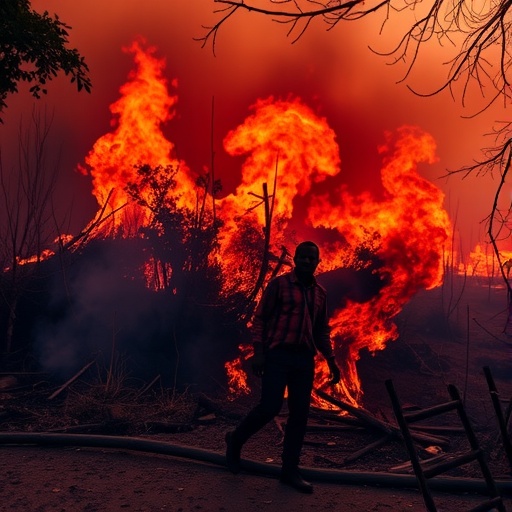
The global landscape of wildland fire exposure is undergoing a profound transformation, with increasing numbers of people facing direct risks even as the total area consumed by fires declines. A recent comprehensive analysis led by Seyd Teymoor Seydi and collaborators has revealed a paradoxical trend: from 2002 to 2021, the population exposed to wildfires worldwide increased by approximately 40%, despite a concurrent 26% decrease in the global burned area. This divergence highlights a shifting human-wildland dynamic that poses significant challenges for fire management, public safety, and environmental policy.
Central to this phenomenon is the expansion of the wildland-urban interface (WUI), defined as the zones where human development meets or intermingles with undeveloped wildland vegetation. Increasingly, communities are establishing residences, infrastructure, and commercial enterprises within these fire-prone ecotones. This migration drives up human exposure, making fire risk not merely a function of area burned but critically dependent on human settlement patterns. In essence, while fewer hectares might be consumed annually by fire in some regions, more people inhabit vulnerable landscapes, elevating the risk of direct encounters with wildfires.
Geographically, the vast majority of global wildland fire exposures during the last two decades—approximately 85%—have been concentrated in Africa. Unlike other continents where fires can escalate to catastrophic proportions, African fires have historically manifested differently. Most wildfires there occur as natural or anthropogenically influenced low-intensity burns that rarely reach the high intensity and rate of spread seen elsewhere. Despite this, the dense population exposure in Africa underscores the scale at which fire interacts with human communities. The continent’s fire regimes are deeply intertwined with traditional agricultural practices, ecological cycles, and socio-economic factors.
By contrast, regions such as western North America, parts of Europe, and Australia have garnered more global attention due to high-profile wildfire disasters marked by rapid fire spread, extreme behavior, and devastating impacts. These areas experience fire seasons stretching over longer periods, influenced by climate change, drought, and other drivers altering fuel conditions. Fires in these landscapes present acute risks, often overwhelming community defenses and emergency response systems. However, their relative contribution to overall population exposure is smaller compared to Africa, emphasizing the varied nature of fire-human interactions worldwide.
Methodologically, Seydi and the research team utilized an extensive dataset—the Global Fire Atlas—which includes approximately 18.6 million fire records spanning three decades. Integrating this with spatially explicit population data and land cover/use classifications, they were able to pinpoint precise intersections where human populations directly overlapped with active fires. Such spatial granularity allowed for nuanced assessments of exposure, moving beyond coarse regional analyses to reveal fire risks at the community and landscape scales. This approach represents a significant advancement in wildfire risk science, enabling targeted interventions.
The human toll linked to wildfires is substantial and multifaceted. From 1990 to 2021, direct impacts of wildland fires accounted for at least 2,500 deaths and over 10,500 injuries globally. These figures, while alarming, only capture immediate or direct fire-related harm. More insidiously, wildfire-induced air pollution has been identified as a critical public health hazard, with an estimated 1.53 million premature deaths worldwide attributable to smoke exposure during the same period. Particulate matter and other combustion byproducts exacerbate respiratory and cardiovascular conditions, highlighting an often underappreciated dimension of wildfire impact.
In light of these findings, fire management strategies must adapt to evolving human settlement patterns and fire regimes. For areas prone to rapid fire spread—such as the wildlands of western North America and Australia—“home hardening” strategies are increasingly vital. These include architectural designs utilizing fire-resistant materials, defensible space landscaping, and community-level preparedness plans. Such measures are designed to reduce ignition vulnerability and bolster property resilience against ember storms and radiant heat, which often precede flame contact.
Furthermore, the study highlights the importance of using intentional fire as a vegetation management tool. Prescribed burns and controlled fires are critical ecological management techniques that reduce fuel loads, restore natural fire regimes, and mitigate the severity of uncontrolled wildfires. This approach requires sophisticated ecological understanding, regulatory oversight, and community engagement to balance ecological benefits with public safety.
The increasing human footprint in fire-prone landscapes also calls for enhanced monitoring and real-time fire detection systems. Satellite remote sensing, in tandem with ground-based sensors and community reporting mechanisms, can improve early warning capabilities. Such integrated fire intelligence supports timely evacuations, resource allocation, and strategic firefighting efforts, potentially saving lives and reducing property losses.
Climate change continues to act as a force multiplier influencing wildfire dynamics. Rising temperatures, altered precipitation patterns, and prolonged drought conditions contribute to increased fuel aridity and longer fire seasons in many parts of the world. These climatic drivers exacerbate fire behavior, but their interactions with socio-ecological variables such as land use, population growth, and vegetation management underscore the complexity of wildfire risk.
Societal resilience to wildland fires hinges on an interdisciplinary melding of ecological science, urban planning, community engagement, public health, and policy innovation. Effective solutions require collaboration across governmental agencies, academia, indigenous and local communities, and international partners. With global exposure to wildland fires on the rise, proactive adaptation is no longer optional but essential to safeguard lives, ecosystems, and economies.
Ultimately, the paradox presented by this research—the simultaneous decline in burned area but rise in people exposed—poses critical questions about sustainable development. How can human expansion into fire-prone areas be managed without exacerbating vulnerabilities? What roles do land tenure, housing policies, and economic incentives play in shaping the WUI? Addressing these questions will demand courageous policy decisions informed by rigorous science and a commitment to long-term resilience.
As Seydi et al. have illuminated, wildland fires remain a formidable natural hazard, complicated and intensified by anthropogenic factors. Their work offers a clarion call to rethink how societies live with fire in an era of dynamic environmental change. The path forward must integrate cutting-edge fire science with comprehensive risk mitigation and equitable community support frameworks. Only through such integrative efforts can the growing challenge of human exposure to wildland fires be effectively addressed on a global scale.
News Publication Date: 21-Aug-2025
Web References: 10.1126/science.adu6408
Cite Scienmag News
Russell Cooper. (August 21, 2025). Increasing Wildfire Exposure Threatens Communities Across Africa. Scienmag. https://scienmag.com/increasing-wildfire-exposure-threatens-communities-across-africa/
Russell Cooper. "Increasing Wildfire Exposure Threatens Communities Across Africa." Scienmag, 21 August 2025, https://scienmag.com/increasing-wildfire-exposure-threatens-communities-across-africa/. Accessed 4 September 2026.
Russell Cooper. "Increasing Wildfire Exposure Threatens Communities Across Africa." Scienmag. August 21, 2025. https://scienmag.com/increasing-wildfire-exposure-threatens-communities-across-africa/


