


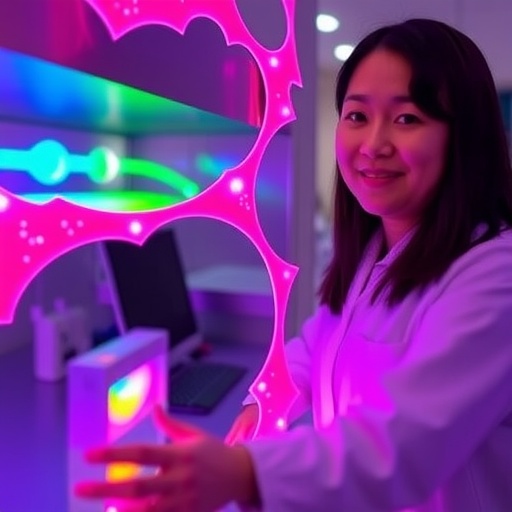
Baker’s yeast, the microorganism behind bread, beer and numerous biotechnology processes, has been given a new kind of vision. Researchers at the National University of Singapore (NUS) have engineered a single yeast strain that can detect and respond independently to red and blue light. The advance gives scientists a way to control genetic activity, chemical production, cell behaviour and even spatial patterns inside living yeast simply by changing the colour, timing and location of illumination.
The work, led by Associate Professor Poh Chueh Loo of NUS Synthetic Biology for Clinical and Technological Innovation and the Department of Biomedical Engineering, addresses a longstanding problem in synthetic biology: how to control engineered cells precisely without repeatedly adding chemical inducers. Although yeast can be redesigned to manufacture medicines, fuels, industrial chemicals and other valuable compounds, biological production systems are often difficult to start, stop or coordinate at the right moment. Light offers a cleaner and more responsive alternative because it can be delivered rapidly, withdrawn instantly and projected onto selected regions.
The researchers used optogenetics, a technique that connects light-sensitive proteins to genetic switches. When activated by a particular wavelength, these proteins interact with DNA or with other regulatory components, changing the expression of selected genes. Earlier studies had produced yeast systems responsive to individual colours, but a single strain able to interpret multiple colours independently had not previously been demonstrated. The NUS team’s system creates two separate communication channels: red light controls one set of genes, while blue light controls another.
A central part of the study was the development of y-iLight, a compact red-light-responsive protein adapted from a tool previously used in bacteria and mammalian cells. In yeast, y-iLight binds to specific DNA sequences after exposure to red light, activating nearby genes. Unlike several earlier red-light systems, it does not require additional cofactors or helper chemicals beyond molecules naturally present in yeast. That simpler architecture could make the system easier to combine with other genetic circuits and more practical for industrial or laboratory applications.
The first version of y-iLight, however, had a serious weakness: blue light could also activate it. This unwanted response, known as crosstalk, would make it impossible to use red and blue signals as independent instructions. The researchers addressed the problem through modular protein engineering. They attached y-iLight to regulatory modules designed to suppress its activity specifically in the presence of blue light, then screened combinations of these modules to identify variants that retained strong red-light activation while reducing accidental responses to blue illumination.
The improved red-light switch was paired with EL222, an established blue-light-responsive system. In the resulting yeast strain, red and blue light could activate different genes without substantial interference between the two channels. This dual-colour control allowed the researchers to test more sophisticated genetic programmes in which distinct biological steps could be triggered separately, in sequence or simultaneously. Such multiplexed optogenetics could provide a more precise way to manage engineered pathways than chemical induction, which often affects an entire culture at once and can be difficult to fine-tune.
To demonstrate the system’s potential in biomanufacturing, the team placed two enzymes involved in the production of luteolin under separate light controls. Luteolin is a naturally occurring plant compound being investigated for potential health-related applications. By adjusting the proportions and timing of red and blue light, the researchers changed how the yeast directed its metabolic resources toward the compound. The experiments also revealed that one enzyme, F3′H, became less effective during later stages of culture, offering a clue that could help researchers improve the pathway’s performance.
The light-responsive yeast was also programmed to change its physical behaviour. The researchers linked the flocculation gene FLO1 to the red-light switch. FLO1 produces a protein that promotes adhesion between yeast cells, causing them to form clumps and settle. In one demonstration, the cells first produced luteolin under blue light and were then exposed to red light, which triggered aggregation. The sequence combined production and separation in a single biological process, suggesting a possible route toward more efficient and less chemically intensive manufacturing.
The system can respond not only to colour and timing but also to location. To show this spatial capability, the team engineered yeast to produce differently coloured compounds in response to red or blue light. The cells were spread as a thin layer on agar, and masks were used to project selected patterns onto them. As the illuminated regions activated different genetic programmes, the yeast grew into patterned, multicoloured “living images.” While the display is primarily a demonstration, the experiment highlights how optogenetic microbes could one day contribute to living materials, biological sensors or spatially organised manufacturing.
The researchers say stronger and more sensitive light-responsive proteins could expand the technology’s usefulness. Future work will focus on rationally designed gene networks that improve the performance of the switches and enable increasingly complex instructions. By combining multiple wavelengths with programmed exposure schedules and precise illumination patterns, scientists may be able to coordinate entire metabolic pathways or cellular behaviours in real time. The study, published in Nature Communications on 22 May 2026, marks a step toward yeast that functions less like a passive production vessel and more like a programmable biological machine.
News Publication Date: 22 May 2026
Web References: National University of Singapore: https://www.nus.edu.sg/ ; NUS Synthetic Biology for Clinical and Technological Innovation: https://syncti.org/ ; NUS Department of Biomedical Engineering: https://cde.nus.edu.sg/bme/
References: Nature Communications, DOI: 10.1038/s41467-026-73399-0
Cite Scienmag News
Gregory Coleman. (August 12, 2026). NUS researchers engineer color-sensing yeast in scientific breakthrough. Scienmag. https://scienmag.com/nus-researchers-engineer-color-sensing-yeast-in-scientific-breakthrough/
Gregory Coleman. "NUS researchers engineer color-sensing yeast in scientific breakthrough." Scienmag, 12 August 2026, https://scienmag.com/nus-researchers-engineer-color-sensing-yeast-in-scientific-breakthrough/. Accessed 4 September 2026.
Gregory Coleman. "NUS researchers engineer color-sensing yeast in scientific breakthrough." Scienmag. August 12, 2026. https://scienmag.com/nus-researchers-engineer-color-sensing-yeast-in-scientific-breakthrough/


