


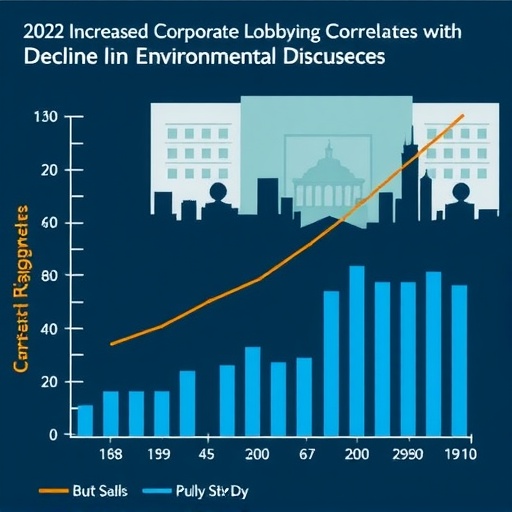
A groundbreaking study recently published in the Journal of Cleaner Production sheds new light on the intricate relationship between corporate political expenditures and sustainability disclosure among major U.S. corporations. The research explores a compelling dynamic revealing that increased corporate lobbying efforts are associated with diminished transparency in environmental, social, and governance (ESG) reporting. This novel investigation bridges a critical gap in understanding how political finance strategies may inversely impact the openness of sustainability practices publicly disclosed by companies within the S&P 500 index.
By meticulously analyzing a robust dataset comprising detailed lobbying expenditures alongside ESG disclosure scores across a broad sample of leading American firms, the study identifies a statistically significant correlation: firms that invest more heavily in political lobbying tend to reveal substantially less about their environmental and social governance measures. This counterintuitive finding challenges the conventional assumption that higher ESG transparency naturally accompanies greater corporate engagement with sustainability concerns, suggesting instead a substitution effect where political influence may replace public disclosure as a strategy.
Importantly, the research highlights that while the overall negative correlation between lobbying spending and ESG transparency is discernible and consistent, it is most pronounced within the environmental disclosure dimension. The effect size for environmental transparency is approximately an order of magnitude stronger than the general ESG score relationship. This indicates companies may deliberately downplay environmental reporting, potentially to avoid attracting regulatory or public scrutiny while simultaneously directing substantial resources toward lobbying efforts intended to mitigate regulatory impacts or influence policy outcomes.
The study’s authors, including Simone Taddeo, emphasize that this phenomenon reflects what they term a “substitutive logic.” This logic posits that political power and public sustainability communication function as strategic interchangeables. Rather than transparently disclosing comprehensive sustainability practices, certain corporations appear to elect for greater political advocacy and lobbying activity as a means to obfuscate or shield potentially incomplete or unfavorable sustainability data from external stakeholders such as investors, regulators, and the public.
This insight is particularly urgent given the evolving landscape of ESG standards and the increasing reliance on sustainability disclosures by a wide range of stakeholders. Institutional investors, who increasingly integrate ESG criteria into risk assessment models and portfolio management, may find themselves confronted with data that systematically underrepresents sustainability risks for those firms most actively engaged in shaping the regulatory environment through political contributions. Such disparities could undermine the reliability and efficacy of ESG ratings as tools for responsible investment decisions.
Moreover, the phenomenon of so-called “greenhushing,” where companies consciously refrain from publicizing environmental commitments to avoid heightened scrutiny or accountability, aligns with the findings of this research. This deliberate silence on sustainability matters, in combination with amplified lobbying efforts, points to a strategic calculus by some corporations to navigate regulatory landscapes through political clout rather than transparency or genuine environmental and social responsibility.
The significance of this research transcends academic discourse, bearing direct implications for policymakers and regulatory bodies tasked with designing and enforcing ESG disclosure requirements. As regulatory frameworks in jurisdictions like the European Union and the United States evolve toward mandatory sustainability reporting, understanding the intertwined effects of corporate political spending becomes critical. Regulators may need to incorporate mechanisms that account for lobbying activities to ensure ESG disclosures remain meaningful, credible, and resistant to being circumvented through political influence.
The methodology underpinning this study is notable for integrating datasets that traditionally belong to distinct realms: corporate political activity and sustainability disclosure metrics. By combining detailed lobbying expenditure records with ESG score data, the authors employ advanced econometric models to isolate the effect of lobbying intensity on disclosure behavior, controlling for confounding factors that could otherwise obscure the relationship. This interdisciplinary approach represents a methodological innovation that opens pathways for further research exploring the political ecology of corporate sustainability practices.
From the theoretical perspective, this research challenges the notion that corporate sustainability is invariably linked with increased transparency and genuine social responsibility. Instead, it reveals a more complex reality where firms strategically balance resource allocation between visible disclosure and behind-the-scenes political engagement depending on their governance objectives and perceived regulatory risks. This nuanced understanding calls for a reassessment of how ESG performance is measured, validated, and incorporated into broader sustainability governance frameworks.
Simone Taddeo, contributing author of the study and an expert affiliated with the Euro-Mediterranean Center on Climate Change (CMCC), articulates the implications succinctly: comprehending the inverse relationship between political influence and ESG disclosure is indispensable for maintaining the credibility and utility of sustainability information. Without such understanding, investors, policymakers, and the wider public risk relying on incomplete or misleading data that masks underlying environmental and social governance challenges.
Overall, the study’s findings underscore the critical need for greater transparency not only in sustainability disclosures but also in corporate political spending. As companies engage more intensively in lobbying to shape regulatory regimes, the intersection between political finance and ESG reporting will become an increasingly important frontier for research, regulation, and investor scrutiny. Ensuring that sustainability information accurately reflects corporate impacts and risks requires a holistic approach that acknowledges the strategic interplay between disclosure and political influence.
In conclusion, this research contributes substantial empirical evidence to the discourse on corporate accountability, illuminating the hidden dynamics that govern the presentation of ESG information in large US firms. By revealing that when money talks in political arenas, ESG disclosures tend to fall silent, the study challenges prevailing assumptions and calls for enhanced governance mechanisms that integrate political expenditure considerations into sustainability assessment frameworks. This pivotal advancement promises to strengthen the reliability of ESG evaluations and support the global pursuit of genuine corporate sustainability.
News Publication Date:
2025
Web References:
https://www.sciencedirect.com/science/article/pii/S0959652625023285
References:
Taddeo, S. et al. (2025). When Money Talks, ESG Falls Silent: Evidence from US Lobbying and Disclosure. Journal of Cleaner Production.
Cite Scienmag News
Courtney Benton. (April 30, 2026). Increased Corporate Lobbying Correlates with Decline in Environmental Disclosures. Scienmag. https://scienmag.com/increased-corporate-lobbying-correlates-with-decline-in-environmental-disclosures/
Courtney Benton. "Increased Corporate Lobbying Correlates with Decline in Environmental Disclosures." Scienmag, 30 April 2026, https://scienmag.com/increased-corporate-lobbying-correlates-with-decline-in-environmental-disclosures/. Accessed 4 September 2026.
Courtney Benton. "Increased Corporate Lobbying Correlates with Decline in Environmental Disclosures." Scienmag. April 30, 2026. https://scienmag.com/increased-corporate-lobbying-correlates-with-decline-in-environmental-disclosures/


