


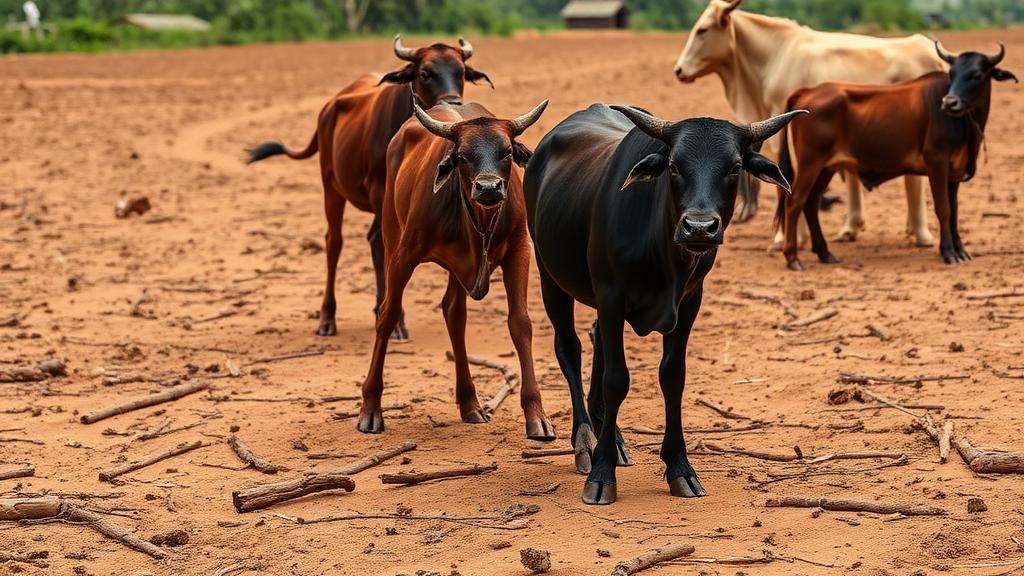
In the semi-arid stretch of Uganda known as the cattle corridor, drought is not an occasional emergency but a recurring feature of life. A new study published in BMC Environmental Science reveals that when the rains fail, whether a household weathers the crisis depends heavily on something often overlooked in climate planning: who owns the assets, who controls the money, and who makes the decisions inside the home. Drawing on interviews with more than 1,100 households across three districts, researchers found that deeply entrenched gender inequalities systematically undermine the ability of families to prepare for, absorb, and recover from drought shocks.
The research team, led by F. S. Nalwanga of Makerere University together with Yeeko Kisira and Paul Isolo Mukwaya, focused on Rakai in the south, Nakasongola in the centre, and Nabilatuk in the north of the corridor. These districts were selected because they face recurrent and severe droughts, prolonged dry spells, and increasingly unpredictable rainfall. Annual rainfall ranges from 875 to 1,120 millimetres in the southern districts but only 500 to 700 millimetres in Nabilatuk, where peaks arrive in May and October. Daily maximum temperatures climb to 35 degrees Celsius, and roughly 75 percent of agro-pastoralists in the region live below the poverty line, leaving them with little buffer against climatic shocks.
Methodologically, the study combined quantitative and qualitative approaches in a cross-sectional exploratory design. Using the Krejcie and Morgan sample-size formula, the team calculated that 1,106 households drawn from a population of 134,450 would yield statistically robust results, and the questionnaire achieved a 99.4 percent response rate. Six graduate research assistants fluent in Luganda, Luluuli, and Karimojong administered the surveys, while twelve single-sex focus group discussions and fifteen key informant interviews with local chairpersons, community development officers, and women leaders provided qualitative depth. Quantitative patterns were tested with chi-square statistics in SPSS, and qualitative transcripts were deductively coded against the research questions. The questionnaire’s reliability was confirmed with a Cronbach’s alpha of 0.795.
The theoretical backbone of the study is Folbre’s feminist political economy, a framework that treats households not as harmonious units but as arenas of power in which access to resources is negotiated along gendered lines. This lens proved apt. The analysis showed that men predominantly control household assets, even where some resources are formally shared. Ownership of and access to community assets differed significantly between men and women for most categories, with exceptions including credit and loans, farmer groups, irrigation, water sources, household labour, savings, pensions, and remittances. In practical terms, this means the very resources households need to pivot during a drought, such as land, livestock, and agricultural services, remain skewed toward men.
District-level disaggregation exposed how local culture and economics shape these disparities. In Rakai, significant gender gaps emerged for agricultural extension services, land, housing, mobile phones, harvested crops, radios, bicycles, livestock units, water tanks, televisions, and wage income. In Nakasongola, access to wells, mobile phones, radios, informal incomes, livestock, and boda boda motorcycles differed significantly, pointing to gendered barriers in mobility, information access, and economic participation. In Nabilatuk, disparities extended to health services, land, schooling, and overall well-being. Notably, ownership of radios and mobile phones, key conduits for climate information, was statistically significant across all three districts, suggesting that who holds the device often determines who receives the early warnings and forecasts that make drought preparedness possible.
Expenditure patterns during drought revealed a second layer of inequality. Both women and men prioritised food first, followed by medical costs and education, but significant differences emerged in food and education spending across districts. Crucially, the ways men and women raise cash diverge sharply: women typically rely on immediate sales of produce, labour, or livestock, while men draw on past earnings and accumulated savings. Focus group participants in Rakai described how shrinking harvests force families to deplete small savings for household expenses. This asymmetry matters because women who must sell assets at the moment of crisis often receive depressed prices and exhaust their resource base, whereas men with reserves retain a financial buffer for recovery. Women in the study were found to hide money at home to buy goats, a quiet strategy to build drought resilience outside male control.
Education spending exposed perhaps the most troubling vulnerability. In Nabilatuk, deviations in educational expenditure suggested that boys’ schooling is sometimes prioritised over girls’ during drought crises, with boys also kept out of school to tend animals. Participants questioned the value of universal primary and secondary education when families cannot afford materials and dropout rates are high. The long-term consequences are stark: girls withdrawn from school during climate shocks face diminished lifetime opportunities, and prior research cited in the study links economic strain under resource scarcity to reduced food and healthcare access for young women. Female-headed households, according to a 2024 FAO report referenced by the authors, lose 8 percent more income from heat stress and 3 percent more from other climate impacts than male-headed households.
Financial support networks followed distinctly gendered geographies. Women gravitated toward community-based credit, including microfinance institutions, NGOs, self-help groups, family, and savings, while men favoured broader networks that included fellow farmers and money lenders, often leveraging collateral such as land that women rarely hold. In Rakai, women’s main credit sources were self-help groups at 26.7 percent, family and friends at 20.5 percent, and savings and credit cooperatives at 18.2 percent. In Nabilatuk, both genders relied heavily on friends, savings, and family. One focus group participant explained that community development funds were preferred because repayment terms are lenient, though elders over sixty are excluded for lacking guarantors. The pattern suggests women’s access to credit is less secure and potentially less advantageous precisely when drought makes liquidity most valuable.
Decision-making remains the domain where inequality is most visible. Husbands were identified as the primary decision-makers for livelihood activities in 65.9 percent of households, compared with 28.8 percent for wives. The pattern held across districts: in Rakai, husbands dominated in every reported case, while in Nabilatuk, 81.3 percent of households named husbands as primary decision-makers, though a notable 59.2 percent of respondents there also acknowledged wives’ involvement. Qualitative accounts revealed that even animals owned by women are often sold only with male permission, and one elderly women’s group reported that men sometimes retain money for basics while spending on alcohol and extramarital affairs. Yet the study also detected change: joint decision-making appears in communities where cultural respect for women is stronger, and evolving norms suggest women’s growing awareness of their economic value may gradually shift household bargaining.
The authors conclude that closing these gaps requires more than generic climate programming. They recommend context-specific strategies that institutionalise women’s resource control and decision-making, integrate women’s informal networks into formal disaster response, reform legal frameworks to promote joint asset ownership, and secure women’s land rights and inheritance within national climate governance. As projected temperature increases threaten to intensify drought across East Africa, the study’s central message is technically precise and politically urgent: drought resilience is not built by rainfall alone, but by the distribution of power within households, and climate policy that ignores that distribution will keep failing the women who hold rural food security together.
Subject of Research: Gendered asset ownership, household expenditure, and decision-making in drought resilience among agro-pastoral households in Uganda's cattle corridor
Article Title: Resilience to drought in Uganda’s cattle corridor: gendered assets, expenditure, and decision-making
Article References: Nalwanga, F. S., Kisira, Y., & Mukwaya, P. I. (2025). Resilience to drought in Uganda’s cattle corridor: gendered assets, expenditure, and decision-making. BMC Environmental Science, 2(1), Article 14. https://doi.org/10.1186/s44329-025-00028-4
Image Credits: AI Generated
DOI: 10.1186/s44329-025-00028-4
Keywords: drought resilience, Uganda, cattle corridor, gender inequality, asset ownership, household expenditure, decision-making, agro-pastoralism, climate adaptation, financial inclusion, land rights, feminist political economy
Cite Scienmag News
Sloane Callahan. (October 2, 2026). In Uganda’s Drought-Hit Cattle Corridor, Gender Gaps Decide Who Survives the Dry Season. Scienmag. https://scienmag.com/in-ugandas-drought-hit-cattle-corridor-gender-gaps-decide-who-survives-the-dry-season/
Sloane Callahan. "In Uganda’s Drought-Hit Cattle Corridor, Gender Gaps Decide Who Survives the Dry Season." Scienmag, 2 October 2026, https://scienmag.com/in-ugandas-drought-hit-cattle-corridor-gender-gaps-decide-who-survives-the-dry-season/. Accessed 5 October 2026.
Sloane Callahan. "In Uganda’s Drought-Hit Cattle Corridor, Gender Gaps Decide Who Survives the Dry Season." Scienmag. October 2, 2026. https://scienmag.com/in-ugandas-drought-hit-cattle-corridor-gender-gaps-decide-who-survives-the-dry-season/


