


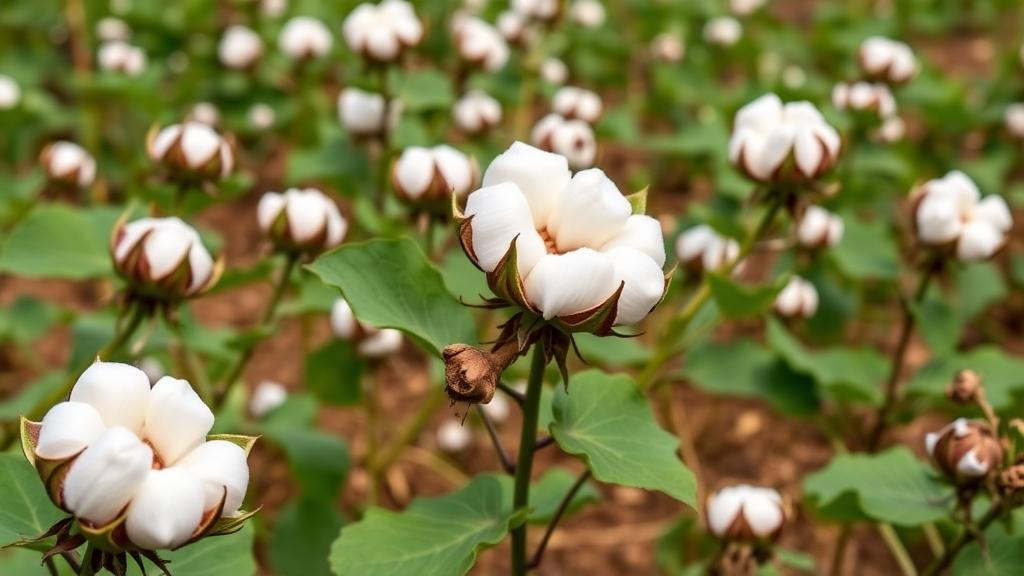
For decades, the default logic of intensive agriculture has been simple: more nitrogen fertilizer, more yield. But a new study on cotton, published in the journal Plant and Soil, turns that assumption on its head. Researchers led by Zihui Shen, Wangfeng Zhang and Xiaozhen Pu at Shihezi University in Xinjiang, China, found that trimming the conventional nitrogen dose by just 15 percent did not hurt cotton plants at all. Instead, it made them more productive, more efficient, and better connected to the invisible microbial economy humming in the soil around their roots. The finding arrives at a moment when farmers and scientists worldwide are wrestling with the double burden of rising fertilizer costs and the environmental damage caused by nitrogen that never reaches the crop.
The experiment was carefully controlled. The team grew cotton in pots under four different nitrogen regimes: a conventional rate of 0.240 grams of nitrogen per kilogram of soil, a 15 percent reduction to 0.204 grams, a 30 percent reduction to 0.168 grams, and a treatment with no nitrogen at all. At the early flowering stage, a moment the researchers identified as a critical turning point in the plant’s life cycle, they collected the chemicals secreted by the roots, known as root exudates. They then measured a battery of indicators: soil nitrogen transformation rates, enzyme activities, microbial biomass, root architecture, total plant nitrogen accumulation, and ultimately the seed cotton yield that farmers actually harvest.
The headline numbers are striking. Compared with plants receiving the full conventional nitrogen dose, those receiving the moderate 15 percent cut produced 14.7 percent more seed cotton per plant. Nitrogen partial factor productivity, a measure of how much yield each unit of applied fertilizer delivers, jumped by 34.9 percent. Nitrogen agronomic efficiency, which captures the yield gain attributable to fertilizer relative to unfertilized controls, rose by 38.7 percent. In other words, less nitrogen did not merely maintain the crop; it actively improved both the harvest and the return on every kilogram of fertilizer invested. The deeper reductions and the zero-nitrogen treatment did not replicate these gains, pointing to a sweet spot rather than a simple rule that less is always more.
What happened below ground helps explain the paradox. Under the moderate reduction, cotton roots developed a compact, dense architecture with higher root tissue density. Rather than chasing nitrogen through long, thin exploratory roots, the plants appeared to reallocate carbon from rapid elongation toward structural reinforcement, building a sturdier, more concentrated root system. This shift reflects a classic economic trade-off in plant biology: when a resource is scarcer, plants invest their finite carbon budget more carefully, favoring traits that improve acquisition efficiency over sheer spatial reach. The result is a root system positioned to exploit the soil volume it occupies more thoroughly.
At the same time, the chemical conversation between root and soil changed. Root exudates, the suite of sugars, amino acids, nucleotides and other compounds that roots release into the rhizosphere, shifted in composition under the moderate nitrogen reduction. Metabolomic profiling revealed two compounds standing out as the dominant responsive metabolites: proline, an amino acid long known as a stress signal and osmoprotectant in plants, and hypoxanthine, a purine base derived from nucleotide metabolism. These are not random leakage products. Their emergence suggests that the plant deliberately reprograms its belowground chemistry when nitrogen supply tightens, broadcasting signals that reshape the microbial community living on its root surface.
The consequences of that chemical broadcast were measurable. The altered exudate profiles were associated with changes in rhizosphere enzyme activities, the catalytic workhorses that microbes use to break down organic matter and release plant-available nitrogen. They were also linked to enhanced retention of nitrogen in microbial biomass, meaning soil microorganisms under the moderate reduction treatment held onto nitrogen more effectively rather than letting it leach away or escape as gas. This matters because microbial nitrogen turnover is a key gateway in the soil nitrogen cycle: nitrogen locked in microbial cells is not lost, and it can be released back to the plant through the continuous cycle of microbial growth, death and decomposition, a process often described as the microbial nitrogen shuttle.
The researchers used structural equation-style path modeling to tie these threads together, and the picture that emerged is one of coupling. Early flowering root exudates appear to link yield formation directly to soil nitrogen transformation and plant nitrogen acquisition, potentially through microbial nitrogen turnover driven by rhizosphere carbon metabolism. In plain terms, the carbon the plant spends on exudates buys it a better-functioning nitrogen economy in the soil. This echoes a growing body of rhizosphere science showing that plants are not passive recipients of soil fertility but active engineers of it, investing photosynthate below ground to cultivate the microbial partners and processes that feed them.
Why early flowering? The timing is not incidental. Flowering marks a major developmental pivot, when the plant shifts resources from vegetative growth toward reproductive structures, and when demand for nitrogen surges to support boll formation in cotton. The study’s authors argue that this window represents a critical opportunity for rhizosphere intervention. If the exudate-mediated dialogue between root and microbe is most consequential at this stage, then management practices, whether fertilizer timing, biostimulants, or microbial inoculants, could be targeted precisely when the plant is most receptive, maximizing effect while minimizing inputs. Related work by the same group has implicated thiamine and L-lysine in cotton exudates under nitrogen reduction, and other studies have shown purine metabolites enriching beneficial root-associated bacteria, suggesting a broader vocabulary of root chemical signals waiting to be exploited.
The implications stretch well beyond cotton. High nitrogen inputs and low nitrogen use efficiency remain critical constraints in cotton production, as the authors note, but the same pattern plagues cereals, oilseeds and vegetables across global agriculture. Applied nitrogen that crops fail to take up does not simply vanish; it contributes to waterway eutrophication, greenhouse gas emissions as nitrous oxide, and the long-term degradation of soil health. A strategy that trims fertilizer by 15 percent while boosting yield and efficiency by double digits offers a template for reconciling productivity with sustainability. It also aligns with the broader scientific push, highlighted in recent reviews, to improve crop nitrogen use efficiency as a pillar of a sustainable green revolution.
Cautions remain. The study was conducted in pots, where root-soil interactions unfold differently than in open fields, and the authors note that data supporting the findings are available from the corresponding author upon reasonable request, inviting replication and field validation. The precise molecular mechanisms by which proline and hypoxanthine steer microbial nitrogen turnover remain to be fully resolved. Still, the core message is compelling and timely: the path to higher yields with lower inputs may not run through the plant’s leaves or even its genes alone, but through the chemical conversation it holds with the soil at the moments that matter most. Listening in on that conversation, and learning to speak it, could reshape how the world fertilizes its crops.
Subject of Research: Root exudate-mediated rhizosphere nitrogen cycling and nitrogen use efficiency in cotton under moderate nitrogen reduction
Article Title: Moderate nitrogen reduction enhances cotton yield and nitrogen use efficiency via early flowering root exudate–rhizosphere interactions
Article References: Shen, Z., Liu, M., He, Y., Liu, X., Wang, H., Yang, Y., Zhang, Q., Zhang, W., & Pu, X. (2026). Moderate nitrogen reduction enhances cotton yield and nitrogen use efficiency via early flowering root exudate–rhizosphere interactions. Plant and Soil. https://doi.org/10.1007/s11104-026-09169-0
Image Credits: AI Generated
DOI: 10.1007/s11104-026-09169-0
Keywords: cotton, nitrogen use efficiency, root exudates, rhizosphere, proline, hypoxanthine, microbial nitrogen turnover, soil enzymes, early flowering, fertilizer reduction, plant-soil interactions, sustainable agriculture
Cite Scienmag News
Alan Morgan. (October 2, 2026). Cutting Nitrogen Fertilizer by 15 Percent Makes Cotton Grow Better, Study Finds. Scienmag. https://scienmag.com/cutting-nitrogen-fertilizer-by-15-percent-makes-cotton-grow-better-study-finds/
Alan Morgan. "Cutting Nitrogen Fertilizer by 15 Percent Makes Cotton Grow Better, Study Finds." Scienmag, 2 October 2026, https://scienmag.com/cutting-nitrogen-fertilizer-by-15-percent-makes-cotton-grow-better-study-finds/. Accessed 4 October 2026.
Alan Morgan. "Cutting Nitrogen Fertilizer by 15 Percent Makes Cotton Grow Better, Study Finds." Scienmag. October 2, 2026. https://scienmag.com/cutting-nitrogen-fertilizer-by-15-percent-makes-cotton-grow-better-study-finds/


