


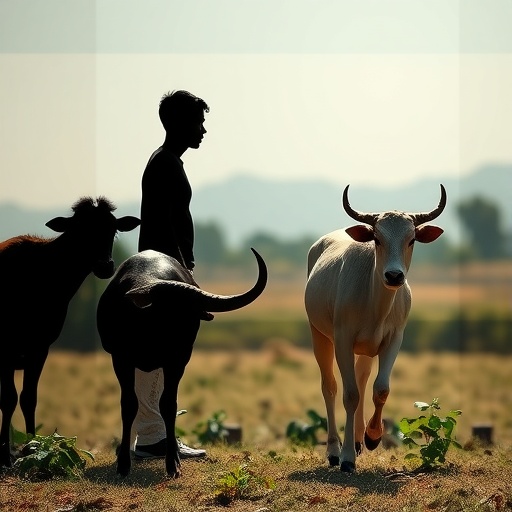
Dryland agro-pastoral systems are often judged by a deceptively simple question: how much can they produce with the resources available? A new study published in Communications Earth & Environment warns that this familiar measure may be hiding a deeper crisis. According to Peng, Zhan, Chen and colleagues, rising technical efficiency in dryland farming and livestock production can occur at the same time that the overall balance among the systems’ many functions is deteriorating.
The finding challenges the assumption that greater efficiency automatically means greater sustainability. In technical terms, efficiency generally describes how close a production system comes to achieving the maximum possible output from a given set of inputs, such as land, labor, water, energy, feed or machinery. A farm may therefore become more efficient by producing more grain or livestock products without proportionally increasing its resource use. But dryland agro-pastoral systems are not factories designed to deliver a single product. They also regulate soil, support biodiversity, store carbon, recycle nutrients, provide livelihoods and buffer communities against climatic shocks.
That distinction is at the heart of the study’s warning. A system can improve its performance on one metric while losing capacity in several others. For example, intensified production may raise output per unit of water or labor, yet weaken soil structure, reduce habitat diversity or increase dependence on external inputs. If assessments focus primarily on production efficiency, these losses may remain statistically invisible. The result is a misleading picture of progress: the system appears to be improving because the most easily measured function is advancing, even as its broader ecological and social portfolio becomes less balanced.
Dryland regions are especially vulnerable to this form of hidden decline. These landscapes operate close to environmental limits, with scarce and highly variable rainfall, high evaporation and frequent exposure to drought, heat and land degradation. Crops and livestock are often linked through complex flows of resources: animals may consume crop residues, manure can return nutrients to fields, and grazing can convert vegetation that people cannot eat into food and income. Such connections create resilience, but they also mean that changes in one part of the system can trigger consequences elsewhere.
The phrase “multifunctional balance” captures this complexity. Rather than asking only whether a system produces more, researchers examine how different outputs and services coexist. These may include food production, economic returns, water conservation, soil fertility, carbon storage, biodiversity and rural employment. In a balanced system, gains in one area do not come at the expense of severe losses in another. Measuring that balance is technically difficult because the functions use different units and operate on different timescales. A crop yield can be recorded in tonnes, soil health through several physical and chemical indicators, and social resilience through economic or demographic measures.
To compare such diverse dimensions, scientists typically standardize indicators and combine them into composite assessments. Yet the choice of indicators, weighting methods and reference conditions can strongly influence the result. An efficiency analysis might identify a production frontier—the best observed performance for a given set of inputs—while a multifunctional assessment asks a broader question: how evenly does the system perform across competing objectives? The new research emphasizes that these analytical lenses are not interchangeable. A system can move closer to a production frontier while moving farther from a desirable balance among ecological, economic and social functions.
The implications extend beyond academic measurement. Governments and development agencies frequently promote technologies, management practices and infrastructure intended to increase productivity per unit of land or water. Those interventions can be valuable, particularly where food security and rural incomes are under pressure. But if efficiency gains are evaluated without tracking soil condition, biodiversity, carbon dynamics and livelihood stability, policies may reward short-term optimization while transferring costs into the future. In drylands, those costs can accumulate slowly and become difficult to reverse once vegetation cover, soil organic matter or local water availability has been significantly reduced.
The study’s message is not that efficiency is undesirable. Rather, efficiency must be treated as one component of sustainability rather than its substitute. A more complete evaluation would pair technical-efficiency analysis with measures of ecological integrity and social outcomes. It would also consider trade-offs explicitly. If a practice increases yield but reduces soil moisture retention, for instance, decision-makers need to know the size of both effects, the time over which they unfold and who gains or loses. This kind of systems analysis can reveal whether an apparent improvement is genuinely transformative or simply a redistribution of benefits and burdens.
The research arrives as climate change is making that distinction increasingly urgent. More erratic precipitation, rising temperatures and intensifying drought can expose weaknesses that remain hidden during favorable years. A highly specialized system may perform impressively under narrow conditions but prove fragile when weather, markets or input supplies change. By contrast, a multifunctional system with diversified crops, integrated livestock, healthier soils and stronger ecological buffers may produce slightly less under ideal conditions yet remain more stable during disruption. The study therefore points toward a broader definition of progress—one based not only on maximum output, but on the capacity to continue providing multiple benefits without exhausting the landscape that supports them.
For scientists and policymakers, the central lesson is clear: a rising efficiency score should never be interpreted in isolation. Dryland agro-pastoral systems must be assessed as interconnected social-ecological networks, where production, conservation and livelihoods are coupled rather than separate. The research by Peng and colleagues highlights a potentially dangerous blind spot in sustainability monitoring: technical success can conceal multifunctional decline. Closing that blind spot will require indicators that capture balance, resilience and long-term ecological capacity alongside productivity. Without that broader perspective, the race to make dryland agriculture more efficient could leave these fragile systems less capable of supporting people and nature in the future.
Cite Scienmag News
Alan Morgan. (July 31, 2026). Improved technical efficiency hides declining multifunctional balance in dryland agro-pastoral systems. Scienmag. https://scienmag.com/improved-technical-efficiency-hides-declining-multifunctional-balance-in-dryland-agro-pastoral-systems/
Alan Morgan. "Improved technical efficiency hides declining multifunctional balance in dryland agro-pastoral systems." Scienmag, 31 July 2026, https://scienmag.com/improved-technical-efficiency-hides-declining-multifunctional-balance-in-dryland-agro-pastoral-systems/. Accessed 3 September 2026.
Alan Morgan. "Improved technical efficiency hides declining multifunctional balance in dryland agro-pastoral systems." Scienmag. July 31, 2026. https://scienmag.com/improved-technical-efficiency-hides-declining-multifunctional-balance-in-dryland-agro-pastoral-systems/


