


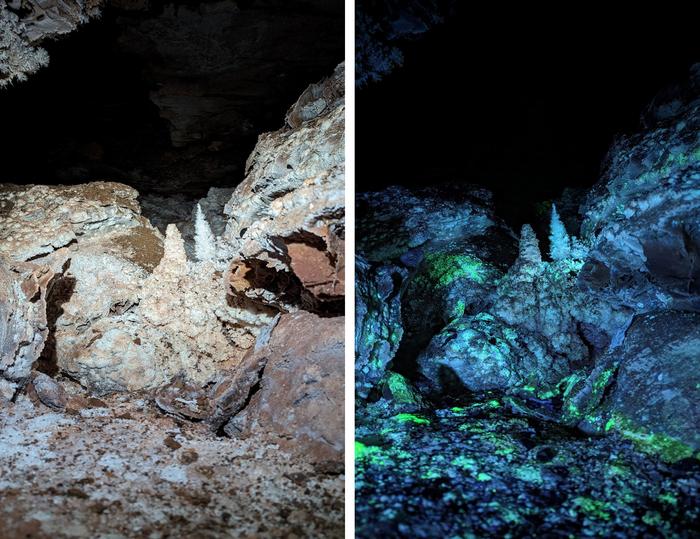
Deep within the subterranean realm of South Dakota’s Wind Cave, a breathtaking transformation occurs when exposed to ultraviolet (UV) light, revealing a vibrant spectrum of colors hidden within the minerals. These extraordinary fluorescent features could provide essential insights into both Earth’s geological history and the possibilities of life in extreme extraterrestrial environments, such as Europa, one of Jupiter’s icy moons. As scientists delve into this unique research, they are using advanced spectroscopic techniques to unlock the mysteries of life in hidden worlds beneath the surface.
Astrobiologist Joshua Sebree, alongside his students from the University of Northern Iowa, is spearheading this ambitious project. Their objective revolves around comprehending the intricate chemical processes occurring deep underground, which not only inform us about Earth’s geological past but also guide our understanding of how life might sustain itself in harsh environments across the cosmos. This exploration resonates with profound implications, as Earth’s ecosystems often serve as a comparative backdrop for examining potential habitats on other planets.
As their research progresses, the team utilizes portable spectrometers during expeditions, enabling them to analyze the fluorescence signatures emitted by various minerals without removing rock samples. This non-invasive approach represents a significant advancement in the methodology of cave studies. Sebree emphasizes that the ability to capture fluorescence spectra while remaining within the cave preserves the integrity of these natural formations, creating a blueprint for understanding the chemical history encapsulated in these ancient rocks.
Each venture into the cave uncovers more than just stunning luminescent minerals. As they meticulously chart the distinct rock formations, underground waterways, and diverse organisms inhabiting these environments, they inadvertently map the history of the cave’s formation and its evolution over millennia. The revelation of what lies beneath the surface is akin to peeling back layers of a geological onion, each layer carefully revealing information about past climatic conditions and biological activity.
The stark contrast between appearance under white light and UV light serves as a gateway to understanding the chemical processes that have transpired over thousands of years. In Wind Cave, once-barren rock walls ignite into vibrant hues, hinting at past geological events that shaped the landscape. This phenomenon occurs because minerals contain impurities that glow under UV exposure, illuminating pathways once carved by ancient water flows. Understanding this fluorescence not only adds depth to our understanding of geological processes on Earth but also invites consideration of similar processes that could occur on icy celestial bodies.
In an effort to catalog and analyze the mineral compositions found in these caves, the team is developing a comprehensive spectral database that will serve as a crucial resource for future cave studies. This fluorescence inventory aims to provide a working reference that connects the physical attributes of cave formations with their underlying chemical compositions. By creating a publicly accessible database, researchers hope to share valuable insights into cave science, enhancing collaborative efforts in the pursuit of knowledge in astrobiology and geology.
The beauty and complexity of these underground ecosystems extend far beyond their geological significance. The participants in this study—students and faculty alike—have reported transformative experiences during fieldwork, where science comes alive amidst the whispers of the cave’s history. Each underground expedition challenges explorers with a plethora of unforeseen hurdles, from the constant chill of cave temperatures to the physical demands of maneuvering through tight spaces and water flows. These challenges are counted among the invaluable experiences that shape budding scientists’ perspectives on their fields.
Moreover, the unique environmental conditions within these caves have inspired additional research initiatives among undergraduate students involved in Sebree’s project. Each student, fueled by curiosity, has embarked on individual inquiries to delve deeper into related disciplines within the realm of cave science. Whether investigating how life survives in extreme environments, innovating autonomous measurement devices, or studying protective techniques for cave explorers, their collective contributions embody the essence of collaborative scientific exploration.
As the investigations progress, Sebree and his team hope to refine their fluorescence analysis techniques further, allowing for more precise examinations of cave water and sediment. This research aims to clarify how surface-level biological activity influences life forms existing deep beneath the surface, thereby providing crucial information on the potential for microbial life on distant moons. The intricate interplay between surface conditions and subterranean ecosystems highlights the fascinating complexities of life’s adaptability in varying environments.
Future studies will undoubtedly build on these initial findings, as Sebree envisions a systematic approach to confirming the fluorescence technique against traditional laboratory methods. By fostering a holistic understanding of the dynamic interactions between geology and biochemistry, researchers can create a more profound narrative of life’s persistence on Earth and potentially beyond.
In summary, the ongoing exploration at Wind Cave demonstrates an innovative fusion of geology, biology, and astrobiology, revealing how the lessons of our planet’s remote corners can inform our search for extraterrestrial life. This journey into the depths of the Earth propels both the scientific community and the general public into a larger narrative—one that considers the vast possibilities of life in the most unexpected of places.
By illuminating the caverns of our world, we are not only uncovering the secrets of our planet’s past but also forging pathways toward understanding the universe’s greatest mysteries. As researchers continue to unlock the fluorescent tales hidden within the rocks, we are reminded of the interconnectedness of life, whether on Earth or among the stars.
Keywords
Fluorescence, Caves, Astrobiology, Chemistry, Geology.
Cite Scienmag News
Bethany Barker. (March 25, 2025). Illuminating the Unknown: How Fluorescent Caves May Offer Insights into Life in Extraterrestrial Environments. Scienmag. https://scienmag.com/illuminating-the-unknown-how-fluorescent-caves-may-offer-insights-into-life-in-extraterrestrial-environments/
Bethany Barker. "Illuminating the Unknown: How Fluorescent Caves May Offer Insights into Life in Extraterrestrial Environments." Scienmag, 25 March 2025, https://scienmag.com/illuminating-the-unknown-how-fluorescent-caves-may-offer-insights-into-life-in-extraterrestrial-environments/. Accessed 3 September 2026.
Bethany Barker. "Illuminating the Unknown: How Fluorescent Caves May Offer Insights into Life in Extraterrestrial Environments." Scienmag. March 25, 2025. https://scienmag.com/illuminating-the-unknown-how-fluorescent-caves-may-offer-insights-into-life-in-extraterrestrial-environments/


