


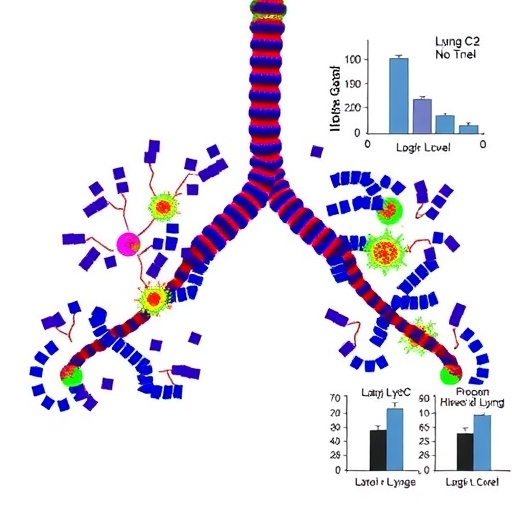
In a groundbreaking study published in Cell Death Discovery, researchers have unveiled a novel subset of T cells that play a pivotal role in fortifying lung immune defenses against bacterial infections. This discovery centers on IL-21-dependent Ly6C^+Ly6G^+CD4^+ T cells, a peculiar and previously underexplored population found within the pulmonary environment. Their unique interaction with macrophages—critical cellular components of innate immunity—has profound implications for our understanding of immune responses during lung infections caused by Actinobacillus pleuropneumoniae in murine models. This revelation opens new avenues for therapeutic interventions targeting respiratory infections and perhaps other inflammatory lung conditions.
The lung, as an interface constantly exposed to airborne pathogens, harbors a complex immune microenvironment. Within this milieu, macrophages serve as frontline defenders, orchestrating pathogen clearance and maintaining tissue homeostasis. However, their antimicrobial efficiency can be severely compromised during infections, particularly when facing virulent bacteria such as A. pleuropneumoniae, a problematic pathogen in veterinary medicine with parallels in human health. This study elucidates how a discrete subset of T helper cells, defined by the expression of Ly6C and Ly6G surface markers, markedly enhances macrophage function, shifting the paradigm of T cell roles in acute pulmonary immune responses.
The research team employed sophisticated immunophenotyping to identify the unique Ly6C^+Ly6G^+CD4^+ T cell population localized in the lungs. Notably, these cells demonstrated a functional dependency on interleukin-21 (IL-21), a cytokine known for modulating immune responses, including those associated with chronic viral infections and autoimmune diseases. IL-21 appears to be a critical driver in the differentiation and activation of these T cells, endowing them with the specific capability to bolster macrophage antimicrobial activity. This cytokine-mediated crosstalk suggests an intricate regulatory axis finely tuning immune enhancements at infection sites.
Through meticulous in vivo experimentation using mouse models infected with A. pleuropneumoniae, the researchers observed that mice with higher levels of IL-21-dependent Ly6C^+Ly6G^+CD4^+ T cells exhibited significantly improved bacterial clearance and lung tissue preservation. This subgroup of T cells seemed to amplify macrophage phagocytic capacity and reactive oxygen species (ROS) production, leading to more effective pathogen elimination. These findings underscore the potential of harnessing or mimicking these T cell subsets pharmacologically to fortify innate immunity during severe pulmonary infections.
Diving deeper into the mechanistic pathways, the study highlighted that IL-21 signaling promotes the expression of genes related to macrophage activation, including those involved in antigen presentation and inflammatory mediator secretion. This gene upregulation suggests a multi-layered enhancement of macrophage functionality beyond mere pathogen harvesting — possibly influencing a feedback loop that modulates adaptive immunity and inflammation resolution. This holistic augmentation of immune components may explain the robustness of host defense when these T cells are active.
Moreover, the expression of Ly6G, traditionally considered a granulocyte marker, on these CD4^+ T cells was a surprising and novel concept. This co-expression might indicate a hybrid phenotype or a transitional differentiation state, representing a previously unidentified category of immune cells with versatile roles. The dual Ly6C and Ly6G expression could reflect enhanced migratory capabilities or tissue retention properties, optimizing their interaction with macrophages in the lung microenvironment where timely immune communication is critical.
One intriguing aspect of the study was the capacity of these specialized T cells to survive and persist in the lung tissue during the acute phase of infection, suggesting that they are part of a dedicated local immune arsenal. Their persistence also implies potential roles beyond bacterial clearance, possibly in tissue repair or modulation of inflammation to prevent excessive damage—a delicate balance in lung immunity.
The findings hold promise not only for combating A. pleuropneumoniae but also for tackling other respiratory pathogens where immune evasion and macrophage dysfunction impede effective treatment. By understanding the molecular cues regulating these IL-21-dependent T cells, future research can explore targeted immunotherapies that augment natural host defenses without relying solely on antibiotics, a crucial consideration given the increasing threat of antimicrobial resistance.
Additionally, the study invites a reevaluation of existing immunological paradigms, particularly concerning T helper cell diversity and specialization. The identification of a lung-resident, cytokine-dependent T cell subtype broadens our comprehension of adaptive immunity’s plasticity in mucosal tissues. It accentuates the relevance of immune cell subsets finely tailored to organ-specific challenges—an insight valuable for designing precision medicine approaches in pulmonary diseases.
The researchers also employed advanced imaging and flow cytometry techniques to confirm the localization and phenotype of these T cells in lung tissue. Combining these methodologies provided robust validation of the cell subset and allowed for temporal tracking of their dynamics during infection progression. Such technological integration underlines the importance of multi-disciplinary approaches in modern immunological research.
While the study was performed in mice, its implications potentially extend to human health. Similar IL-21-dependent immune mechanisms may underlie responses to respiratory pathogens in humans, including bacteria responsible for pneumonia and other inflammatory lung disorders. Translation of these findings into clinical contexts could revolutionize how immunomodulatory therapies are developed to enhance macrophage function and improve patient outcomes in infectious diseases.
This research also highlights the importance of cytokine environment and intercellular communication in shaping effective immune responses. IL-21, beyond its established roles, emerges as a powerful immunomodulator within the lung, suggesting its therapeutic potential can be harnessed with precision to modulate local immunity without systemic immune activation or autoimmunity risks.
Furthermore, uncovering the interaction network between Ly6C^+Ly6G^+CD4^+ T cells and macrophages provides a blueprint for exploring similar cellular crosstalk in other organs facing chronic or acute infections. It may inspire the discovery of tissue-specific immune enhancers that, when activated, could mitigate infectious and inflammatory diseases with high specificity and reduced side effects.
In summary, the study breaks new ground in immunology by showcasing how a unique T cell subset enriches macrophage responsiveness against lung bacterial infections. This synergy between adaptive and innate immunity, mediated by IL-21 signaling, deepens our understanding of pulmonary host defense. It also sets the stage for innovative treatments aiming to leverage endogenous immune mechanisms to safeguard respiratory health against evolving pathogenic threats.
With infectious diseases remaining a leading cause of morbidity worldwide, such breakthroughs provide hope and tangible pathways toward improved therapeutic strategies. The intricate dance of immune cells within the lung is gaining clarity, and with it, our capacity to intervene in disease processes more effectively than ever before.
As science continues to decipher the nuances of immune regulation in specific tissue contexts, discoveries like these not only enrich basic knowledge but also invigorate translational research. By fostering immune cell cooperation and functional specialization, the body’s natural defenses can be amplified in ways that modern medicine is just beginning to harness. The future of immunotherapy, particularly in respiratory medicine, shines brighter with these insights.
Cite Scienmag News
Kristina Jarvis. (October 6, 2025). IL-21-Driven Ly6C+Ly6G+ CD4+ T Cells Boost Lung Immunity. Scienmag. https://scienmag.com/il-21-driven-ly6cly6g-cd4-t-cells-boost-lung-immunity/
Kristina Jarvis. "IL-21-Driven Ly6C+Ly6G+ CD4+ T Cells Boost Lung Immunity." Scienmag, 6 October 2025, https://scienmag.com/il-21-driven-ly6cly6g-cd4-t-cells-boost-lung-immunity/. Accessed 4 September 2026.
Kristina Jarvis. "IL-21-Driven Ly6C+Ly6G+ CD4+ T Cells Boost Lung Immunity." Scienmag. October 6, 2025. https://scienmag.com/il-21-driven-ly6cly6g-cd4-t-cells-boost-lung-immunity/


