


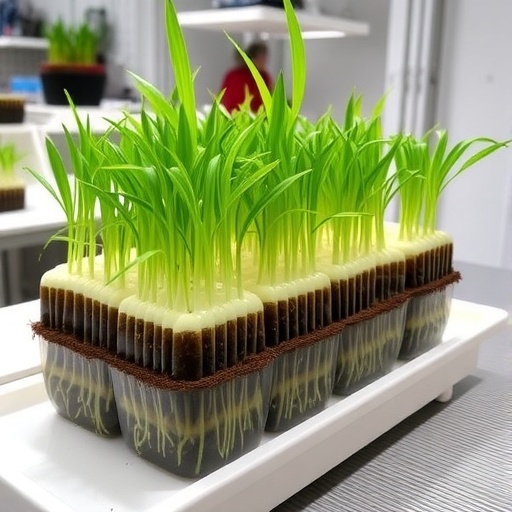
Scientists have developed a hydroponic platform that makes it possible to watch and measure a part of grass biology that has long been difficult to study: the development of nodal roots emerging from the plant’s stem. The system, described in Plant Methods, allows researchers to induce these shoot-borne roots under controlled conditions and then examine how plant hormones reshape their growth, internal anatomy, and cell walls. The work could give crop scientists a faster way to investigate root traits linked to water and nutrient uptake, anchorage, and resistance to lodging—the bending or toppling of plants during storms and heavy winds.
Nodal roots are especially important in grasses, including wheat and other major cereal crops. Unlike the first roots produced by a germinating seed, nodal roots arise later from stem nodes, the joints along the shoot. As a grass plant grows taller, these roots can expand the underground system that supports the plant and helps it access resources. They also contribute to mechanical stability by reinforcing the base of the shoot. Yet studying them in a laboratory is surprisingly challenging. Soil obscures the roots, plants develop at different rates, and environmental conditions can make it difficult to distinguish genuine biological responses from experimental variation. The new hydroponic approach replaces much of that uncertainty with a visible, reproducible growth environment.
Hydroponics grows plants without soil, supplying water and dissolved nutrients directly to the roots. In the platform developed by researchers at the University of Massachusetts Amherst, this arrangement supported nodal root development beyond the early seedling stage and allowed the team to apply chemical treatments while the plants continued growing. That combination is important because hormones can influence different phases of root biology. A treatment may alter whether a root begins to form, how rapidly it elongates, or how its tissues mature after initiation. By making roots accessible for imaging and sampling, the platform connects those visible growth outcomes with changes taking place inside individual cell layers.
The researchers tested the system in the grass model Brachypodium distachyon and in bread wheat, Triticum aestivum. They combined the hydroponic growth setup with histology and quantitative imaging. Histology involves preparing thin sections of plant tissue so that researchers can inspect its cellular organization under a microscope. Quantitative imaging goes further by converting visual features into measurable traits, such as the thickness of a cell wall in a defined tissue. This distinction matters because a root is not a uniform cylinder. Its cortex, the tissue between the outer surface and the vascular core, performs different functions from the vascular tissues that transport water and nutrients. The platform allowed the investigators to ask not merely whether a root became “stronger,” but which cells changed and how.
A central focus was secondary cell-wall thickening. Plant cell walls are built largely from cellulose and other structural polymers, but secondary walls are deposited inside some mature cells after the cells have stopped expanding. These reinforced layers can improve mechanical strength and alter the movement of water through tissues. Lignin, a complex polymer embedded in many secondary walls, is often associated with stiffening, but the study shows why lignin accumulation and wall thickness should not automatically be treated as identical measurements. A tissue can increase its lignin content without producing a proportionate increase in wall thickness, and different cell types can respond independently to the same signal.
The clearest effects came from treatments involving gibberellic acid, or GA3, and trans-zeatin, a form of cytokinin. Both hormone perturbations increased secondary-wall thickening in cortical and vascular tissues of nodal roots in Brachypodium. GA3 belongs to a family of hormones known for promoting growth and influencing developmental transitions, while cytokinins regulate cell division, differentiation, and the balance between shoot and root activity. Their effects on wall deposition suggest that hormonal signals controlling overall plant development can also reach the specialized process by which root cells reinforce themselves. The same broad response was observed in wheat: GA3 treatment induced cortical secondary-wall thickening similar to that seen in the model grass.
Auxin produced a different pattern. Applying or perturbing auxin primarily affected root initiation and elongation, with comparatively limited effects on wall deposition. Auxin is a key regulator of plant development, helping establish patterns of cell division and directional growth. The result suggests that the decision to launch a nodal root and the decision to reinforce its mature tissues are at least partly separable biological programs. In practical terms, a hormone that increases the number or length of roots may not necessarily make those roots anatomically stronger. That separation could become important in crop improvement, where a desirable root system may need both extensive growth and appropriate structural reinforcement.
Jasmonate signaling revealed another layer of complexity. Jasmonates are plant hormones associated with defense responses and environmental stress, but they also influence development. In the experiments, jasmonate perturbation changed cell-wall properties mainly in the outer cortical tissues, while vascular wall thickness remained largely unchanged. The findings point to a cell-type-specific response rather than a single root-wide switch. They also exposed an uncoupling between lignin accumulation and wall thickness: changes in one property did not necessarily predict changes in the other. By linking hormone treatments to precise anatomical measurements, the platform could help researchers identify the molecular pathways that make neighboring tissues respond differently to the same chemical signal.
The authors present the system as scalable and accessible, with potential for comparative studies across grasses and for examining traits relevant to crop performance under difficult weather. The approach does not by itself prove that hormonally induced wall thickening will make field-grown wheat more resistant to lodging, nor does it establish how these responses operate under drought, flooding, nutrient limitation, or disease. Its importance is methodological as much as biological: it provides a controlled bridge between hormone signaling, root architecture, and cell-level anatomy. Future experiments can use the platform to test genetic variants, environmental stresses, and combinations of treatments while measuring the resulting roots with greater precision. For crops facing increasingly variable growing conditions, that ability to dissect the hidden engineering of the root system could turn an overlooked plant structure into a major target for research.
Cite Scienmag News
Alan Morgan. (August 28, 2026). Hydroponic Platform Reveals Grass Nodal Root Development, Cell Wall Thickening, Hormone Responses. Scienmag. https://scienmag.com/hydroponic-platform-reveals-grass-nodal-root-development-cell-wall-thickening-hormone-responses/
Alan Morgan. "Hydroponic Platform Reveals Grass Nodal Root Development, Cell Wall Thickening, Hormone Responses." Scienmag, 28 August 2026, https://scienmag.com/hydroponic-platform-reveals-grass-nodal-root-development-cell-wall-thickening-hormone-responses/. Accessed 3 September 2026.
Alan Morgan. "Hydroponic Platform Reveals Grass Nodal Root Development, Cell Wall Thickening, Hormone Responses." Scienmag. August 28, 2026. https://scienmag.com/hydroponic-platform-reveals-grass-nodal-root-development-cell-wall-thickening-hormone-responses/


