


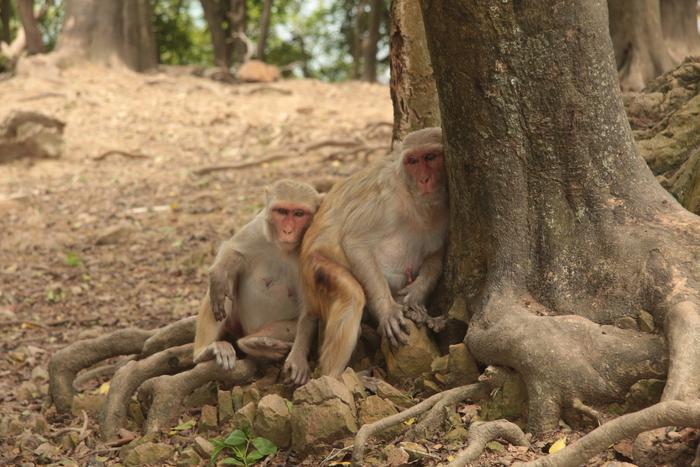
A devastating hurricane transformed a monkey society by changing the pros and cons of interacting with others, new research shows.

Credit: Lauren Brent
A devastating hurricane transformed a monkey society by changing the pros and cons of interacting with others, new research shows.
Hurricane Maria hit Puerto Rico in 2017, killing more than 3,000 people. It also destroyed 63% of vegetation on Cayo Santiago (also known as Monkey Island), which is home to a population of rhesus macaques.
Even now, tree cover remains far below pre-hurricane levels and – in this hot part of the world – that makes shade a scarce and precious resource for the macaques.
The new study, led by the universities of Pennsylvania and Exeter and published in the journal Science, shows the storm damage altered the evolutionary benefits of tolerating others and sharing shade – giving a survival advantage to tolerant macaques.
With many ecosystems changing rapidly due to human activity, this study is an example of a species adapting its social strategy to survive.
“In response to the drastic changes caused by the hurricane, macaques persistently increased tolerance and decreased aggression towards each other,” said Dr Camille Testard, from the University of Pennsylvania.
“This enabled more macaques to access scarce shade, which is critical for survival.”
Dr Testard added: “We examined 10 years of data on the strength and number of macaques’ social ties, before and after the hurricane.
“Before the hurricane, tolerating others had no impact on risk of death.
“Afterwards, macaques that displayed more than average social tolerance – and were therefore better able to share shade – were 42% less likely to die than those that were less tolerant.”
This represents a sudden change in “selection pressure” – the evolutionary benefits or costs of different traits or behaviours.
Social behaviour was assessed by recording aggression and how often individuals were seen sitting together.
“Macaques aren’t the best at sharing resources – be they food or shade. They are well known to live in an aggressive, highly competitive society,” said Professor Lauren Brent, from the University of Exeter.
“But in the heat caused by ecological changes, often around 40C, the macaques had to share space or die.”
Dr Testard added: “To access shade, they need to tolerate – and be tolerated by – others, and we found that this tolerance spills over into other daily interactions.
“Macaques that began sharing shade also spend time together in the mornings, before the day’s heat forces them to seek shade.
“In effect, the hurricane changed the rules of the game in the monkeys’ society.”
Professor Brent added: “For group-living animals, social relationships may allow them to cope with disturbances in the environment, including human-induced climate change.
“We were surprised the macaques’ social behaviour was so flexible, making them resilient to this environmental change, but some species may not display this same flexibility.”
The research team included Arizona State University and New York University.
Funders included the National Institutes of Health, the European Research Council, the National Science Foundation and the Royal Society.
The paper is entitled: “Ecological disturbance alters the adaptive benefits of social ties.”
Journal
Science
Article Title
Ecological disturbance alters the adaptive benefits of social ties.
Article Publication Date
20-Jun-2024
Cite Scienmag News
Sloane Callahan. (June 23, 2024). Hurricane changed ‘rules of the game’ in monkey society. Scienmag. https://scienmag.com/hurricane-changed-rules-of-the-game-in-monkey-society/
Sloane Callahan. "Hurricane changed ‘rules of the game’ in monkey society." Scienmag, 23 June 2024, https://scienmag.com/hurricane-changed-rules-of-the-game-in-monkey-society/. Accessed 5 September 2026.
Sloane Callahan. "Hurricane changed ‘rules of the game’ in monkey society." Scienmag. June 23, 2024. https://scienmag.com/hurricane-changed-rules-of-the-game-in-monkey-society/

