


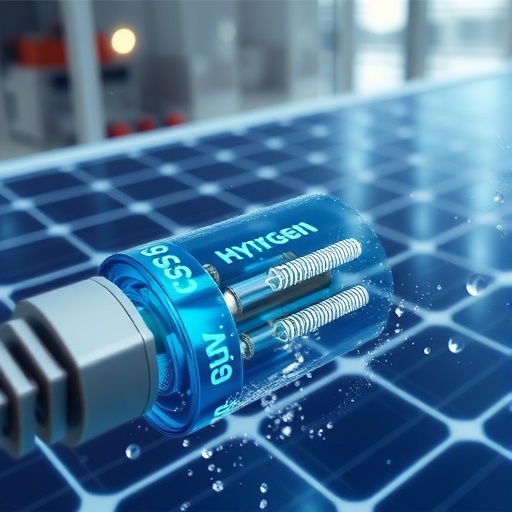
In the rapidly evolving landscape of clean energy, hydrogen is emerging as a pivotal player, promising a sustainable future powered by zero-emission fuels. However, the widespread adoption of hydrogen technologies hinges on overcoming safety challenges, particularly the detection of hydrogen leaks that could lead to the formation of explosive oxyhydrogen gas. Addressing this critical issue, a team of researchers at Chalmers University of Technology in Sweden has unveiled a groundbreaking hydrogen sensor that not only performs reliably in humid environments but intriguingly improves its response as humidity increases—a stark departure from the limitations of existing sensor technologies.
The challenge with conventional hydrogen sensors lies in their compromised efficacy under humid conditions, which is problematic given that hydrogen installations are frequently situated in environments where moisture is abundant. Traditional sensors suffer from slower response times and decreased sensitivity when exposed to water vapor, limiting their practical use. The Chalmers team’s innovation confronts this problem head-on by introducing a compact sensor leveraging platinum nanoparticles, which play a dual role as catalysts and sensing elements to create a novel humidity-resilient detection mechanism.
At the heart of this sensor’s operation is a fascinating interplay between hydrogen concentration, humidity, and optical physics. Platinum nanoparticles catalyze the reaction of hydrogen and oxygen present in ambient air, generating heat that causes the thin water film naturally coating the sensor’s surface to evaporate. This evaporation is proportional to the hydrogen concentration because more hydrogen leads to more heat and thus more water ‘boiling away.’ Simultaneously, the thickness of the water film is governed by the environmental moisture level, meaning higher humidity increases the film’s thickness, consequently enhancing the sensor’s sensitivity. This mechanism allows the device to effectively measure hydrogen levels by monitoring changes in the water film.
The optical detection principle employed here exploits plasmons—coherent oscillations of electrons excited by light on the surface of platinum nanoparticles. As hydrogen molecules interact with the sensor, the optical properties of the nanoparticles shift, causing a change in color visible at the nanoscale. This colorimetric change provides an immediate and precise indication of hydrogen presence and concentration, with the sensor capable of triggering alarms at critical thresholds. This opto-chemical approach enables the real-time and highly sensitive detection of hydrogen without the drawbacks of traditional electrochemical sensors.
Chalmers University’s research team, led by doctoral candidate Athanasios Theodoridis under the guidance of Professor Christoph Langhammer, has extensively tested this sensor design. Over 140 hours of continuous exposure to humid air confirmed the sensor’s stability and reliability, demonstrating consistent performance across various humidity levels. Notably, the sensor remains operational and maintains sensitivity at high humidity, overcoming a primary hurdle that has impeded hydrogen safety sensor technologies until now.
The context of their work situates hydrogen not just as an alternative fuel but as a critical energy carrier in sectors ranging from transportation to industrial manufacturing. Hydrogen’s role is expanding in clean steel production, chemical synthesis, and especially in fuel cells used by vehicles and marine vessels. These applications all share a common obstacle: the necessity to safely manage hydrogen gas in environments where moisture is omnipresent, whether from ambient conditions or as a byproduct of the hydrogen reaction itself. Hence, the Chalmers sensor meets an urgent demand for robust, accurate, and mass-producible detection technology.
This sensor innovation follows a trajectory of prior breakthroughs achieved by the Chalmers team in nanoplasmonic sensing, where they have developed sensors exhibiting exceptional speed and sensitivity. Previous sensors based on palladium nanoparticles capitalized on hydrogen absorption but encountered challenges with humidity. The transition to platinum nanoparticles marks a paradigm shift, enabling catalytic plasmonic sensing that not only tolerates but thrives in humid atmospheres, setting a new standard for environmental adaptability in hydrogen detection.
The compact design, roughly fingertip-sized, along with the potential for large-scale production, positions this sensor as a promising candidate for widespread deployment. It answers the growing call for miniaturization, lower costs, and flexibility without compromising on performance. Furthermore, the sensor detects hydrogen at concentrations as low as 30 parts per million—a remarkable threshold that rivals the best performing sensors worldwide, especially in challenging humid conditions.
Chalmers’ research is situated within the TechForH2 competence center, a multidisciplinary initiative dedicated to advancing hydrogen technologies. Their collaborative framework integrates advanced materials science, nanofabrication, and AI-assisted optimization to refine sensor response and humidity resistance. The incorporation of artificial intelligence stands out as a notable future direction, aiming to further enhance the sensor’s predictive capabilities and operational robustness under diverse environmental scenarios.
The principal investigator, Professor Christoph Langhammer, acknowledges that future hydrogen sensing technologies will likely require a portfolio of materials tailored for different operational contexts. The diversity of environments where hydrogen is utilized—ranging from dry industrial sites to humid natural settings—means a one-size-fits-all sensor is unlikely. Instead, a combination of active materials with complementary properties will form the backbone of next-generation sensor systems, combining speed, sensitivity, and humidity tolerance.
Significantly, Langhammer is also a co-founder of Insplorion, a spin-off company that has transitioned these nanoplasmonic sensor technologies from laboratory innovation to commercial products. Insplorion’s recent launch of hydrogen sensors underscores the practical impact of this research and its readiness for industrial adoption, potentially revolutionizing safety protocols in hydrogen infrastructure worldwide.
The scientific community and energy industry stand to benefit immensely from this advancement as it directly confronts a major safety hurdle that has slowed hydrogen integration into mainstream energy systems. By enabling continuous, reliable hydrogen monitoring even in complex ambient conditions, the Chalmers sensor supports safer hydrogen economies and accelerates the transition towards sustainable energy solutions that can meet the demands of a cleaner future.
As hydrogen’s prominence grows in the global energy portfolio, innovative sensing technologies like this catalytic-plasmonic platinum nanoparticle sensor will be indispensable. They facilitate safer handling, reduce risk of accidents, and underpin regulatory frameworks necessary for scaling hydrogen technologies. The sensor’s elegant coupling of catalysis, plasmonic effects, and humidity sensitivity exemplifies the ingenuity needed to tackle one of the most pressing challenges in the clean energy transition.
The journey from fundamental research in nanoplasmonics to a deployable, scalable sensor solution demonstrates the vitality of interdisciplinary collaboration and forward-looking research programs. Through sustained investment and integration of cutting-edge physics, materials science, and engineering, the Chalmers group is setting new benchmarks for hydrogen safety technology that promises to reverberate across the energy sector for decades to come.
News Publication Date: 18-Nov-2025
Web References:
References:
Theodoridis, A., Andersson, C., Nilsson, S., Fritzsche, J., & Langhammer, C. (2025). A Catalytic-Plasmonic Pt Nanoparticle Sensor for Hydrogen Detection in High-Humidity Environments. ACS Sensors. https://doi.org/10.1021/acssensors.5c03166
Cite Scienmag News
Faith Mcneil. (February 5, 2026). Humidity-Resistant Hydrogen Sensor Enhances Safety in Large-Scale Clean Energy Applications. Scienmag. https://scienmag.com/humidity-resistant-hydrogen-sensor-enhances-safety-in-large-scale-clean-energy-applications/
Faith Mcneil. "Humidity-Resistant Hydrogen Sensor Enhances Safety in Large-Scale Clean Energy Applications." Scienmag, 5 February 2026, https://scienmag.com/humidity-resistant-hydrogen-sensor-enhances-safety-in-large-scale-clean-energy-applications/. Accessed 4 September 2026.
Faith Mcneil. "Humidity-Resistant Hydrogen Sensor Enhances Safety in Large-Scale Clean Energy Applications." Scienmag. February 5, 2026. https://scienmag.com/humidity-resistant-hydrogen-sensor-enhances-safety-in-large-scale-clean-energy-applications/


