


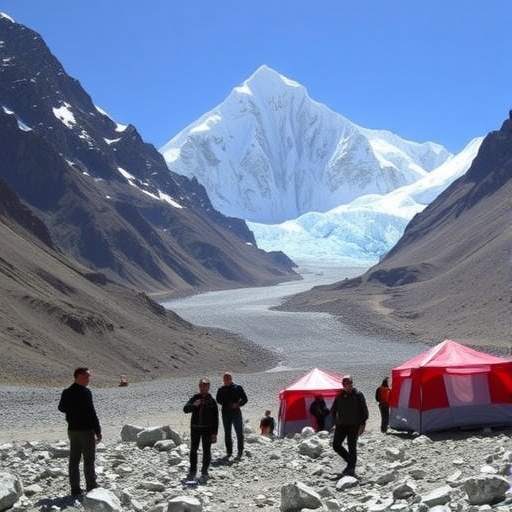
Mount Everest’s Khumbu Glacier is being warmed by forces far larger than anything happening at the mountain’s crowded base camp. Rising global temperatures remain the dominant threat to the Himalayan ice, but a new study argues that the thousands of people who gather each spring at Everest Base Camp are adding a measurable local heat burden of their own. Cooking fuel, kerosene heaters, petrol-powered equipment and even human urinary discharge together released an estimated 849,174 ± 179,774 megajoules of heat at the camp during the 2023 climbing season. In theoretical terms, that energy could melt approximately 2,492 ± 528 tonnes of glacier ice and snow. The calculation does not mean that every joule flowed directly into the glacier, but it illustrates how an intense human presence can modify an already fragile high-altitude environment.
The research, published in Regional Environmental Change, examines the environmental consequences of a camp located directly on the glacier’s surface. Everest Base Camp is not a permanent city, but during the spring climbing season it becomes a temporary settlement of climbers, trekking groups, guides, porters, cooks, medical teams and support staff. The number of people, tents, kitchens and generators has grown substantially over recent decades, increasing demand for heat, electricity and food preparation. On a glacier, those activities have consequences beyond ordinary pollution. Fuel combustion releases thermal energy and exhaust into the surrounding air, while dark particles and other pollutants can settle on snow, lowering its reflectivity. A darker surface absorbs more solar radiation, potentially accelerating melt through the albedo effect.
The researchers focused on three sources of local anthropogenic heat: liquefied petroleum gas, or LPG, used largely for cooking; kerosene used for heating and other camp operations; and petrol consumed in equipment and electricity generation. They combined field observations from the spring 2023 expedition season with fuel-use estimates to calculate the energy released. The basic approach applies the amount of each fuel consumed to its calorific value, the energy liberated during combustion. Not all of that energy is transferred to the glacier. Some leaves the area in hot exhaust, some warms cooking vessels or tent interiors, and some is radiated or carried away by turbulent winds. Nevertheless, the total provides an estimate of the thermal scale of the camp’s activity. The researchers also included the heat associated with urine released by people at the site, treating the warming of liquid excreted by the human body as a small but cumulative contribution.
That inclusion is likely to attract the most attention, but it reflects a broader principle in environmental physics: heat produced by living bodies and human infrastructure can accumulate in places where the surrounding environment is unusually cold and energy flows are limited. At extreme altitude, people consume large amounts of food to maintain body temperature and sustain strenuous activity. Their metabolism converts chemical energy into heat, while cooking, shelter heating and power generation add further inputs. Human urine is warm relative to snow and ice, and repeated discharge can deliver sensible heat—the energy associated with a temperature difference—to the surface. The researchers did not suggest that urine rivals fossil fuels as a source of melt. Rather, they counted it as one component of the total human heat budget, alongside much larger fuel-related sources. The estimate is best understood as an upper-bound accounting exercise, not a direct measurement of ice loss caused by individual acts.
To place the energy estimate in physical terms, melting ice requires overcoming the latent heat of fusion: about 334 kilojoules are needed to convert one kilogram of ice at its melting point into liquid water, without raising its temperature. Dividing the calculated heat release by that value produces a melt-equivalent of roughly 2.5 million kilograms. The uncertainty is substantial because the researchers had to estimate fuel consumption, operating conditions and the fraction of heat available to the snow and ice. In the real environment, much of the energy would be dispersed into the atmosphere or absorbed by tents, equipment and debris. Solar radiation, wind, humidity, snow grain size and the thickness of rocky debris covering the glacier also control how much energy reaches the ice. The calculation therefore does not establish that the camp melted 2,492 tonnes of glacier material; it quantifies the amount of ice that the measured energy could melt under idealized conversion conditions.
The study’s satellite analysis provides a broader and more direct indication that the base-camp area is warming rapidly. The authors examined land-surface temperature records derived from Landsat 5, Landsat 7 and Landsat 9 imagery spanning 1991 to 2023. Thermal sensors aboard these satellites detect infrared radiation emitted by the ground, allowing researchers to estimate the temperature of the land or snow surface rather than the temperature of the air several metres above it. At Everest Base Camp, the analysis found an increase of 0.28 °C per year across the 32-year record. That trend was approximately twice the warming rate observed on the adjacent surface of Khumbu Glacier and about 15 per cent higher than the increase measured over debris-covered terrain immediately north of the camp.
The contrast suggests that local surface conditions may be amplifying the regional climate signal. A concentration of tents, people, fuel-burning equipment and exposed ground can create a small heat-island effect, in which built or heavily disturbed surfaces become warmer than nearby natural terrain. Dark fabrics, rock, equipment and soot absorb more sunlight than clean snow. Combustion adds heat directly, while packed snow and altered surface drainage can change how energy is stored and released. Satellite-derived surface temperature cannot by itself identify the exact cause of the trend, and the researchers do not claim that local activity explains the wider warming of the Khumbu region. Instead, the result indicates that the base camp is experiencing a particularly strong warming signal at the surface, where even modest changes can influence snow stability, meltwater formation and the safety of people living and working on the glacier.
Khumbu Glacier is already under pressure from global climate change. Across the Himalaya, retreating and thinning glaciers threaten water supplies, ecosystems and mountain economies, while changing ice conditions create hazards for climbers and local communities. The glacier’s surface is partly covered by debris, a layer of stones and sediment that can either insulate the ice when thick or increase melt when thin, depending on its properties. Crevasses, melt channels and unstable ice are not simply scenic features; they are indicators of a dynamic system responding to changing energy balances. As the glacier thins, a camp built on its surface becomes more difficult to maintain. The ground beneath tents can deform, meltwater channels can shift, and ice blocks can become unstable. The study therefore links the local heat budget to a practical question: whether Everest Base Camp should remain on its current supraglacial location.
The authors identify two potential relocation sites southwest of the existing camp. Unlike the current site, both are described as being on stable ground rather than directly on the glacier. Moving the camp would not halt regional glacier melt, nor would it remove the need to reduce emissions and manage waste. It could, however, separate the main human settlement from the most vulnerable ice surface and reduce risks associated with ground movement and meltwater. The researchers frame relocation as part of a wider transformation that would also include cleaner energy systems, more efficient cooking and heating, stricter control of fuel use, improved sanitation and limits on the concentration of visitors. Such measures could reduce local heat release, black-carbon deposition and pressure on water and waste systems at the same time.
The findings arrive as Everest tourism confronts a paradox: the glacier that makes the mountain’s landscape iconic is becoming less stable partly because the mountain is drawing more visitors. Replacing fossil-fuel equipment with renewable electricity, improving insulation in shelters, using high-efficiency stoves and consolidating power systems could lower the camp’s energy demand. Sanitation systems that prevent direct discharge onto snow and ice would reduce contamination and eliminate one pathway for localized heat transfer. Yet the researchers emphasize that local interventions are complementary to, not substitutes for, rapid reductions in greenhouse-gas emissions worldwide. Global warming determines the background conditions under which the glacier gains or loses mass; camp activity modifies the immediate environment. Together, the study’s field calculations and satellite record show why protecting Everest Base Camp requires treating it not as an isolated outpost, but as a human settlement embedded in a changing cryosphere.
Cite Scienmag News
Sloane Callahan. (August 27, 2026). Human Activity Threatens Khumbu Glacier, Prompting Sustainable Everest Base Camp Plans. Scienmag. https://scienmag.com/human-activity-threatens-khumbu-glacier-prompting-sustainable-everest-base-camp-plans/
Sloane Callahan. "Human Activity Threatens Khumbu Glacier, Prompting Sustainable Everest Base Camp Plans." Scienmag, 27 August 2026, https://scienmag.com/human-activity-threatens-khumbu-glacier-prompting-sustainable-everest-base-camp-plans/. Accessed 3 September 2026.
Sloane Callahan. "Human Activity Threatens Khumbu Glacier, Prompting Sustainable Everest Base Camp Plans." Scienmag. August 27, 2026. https://scienmag.com/human-activity-threatens-khumbu-glacier-prompting-sustainable-everest-base-camp-plans/


