


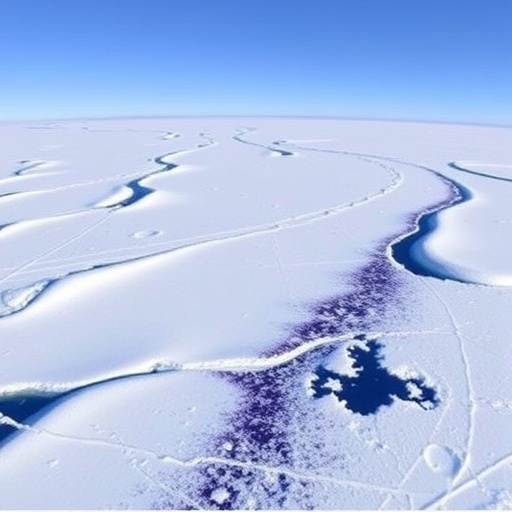
A new study has uncovered a surprising climate connection linking sea ice in the Beaufort Sea, north of Alaska and western Canada, with summer ocean temperatures thousands of kilometres away in the tropical North Atlantic. The research, based on observations and atmospheric data from 1979 to 2023, finds a statistically significant negative relationship between the two regions: years with unusually extensive Beaufort Sea ice tend to coincide with cooler-than-average sea-surface temperatures in the Tropical North Atlantic, while reduced Beaufort ice is associated with warmer tropical Atlantic waters. The result adds a new Arctic pathway to the growing network of connections that allow changes in one part of the climate system to influence weather and climate far beyond the polar region. Although the study does not suggest that Beaufort Sea ice is the only force controlling tropical Atlantic temperatures, it identifies a physical mechanism that may help explain part of their year-to-year variability during the Northern Hemisphere summer.
The finding is especially notable because the Arctic and the tropical Atlantic are often treated as distinct climate domains. The Arctic is dominated by frozen ocean, cold air and strong seasonal contrasts, whereas the Tropical North Atlantic is shaped by intense solar heating, evaporation, convection and interactions with tropical circulation systems. Yet the atmosphere can transmit disturbances between these distant regions through planetary-scale waves. The study, led by Aminu Dalhatu Datti and colleagues, argues that fluctuations in Beaufort Sea ice concentration can alter the Arctic energy balance, disturb atmospheric circulation and initiate a stationary Rossby wave train. This chain of events carries the influence southeastward across Canada and the northern United States, over the western and subtropical North Atlantic, and eventually into the tropical North Atlantic. In this view, the Arctic is not an isolated frozen cap but an active source of atmospheric disturbances capable of reshaping conditions across an entire ocean basin.
Sea ice concentration refers to the fraction of the ocean surface covered by ice. Its importance extends beyond the ice itself because frozen seawater changes how energy moves between the ocean, atmosphere and space. Bright sea ice reflects a large proportion of incoming sunlight, a property known as the surface albedo effect. Open water, by contrast, absorbs much more solar radiation and can release heat and moisture into the atmosphere. In the Beaufort Sea, an increase in ice concentration reduces the exposed ocean area and changes both radiative and turbulent exchanges at the surface. The researchers report that greater Beaufort ice is linked to local radiative cooling, including reduced upward longwave radiation and enhanced reflection of incoming shortwave radiation. Longwave radiation is thermal energy emitted by Earth’s surface, while shortwave radiation is primarily sunlight. Together, these changes can cool the air above the ice and modify the pressure and wind patterns surrounding the region.
Those local energy changes may then produce a Rossby wave source in the Arctic atmosphere. Rossby waves are large-scale undulations in the mid- and upper-level westerly winds, shaped by Earth’s rotation and the conservation of planetary vorticity. They are responsible for many persistent ridges and troughs in the jet-stream system. A disturbance over the Beaufort Sea can therefore behave less like a local weather event and more like a pulse sent through the atmospheric circulation. According to the study, the resulting stationary wave pattern propagates southeastward from the Beaufort region, crossing North America before reaching the North Atlantic. Stationary waves move slowly relative to the prevailing flow and can establish prolonged regions of rising or sinking air. Their effects may persist for weeks, making them important drivers of seasonal weather anomalies rather than merely short-lived disturbances.
As the wave train reaches the Atlantic, it appears to create atmospheric conditions that favour cooling in the Tropical North Atlantic. The mechanism involves changes in circulation, cloudiness, surface winds and heat exchange between the atmosphere and ocean. Sea-surface temperature is not determined simply by the amount of sunlight reaching the ocean. It also depends on evaporation, sensible heat transfer, cloud cover, ocean mixing, currents and the transport of heat by winds. Stronger evaporation removes energy from the sea surface because the conversion of liquid water into water vapour consumes heat. Winds can also promote turbulent mixing, drawing cooler water upward or redistributing warm water across the surface. The study’s analysis of turbulent heat fluxes suggests that the circulation anomaly connected to Beaufort Sea ice can modify these air–sea exchanges in the tropical Atlantic, providing an energetic pathway between Arctic ice variability and tropical ocean temperatures.
The relationship is described as interannual, meaning that it concerns changes from one year to the next rather than a simple long-term trend. That distinction matters because the Arctic has undergone dramatic multi-decadal warming and sea-ice loss, while natural climate variability continues to operate on shorter timescales. The researchers examined boreal-summer conditions over more than four decades, using sea-ice concentration and sea-surface-temperature records from the Met Office Hadley Centre, together with atmospheric circulation data from the US National Oceanic and Atmospheric Administration. By analysing anomalies—departures from the seasonal average—they focused on the fluctuating component of the climate signal. Statistical relationships alone cannot prove that one region causes another, but the alignment between the observed correlation, atmospheric wave behaviour and heat-flux response strengthens the case for a physically meaningful connection.
To test whether the proposed atmospheric pathway could be reproduced in a climate model, the team used version 5.3 of the National Center for Atmospheric Research Community Atmosphere Model, known as CAM5.3. Climate models represent the atmosphere using mathematical equations that describe fluid motion, radiation, cloud processes, moisture transport and interactions with the land and ocean surface. In the simulations, CAM5.3 reproduced the broad features of the observed mechanism to a reasonable extent, including the circulation response associated with Beaufort Sea ice variability and its extension toward the tropical Atlantic. Model agreement is not a guarantee that every detail is correct: atmospheric models can misrepresent clouds, convection, jet-stream structure and surface fluxes, particularly in regions where observations are sparse. Nevertheless, the simulation provides an independent line of support beyond the statistical analysis and suggests that the proposed teleconnection is dynamically plausible.
The discovery could have implications for seasonal forecasting and for understanding climate risks in regions influenced by the Tropical North Atlantic. Tropical Atlantic sea-surface temperatures affect atmospheric convection, the position and strength of the Intertropical Convergence Zone, rainfall over nearby continents and the development of weather systems. They can also influence African rainfall, Atlantic hurricane environments and atmospheric circulation extending into other parts of the Northern Hemisphere. A previously underappreciated Arctic contribution could therefore improve forecasts if scientists can determine how consistently the signal operates and how it interacts with better-known influences such as the El Niño–Southern Oscillation, the Atlantic Meridional Overturning Circulation and internal tropical variability. The result does not mean that the Beaufort Sea can forecast every tropical Atlantic event, but it suggests that Arctic observations may contain useful information about conditions far to the south.
The study also arrives as rapid Arctic change is making the climate system increasingly different from the one represented by much of the historical record. The Arctic has warmed nearly four times faster than the global average since 1979, and the Beaufort Sea has experienced substantial changes in its seasonal and multiyear ice cover. As ice becomes thinner, more mobile and more vulnerable to summer melt, the region’s influence on radiation, winds and ocean–atmosphere exchange may change as well. Whether the Arctic–tropical Atlantic relationship will strengthen, weaken or shift under continued warming remains uncertain. The authors’ results are therefore best understood as a newly identified piece of a larger puzzle. They show that a variation in summer ice near the top of the world can be associated with a measurable response in tropical Atlantic waters, revealing once again that climate boundaries are far less rigid than geography suggests.
Cite Scienmag News
Sloane Callahan. (August 27, 2026). Arctic-Tropical Summer Link Connects Beaufort Sea Ice Variability With North Atlantic Temperatures. Scienmag. https://scienmag.com/arctic-tropical-summer-link-connects-beaufort-sea-ice-variability-with-north-atlantic-temperatures/
Sloane Callahan. "Arctic-Tropical Summer Link Connects Beaufort Sea Ice Variability With North Atlantic Temperatures." Scienmag, 27 August 2026, https://scienmag.com/arctic-tropical-summer-link-connects-beaufort-sea-ice-variability-with-north-atlantic-temperatures/. Accessed 3 September 2026.
Sloane Callahan. "Arctic-Tropical Summer Link Connects Beaufort Sea Ice Variability With North Atlantic Temperatures." Scienmag. August 27, 2026. https://scienmag.com/arctic-tropical-summer-link-connects-beaufort-sea-ice-variability-with-north-atlantic-temperatures/


