


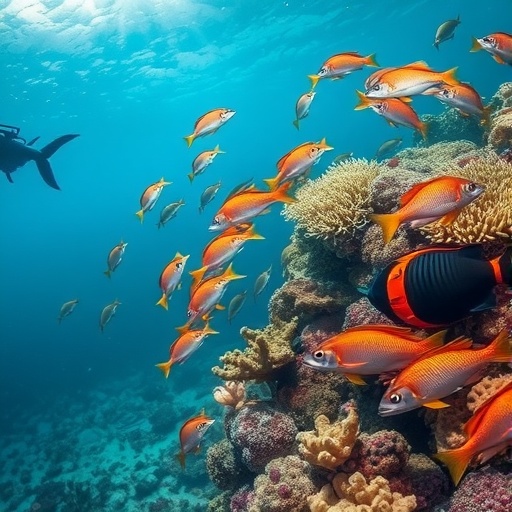
Turbulence in ocean waters is a phenomenon that has garnered much attention in marine biology as it plays a pivotal role in influencing the behaviors and ecological dynamics of various marine species. Among these, zooplanktivorous fish inhabiting coral reefs show remarkable adaptability to ever-changing environmental conditions. Recent research conducted by Ishikawa et al. illuminates the complex relationship between turbulence and the behaviors of both free and anchored zooplanktivorous fish within these vibrant ecosystems. This study, published in the esteemed journal Coral Reefs, delves into how these fish respond to turbulence, which is crucial for their survival and ecological roles.
In coral reef environments, zooplanktivorous fishes primarily feed on zooplankton – microscopic organisms drifting in the ocean. The presence of turbulence can significantly alter the distribution and availability of these prey items, consequently influencing predator-prey dynamics. Fish themselves are subject to the laws of fluid dynamics; their movement strategies may be affected by both environmental turbulence and their foraging behaviors. Understanding this relationship sheds light on the intricate dependencies between physical oceanographic processes and marine biodiversity.
The study focused on specific species of zooplanktivorous fish, analyzing how their behaviors change in response to varying turbulence conditions. By examining both free-swimming and anchored behavior of these fish, the researchers uncovered a nuanced picture of how turbulence influences their foraging strategies. Free-swimming fish adopted increased swimming speeds and altered their pathways, showcasing an evolutionary response to optimize feeding in turbulent waters. In contrast, anchored fish exhibited a more passive approach, relying on the chaotic movement of zooplankton induced by turbulence for sustenance.
The implications of these findings extend beyond just the behaviors of individual species. The research underscores the importance of turbulence as a key ecological factor driving community dynamics within coral reef ecosystems. The interaction patterns among species, the competition for resources, and even the rates of predation can all be influenced by turbulence levels, leading to potential changes in population structures over time. Such insights are vital for marine conservation efforts, as they highlight the need to consider physical processes when assessing the health and resilience of coral reef systems.
Additionally, the study offers a lens through which to view the overall impact of climate change on marine ecosystems. As sea temperatures rise and extreme weather events become more frequent, turbulence patterns in the ocean may also change. This could have cascading effects on the behaviors and interactions of marine organisms, particularly those reliant on specific physical conditions for feeding and reproduction. The potential shift in species distribution, competition, and predator-prey dynamics warrants further extensive research, particularly as temperatures continue to trend upwards globally.
One of the key findings of the research is the significant variation in fish behavior depending on the intensity and type of turbulence encountered. For example, under moderate turbulence, free-swimming fish tend to adopt more exploratory behaviors, expanding their foraging ranges. Conversely, in highly turbulent conditions, their swiftness may be compromised, forcing them into more static foraging patterns that mimic those of anchored species. These behavioral shifts indicate a sophisticated level of adaptability that underscores the critical importance of understanding fish behavioral ecology.
Furthermore, the differing reactions to turbulence between free and anchored zooplanktivorous fish highlight the diversity of adaptations seen within these communities. Each strategy represents a balance between feeding efficiency and the risk of predation. While free-swimming fish may take advantage of abundant prey during turbulent events, they also expose themselves to greater risks from larger predators. Anchored fish, while less mobile, benefit from a stable position that may reduce predation risks but comes with challenges in accessing moving prey.
Moreover, the methodologies employed by Ishikawa et al. to assess the impacts of turbulence on fish behavior are noteworthy. Utilizing advanced tracking technologies and computational fluid dynamics simulations, the researchers constructed a robust framework to quantify behaviors under diverse turbulence scenarios. Such methodological sophistication not only enriches the study at hand but also sets a precedent for future investigations into the impacts of physical forces on marine life.
As researchers further unravel the complexities of marine ecosystems, findings such as these serve as essential pieces in the larger puzzle. They exemplify the interconnectedness of physical processes, biological responses, and ecological outcomes. In an era marked by profound environmental change, the insights brought forth by studies on turbulence and fish behavior could play a critical role in shaping strategies for marine conservation and management.
Going forward, it is paramount that researchers continue to explore how varying levels of turbulence not only affect community dynamics but also the evolutionary trajectories of marine species. As we deepen our understanding of these relationships, we can better predict the resilience of coral reef ecosystems and their inhabitants to ongoing environmental changes.
In conclusion, Ishikawa et al.’s examination of turbulence’s effects on zooplanktivorous fish enriches our understanding of marine behavioral ecology. By dissecting the interplay between physical forces and biological responses, this study provides valuable insights that extend beyond academic inquiry, contributing to our broader knowledge of ocean resilience in the face of climate change. Marine ecosystems are complex and intricate, and as such, they require continuous and concerted scientific effort to safeguard their future integrity and diversity.
Cite Scienmag News
Violet Maxwell. (August 8, 2025). How Turbulence Affects Reef Fish Feeding Habits. Scienmag. https://scienmag.com/how-turbulence-affects-reef-fish-feeding-habits/
Violet Maxwell. "How Turbulence Affects Reef Fish Feeding Habits." Scienmag, 8 August 2025, https://scienmag.com/how-turbulence-affects-reef-fish-feeding-habits/. Accessed 4 September 2026.
Violet Maxwell. "How Turbulence Affects Reef Fish Feeding Habits." Scienmag. August 8, 2025. https://scienmag.com/how-turbulence-affects-reef-fish-feeding-habits/


