


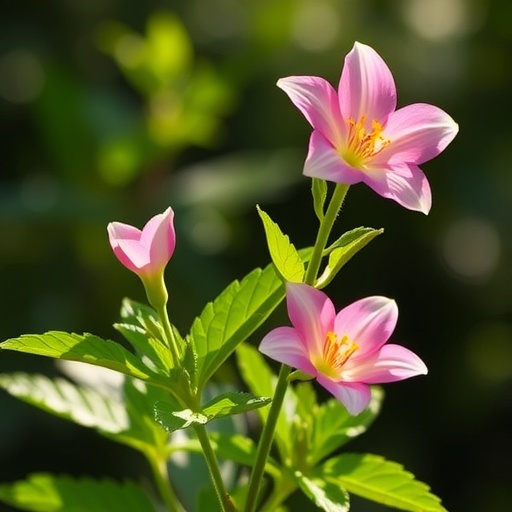
In the intricate tapestry of plant life, adaptation to fluctuating environmental conditions is paramount for survival and reproduction. Unlike mobile organisms, plants remain rooted in place, compelled to develop sophisticated systems to monitor and respond to their surroundings. A groundbreaking study led by scientists at the Salk Institute has unraveled a previously unknown genetic mechanism that fine-tunes flowering in response to the simultaneous presence of blue light and low temperature. This discovery not only enriches our understanding of plant sensory integration but also offers promising avenues for optimizing crop performance amid rapidly changing climates.
Flowering represents a critical developmental milestone in a plant’s lifecycle, directly influencing reproductive success and yield. The timing of this event is tightly regulated by an array of environmental cues such as photoperiod, light quality, and ambient temperature. However, the dynamic interplay of these signals and the molecular frameworks orchestrating their integration have remained elusive. The recent investigation published in Nature Communications sheds light on how Arabidopsis thaliana, a widely used model organism, leverages a genetic coincidence detector to seamlessly integrate blue light and low temperature signals to regulate flowering time.
Central to this process is the PHOT2 blue light receptor, a specialized photoreceptor that perceives blue wavelengths and initiates downstream signaling pathways. Upon activation by blue light, PHOT2 collaborates with NPH3, a partner protein that functions as a signal transducer. Simultaneously, exposure to low ambient temperatures activates a distinct transcription factor known as CAMTA2. CAMTA2 navigates the temperature signal by enhancing the expression of a gene termed EHB1. Intriguingly, EHB1 physically interacts with NPH3, placing NPH3 at a crucial nexus where blue light and cold signals converge, effectively forming a genetic coincidence detector.
This genetic architecture resembles a molecular logic gate, wherein dual conditions—blue light and low temperature—must be met to trigger gene expression changes that initiate flowering. The interaction between EHB1 and NPH3 ensures that flowering is precisely timed, enabling plants to avoid premature development under suboptimal conditions. Such fine-tuning could prove vital as plants confront increasingly unpredictable weather patterns driven by global climate change.
The Salk Institute team utilized a combination of genetic, biochemical, and physiological assays to delineate this mechanism. Through mutant analysis, plants deficient in PHOT2, NPH3, CAMTA2, or EHB1 exhibited disrupted flowering responses when exposed to blue light and low temperatures. Chromatin immunoprecipitation assays further confirmed CAMTA2’s role in upregulating EHB1 under cold stress, while protein-protein interaction studies validated the physical association between EHB1 and NPH3. Collectively, these findings highlight an elegant molecular system that decodes combinatorial environmental information.
Understanding this coincidence detector extends beyond fundamental plant biology; it holds significant agricultural implications. Crop species often suffer yield losses due to improper flowering times induced by erratic environmental cues. By leveraging insights into the PHOT2-NPH3-CAMTA2-EHB1 module, plant scientists and breeders may engineer crops with enhanced adaptability, enabling flowering that matches ideal growth seasons despite temperature fluctuations or altered light regimes. Such advances align with the Salk Institute’s Harnessing Plants Initiative, which aims to optimize plant growth and regeneration amidst the challenges imposed by a changing climate.
Adam Seluzicki, the study’s lead author and staff researcher at Salk, emphasized the evolutionary ingenuity of plants in environmental sensing. “Unlike animals that can seek new habitats when conditions deteriorate, plants must maximize their environmental awareness by integrating multiple signals,” he explained. “Our work uncovers a sophisticated genetic system that processes blue light and cold cues together to regulate flowering, a development crucial for reproduction and food production in the future.”
This discovery also pays homage to the late Joanne Chory, a titan in plant biology who co-authored the manuscript. Chory’s pioneering research profoundly shaped understanding of plant genetic regulation, and her recent passing marks a significant loss for the scientific community. The dedication of this manuscript to her legacy underscores the enduring impact of her contributions.
The molecular interplay uncovered here exemplifies how plants translate a complex matrix of environmental inputs into concrete developmental decisions. It expands the paradigm of photoreceptor-mediated signaling by integrating temperature-responsive transcriptional regulators, reflecting the sophistication of plant environmental integration. Moreover, it prompts new questions regarding the broader prevalence of such coincidence detectors in other plant species and developmental processes.
Further research may explore how this system interacts with other known flowering regulators, including the circadian clock and hormonal pathways. Elucidating these networks will be essential for constructing a holistic model of plant environmental responsiveness. Additionally, dissecting the structural features that enable EHB1 and NPH3 interaction could inform synthetic biology approaches aimed at tailoring plant growth traits.
The funding from prestigious agencies such as the National Institutes of Health and the Howard Hughes Medical Institute, coupled with support from philanthropic organizations, underscores the high scientific and societal relevance of this research. The dedication to expanding fundamental knowledge while addressing real-world agricultural challenges epitomizes the mission of the Salk Institute.
In sum, the identification of a genetic coincidence detector that couples blue light and low temperature signaling represents a landmark advance in plant science. It reveals a molecular mechanism that imparts exquisite control over flowering time, a trait crucial for survival and productivity. As climate unpredictability intensifies, such insights become instrumental in guiding innovation in sustainable agriculture, securing food supplies, and preserving ecological balance. The marriage of basic discovery with applied potential exemplifies the transformative power of cutting-edge plant biology research.
News Publication Date: 26-Aug-2025
Web References:
https://www.nature.com/articles/s41467-025-62194-y
http://dx.doi.org/10.1038/s41467-025-62194-y
https://www.salk.edu/harnessing-plants-initiative/
http://www.salk.edu/
References:
Seluzicki, A., et al. (2025). Genetic architecture of a light-temperature coincidence detector. Nature Communications. DOI: 10.1038/s41467-025-62194-y.
Cite Scienmag News
Alan Morgan. (September 2, 2025). How Plants Synchronize Flowering with Light and Temperature Signals. Scienmag. https://scienmag.com/how-plants-synchronize-flowering-with-light-and-temperature-signals/
Alan Morgan. "How Plants Synchronize Flowering with Light and Temperature Signals." Scienmag, 2 September 2025, https://scienmag.com/how-plants-synchronize-flowering-with-light-and-temperature-signals/. Accessed 5 September 2026.
Alan Morgan. "How Plants Synchronize Flowering with Light and Temperature Signals." Scienmag. September 2, 2025. https://scienmag.com/how-plants-synchronize-flowering-with-light-and-temperature-signals/


